A sensor can show what happens between finger-prick checks. It does not turn every meal into a medical examination. Its usefulness is established in several diabetes settings. For someone without diabetes, seeing more glucose data does not prove that their health is improving. The overview of connected health devices and what they measure also helps distinguish this medical sensor from wellness rings and watches.
Before paying, the useful question is this: what decision will this curve help you make with a healthcare professional? The budget matters too. The verified French price for a 15-day model comes to €141.20 for 30 days of sensors, excluding additional costs. This guide is neither a personal product test nor a brand ranking.
Continuous sensor, finger-prick meter and watch: do not confuse them
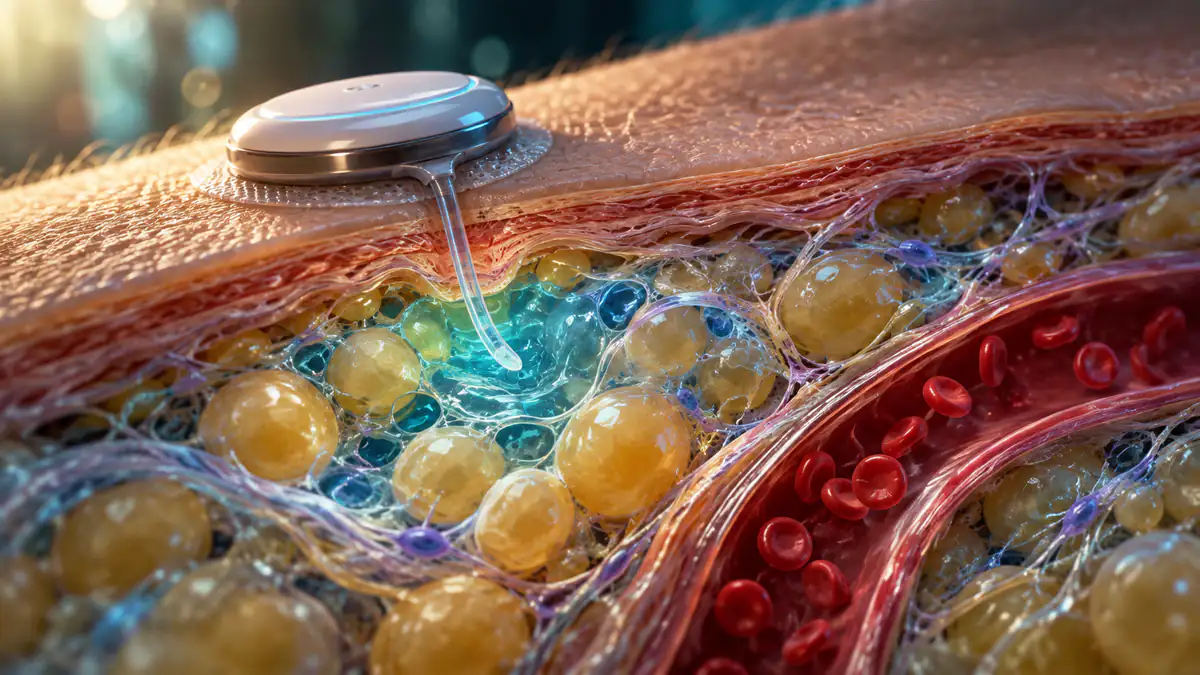
A CGM, short for continuous glucose monitoring, regularly measures glucose in the interstitial fluid between the cells beneath the skin. A small adhesive housing holds a flexible filament in place. The applicator inserts it, but the insertion needle does not remain in your arm. The filament stays in place for the intended wear period.
A finger-prick meter analyses a drop of blood placed on a test strip. It provides a reading at one moment, without reconstructing what happened between measurements. Assurance Maladie describes these two methods and stresses the training needed to use an interstitial monitoring system.
A watch can display data sent by a compatible sensor. In that case, it measures nothing itself. A watch promising standalone estimates without a filament raises a different question, covered in our analysis of needle-free glucose claims · FR.
| Device | What it measures or displays | What it does not replace |
|---|---|---|
| Finger-prick meter | Blood glucose at a specific moment | The curve between checks |
| Sensor with a filament | Interstitial glucose and trends | All backup finger-prick checks |
| Watch connected to a CGM | Data from the external sensor | The sensor supplying that data |
| Laboratory testing | Standardised blood measurements | Continuous monitoring of everyday life |
The opening image is also a conceptual illustration, not to scale, and not an application guide.
“No finger pricks” therefore does not mean “no penetration of the skin”. Also check how readings are obtained: depending on the generation, scanning, automatic transmission, alarms and sharing options may differ.
Interstitial glucose: lag, accuracy and possible errors
Blood and sensor readings do not capture exactly the same moment
Glucose circulates in the blood and then exchanges with the interstitial fluid. During a rapid rise or fall, the two compartments may show different values. The physiological review by Cengiz and Tamborlane explains this phenomenon and the associated measurement challenges.
There is no universal lag you can correct by shifting every point by ten minutes. Both physiological dynamics and signal processing play a role. After a meal or during physical activity, a difference from the meter reading does not, by itself, show that either device is faulty.
To understand a comparison, look at the time, rate of change, symptoms and measurement conditions. Our guide to blood glucose after meals explains the difference between a single observation and reading a curve.
Good average performance does not guarantee every reading
Reported performance depends on the model and evaluation protocol. An average error metric does not guarantee that every value is accurate, particularly in low ranges. The review of uses outside diabetes highlights this limitation and the risks of inappropriate decisions based on an incorrect measurement.
Before applying the sensor, check the following:
- approved application site and skin condition
- warm-up time, wear duration and replacement conditions
- compatibility of the phone, app and operating system
- interfering substances or medicines listed in the instructions for the exact model
- what to do if the signal is lost, the sensor comes loose or a result is inconsistent
Adhesive-related irritation or skin injury is possible. Seek advice if you have a significant reaction, persistent pain or signs of infection. Do not apply another sensor to damaged skin.
Safety: for the FreeStyle Libre 3 Plus, the French documentation specifies that a finger-prick meter must remain available. A finger-prick check is necessary when symptoms do not match the result or when the result seems inaccurate. Follow the instructions and your care plan rather than improvising an insulin correction.
Check safety notices too
As of 6 October 2026, the French Abbott checking website displays a recall affecting certain FreeStyle Libre 3 and 3 Plus sensors, which may give incorrectly low readings. It lets you check the serial number by selecting the country where the sensor was received.
The notice does not affect all sensors in these ranges. Check both the ones you are wearing and those still in their packaging. If a serial number is affected, follow the notice’s instructions for stopping use and obtaining a replacement. This check is separate from simply checking the expiry date.
Medical indications and limits without diabetes
With diabetes, a curve can change care
If you use insulin, trends and alerts can help manage changes between individual checks. The benefit depends on learning how to use the system and on decisions made from the data, not just on the number of points recorded.
The randomised MOBILE trial, published in JAMA in 2021, followed 175 adults with inadequately controlled type 2 diabetes treated with basal insulin but no mealtime insulin. At eight months, the adjusted HbA1c difference was 0.4 percentage points in favour of CGM, compared with a finger-prick meter. This finding applies to that population, not to healthy adults. The trial was funded by Dexcom, and several authors had industry ties.
It also shows why “just one injection” is not enough to conclude that a sensor would be useless. Clinical value and administrative reimbursement criteria are two different questions.
Without diabetes, the added benefit remains uncertain
The strongest argument in favour is immediate feedback: someone may better understand their habits or find motivation to move more. This potential deserves study, but it does not demonstrate that wearing a sensor prevents a heart attack or diabetes, or improves longevity.
The 2025 systematic review of cardiovascular prevention in people without diabetes mainly found data on glycaemic responses, associations and behaviours. It calls for long-term studies focused on health outcomes. The authors declare no conflicts of interest or external funding.
The review by Klonoff and colleagues also presents possible uses, but highlights the lack of consensus on abnormal values and how to manage them outside diabetes. Several authors declare ties to manufacturers. A therapeutic target for a patient with diabetes does not become an optimisation standard for everyone.
A spike after carbohydrates is not, by itself, proof that a food is bad. A flat curve does not prove that a meal meets your needs either. If monitoring triggers food restriction, anxiety or compensatory exercise, its cost is no longer just financial.
Price, sensor duration and recurring cost: dated table
On 6 October 2026, the French Abbott store listed the FreeStyle Libre 3 Plus at €70.60 including VAT for immediate purchase, with a stated duration of 15 days. Despite its legacy URL, the page reviewed does indeed present the “3 Plus” model.
Here is the sensor cost calculated from that price, without discounts or interruptions:
| Period to cover | 15-day sensors | Calculated cost |
|---|---|---|
| 15 days | 1 | €70.60 |
| 30 days | 2 | €141.20 |
| 90 days | 6 | €423.60 |
| 365 days | 25 purchased, covering up to 375 days | €1,765.00 |
This table is a budgeting reference, not an exhaustive comparison or a reimbursement rate. Prices may change. It assumes that each sensor lasts for its maximum duration and does not include delivery or additional equipment. A calendar month with 31 days is not exactly a 30-day period.
Add the items you actually need to the estimate:
- backup finger-prick meter, test strips and lancets
- compatible phone or a receiver suited to the chosen system
- any delivery charges and accessories to keep the sensor in place
- coaching or analysis subscription, if sold separately
For this model, the applicator is already assembled, and the page describes use with a compatible app. Other systems may have a separate transmitter or a dedicated receiver. Do not compare two unit prices without comparing duration and kit contents. Also check the replacement conditions for a sensor that comes loose: do not assume a replacement will be free.
Prescription, reimbursement and access in France
Can you buy it without a prescription?
Some sensors are sold directly to consumers at their own expense. The French Abbott store and its general terms of sale reviewed do not mention submitting a prescription for this purchase. Have the seller or pharmacist confirm the conditions for the model. We did not place a test order.
Commercial availability does not broaden the medical indication. The French 3 Plus page states that it is intended for people living with diabetes aged two years and over, including during pregnancy. It does not demonstrate a preventive benefit for a healthy person.
A prescription does not guarantee reimbursement
The ameli page reviewed, dated 4 October 2024, describes prescribing interstitial monitoring in certain situations involving insulin treatment. It is not an up-to-date list of each model’s criteria as of 6 October 2026. The exact coverage conditions must be confirmed against the current entry in the List of Products and Services (LPP).
Do not transfer the rules for one Libre model to another, or those for a standalone sensor to a system linked to a pump. Ask the healthcare professional to check the model and its LPP code, diabetes type, treatment, clinical criteria, authorised initial prescriber, training, renewal arrangements and covered quantities.
For wellness use without diabetes, do not build your budget around expected reimbursement. For medical use, have eligibility checked before paying through direct sale. The pharmacist and care team can clarify the applicable dispensing process.
Decision grid and questions to ask a healthcare professional
| Situation | First step | Limit to keep in mind |
|---|---|---|
| Diabetes treated with insulin | Discuss the system, alerts and backup plan | The curve requires training |
| Diabetes without insulin | Define a clinical question with your doctor | Usefulness and reimbursement are not automatic |
| Symptoms or suspected diabetes | Seek a consultation for standardised testing | CGM does not establish the diagnosis |
| Curiosity without diabetes | Discuss the goal and cost before buying | No lasting clinical benefit demonstrated here |
| Fear of foods or compulsive monitoring | Avoid self-directed tracking and seek help | More data may worsen the preoccupation |
The NIDDK points out that diagnosis relies on standardised blood tests. Unusual thirst, frequent urination or unexplained weight loss warrant a consultation, not waiting for a delivery. Confusion, seizures or loss of consciousness require emergency help, including 15 or 112 in France.
Before committing to the expense, ask these questions:
- What concrete decision could change thanks to this curve?
- Is the model suitable for my treatment and my phone?
- When should I confirm with a finger-prick check, and what should I do if the readings disagree?
- Who will review the data, and when?
- What is the total cost, and what coverage has actually been confirmed?
If you and a healthcare professional agree on exploratory monitoring, set a narrowly defined question, a review date and a stopping rule. This is not an invitation to provoke changes through fasting, excessive sugar intake or medication changes.
Le Biohacker verdict
I distinguish a care tool from a subscription to curiosity. A sensor is a defensible choice when it supports a medical decision and its user understands its limits. Without diabetes, its ability to produce a curve is certain; its added health benefit remains uncertain.
Before buying, check the indication, recurring budget, compatibility and safety notices. The question is not just “how much does a sensor cost?” but “what useful decision will it help you make?”.