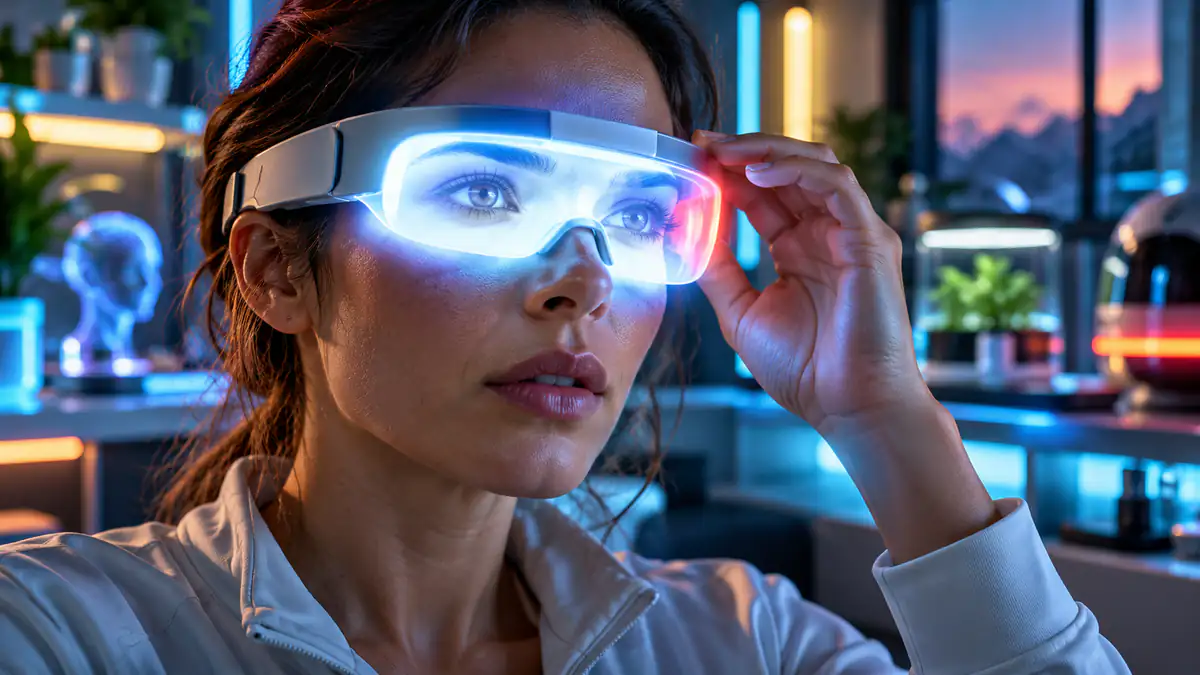
Light therapy glasses are not risk-free, but the evidence does not support presenting them as dangerous for everyone’s eyes either. The risk depends on the device, how it is used and, above all, your individual circumstances: retinal disease, photosensitizing treatment, bipolar disorder or light sensitivity.
If you currently have sudden vision loss, a dark curtain across your vision or significant eye pain, remove the glasses and seek medical attention immediately. Mild discomfort is not managed like a vision emergency. And sleeping much less while feeling unusually energetic calls for medical advice, not another session.
This article addresses safety before purchase or use. For differences between models, see the Luminette 3 and Pegasi comparison · FR. No brand wins a contest here: the question is when to use, pause or avoid this category of devices.
When should you stop and seek medical advice?
Never use a session to see whether a worrying symptom “eventually goes away.” The following guidance concerns what to do, without automatically attributing the problem to the device.
Visual symptoms that require prompt assessment
Reduced vision in one eye, even without pain, or a dark curtain across your vision warrants an ophthalmology assessment the same day. Assurance maladie describes these retinal warning signs. New flashes or the sudden appearance of many floaters also require prompt contact with an ophthalmologist, who will determine the urgency.
A very painful red eye, or blurred vision accompanied by light sensitivity or vomiting, also requires an urgent assessment. Do not resume sessions before getting this advice. These symptoms may reveal a condition unrelated to light therapy: appearing after a session does not prove the session caused them.
Recurring discomfort also calls for a pause
Stinging, discomfort or a headache do not prove retinal damage. But they are not session goals either. If discomfort develops, stop the exposure. If it persists or returns with every use, seek advice before starting again. Keep a record of the model name, setting and actual duration used: this information is more useful than a general impression that the light was “too bright.”
Blue light: a useful mechanism and eye risk are separate questions
The retina does more than form images. Certain cells containing melanopsin send a light signal to the biological clock. This is one of the foundations of light therapy, explained in the ISBD recommendations. The glasses use this signal by placing a light source close to the eyes.
Three effects must be distinguished: influencing the biological clock, causing glare and producing phototoxic exposure. An intended biological effect is not evidence of injury, and comfortable light is not a measure of safety.
The INRS notes that high luminance levels rich in blue light can damage the retina. This does not demonstrate that a session following the instructions for any commercially available glasses causes such damage. Spectrum, geometry and duration matter. The word “blue” alone on a product sheet is therefore not enough to condemn or endorse the device.
Conversely, “UV-free” does not answer every question. The absence of ultraviolet light assesses neither visible-light risks nor psychiatric tolerability. Marketing loves two-word guarantees. Your eyes need a little more information.
What safety studies actually allow us to say
The systematic review by Brouwer and colleagues, published in 2017, included 43 articles on eye complaints and examinations during light therapy. Its abstract reports generally reassuring safety in physically healthy people taking no medication. However, it notes one case of maculopathy in a person taking clomipramine, a photosensitizing antidepressant. An isolated case does not establish causality on its own.
This review does not settle the question of safety in people with pre-existing eye abnormalities or increased photosensitivity. Nor does it certify the glasses sold today: the devices studied and their exposure conditions vary.
A study published in 2025 on Luminette provides evidence more directly relevant to wearable devices. In patients with depression, the authors compared an active device with a placebo and assessed retinal function using electroretinography. After eight weeks, they detected no significant difference between groups in the measured responses.
The result is reassuring within this specific setting. The limited sample, short follow-up and use of a standardized research setting prevent it from serving as a guarantee for years of use, every setting or every retinal disease. Lucimed supplied the devices and contributed funding. The authors state that the company was not involved in data collection, data analysis or writing. No conclusion from this study automatically applies to another model of glasses.
Retinal disease and eye history: seek advice before the first session
The NIMH states that certain eye diseases may require another option or light therapy under medical supervision. This is not an invitation to guess your way to the lowest setting.
If you have diabetic retinopathy, age-related macular degeneration, an inherited retinal disease or unexplained vision loss, ask your ophthalmologist whether the device you are considering is compatible with your situation. The exact diagnosis matters more than a vague label such as “sensitive eyes.” After recent eye surgery, also ask when you can resume therapeutic light exposure.
Prepare for this appointment with specific information:
- The exact name of the glasses and their complete instructions.
- Your medical history, recent procedures and current symptoms.
- The medications, eye drops and supplements you use.
- Your reason for light therapy and the planned time of exposure.
The aim is not to obtain an abstract certificate of a “robust retina.” It is to decide whether this device and exposure are acceptable for you. A previous normal examination does not mean you can skip mentioning a recent change in vision.
Bipolar disorder: the risk of a manic switch is not visible in the eye
Light therapy can be part of treatment for certain bipolar depressive episodes, but within a medical framework. The 2025 ISBD recommendations call for mood monitoring and appropriate management. They identify acute or recent mania, recent hypomania, mixed symptoms and rapid cycling as contraindications.
A history of bipolar disorder therefore rules out trying it on your own to “get your energy back.” Discuss the device, exposure timing and monitoring with your psychiatrist. Commercial instructions do not replace this clinical decision.
The NIMH fact sheet on bipolar disorder helps identify concerning changes: reduced need for sleep, racing thoughts, unusually rapid speech, irritability or euphoria, and excessive activity. Hypomania can feel like doing particularly well while people around you notice unusual behavior.
If these signs appear during use, pause the sessions and contact your healthcare professional promptly. Do not try to compensate simply by changing the timing of the light. If there is dangerous behavior, severe agitation or suicidal thoughts, seek urgent help. This vigilance also applies without a known diagnosis if the change is clear. Feeling alert after a session and losing your usual need for sleep are not equivalent observations.
Photosensitizing medications: have the combination checked
Some treatments increase sensitivity to light. The NIMH recommends medical supervision or an alternative when these medications are used. The abstract of Brouwer’s review specifically mentions the safety signal involving clomipramine. This observation warrants a check, not stopping an antidepressant.
The ISBD also mentions certain sulfonamides, chloroquine and St. John’s wort among substances that may pose problems. Herbal products therefore need to be disclosed too. This short list is neither exhaustive nor a list of universal bans: the exact substance, context and type of exposure must be assessed.
The question to ask your pharmacist is specific: “Is this treatment compatible with these glasses, at this setting and for this duration?” Bring the instructions rather than a screenshot of an advertisement. Skin photosensitivity to sunlight and eye toxicity are not automatically the same thing.
Never stop a medication on your own to make your purchase usable. If the combination is not recommended, ask about another strategy for sleep or mood. The glasses are an optional tool; prescribed treatment addresses a medical indication.
Migraines, light sensitivity and disrupted sleep
Headaches and eye strain are among the reported adverse effects of light therapy. Light-triggered migraine calls for particular caution: do not use a session as training in tolerating pain. Seek advice before trying it if you have significant light sensitivity or frequent attacks.
The INRS also notes that LED flicker can contribute to migraines in sensitive individuals. This finding about lighting does not demonstrate that every pair of glasses flickers or triggers attacks. It is a reason to request technical documentation rather than rely on how a photo looks.
Sleep is another indicator to monitor. The NIMH generally describes morning use of light boxes for seasonal depression. This does not establish a universal duration for glasses. If your sleep worsens after you start using them, pause the trial and have the exposure timing reviewed, especially if you work nights or already receive sleep treatment.
Standards and CE marking: what to ask the seller
The CE marking commits the manufacturer to compliance with applicable requirements. The European Commission specifies that it does not mean safety approval has been granted by the European Union. This logo therefore does not settle your personal contraindications or, on its own, demonstrate clinical effectiveness.
For photobiological safety, the INRS describes the risk groups in standard EN 62471. But a classification can only be interpreted alongside its test conditions. For a source worn close to the eye, ask whether the assessment covers the complete model in its actual position of use.
Before choosing, check the following documents:
- Instructions in French identifying settings, durations, restrictions and contraindications.
- A declaration of conformity matching the exact model sold.
- A photobiological assessment specifying the standard, result and measurement conditions.
- The light’s characteristics and contact details for a reachable manufacturer.
If the seller’s only answer is “natural technology,” put off the purchase. A vague answer does not prove danger, but it does not support an informed decision. Keep the documents with the product reference and purchase date: a study of an older version does not necessarily document the one you wear.
Cautious use starts before the timer
There is no single dose you can copy from a light box to every pair of glasses. Frequency and duration should follow the device’s instructions or medical plan. Do not double up after a missed session or combine several devices to speed up results.
To keep a trial interpretable, record the time, setting, duration, sleep onset and any symptoms. Review tolerability from the first few uses. If you experience recurring discomfort, insomnia or mood changes, the next step is professional advice, not a higher dose.
For a minor, during pregnancy or if you have a condition under medical care, seek advice beforehand rather than adapting an adult protocol yourself. Finally, persistent fatigue or persistently low mood requires an assessment of its cause. Buying a light source is not a diagnosis.
The Verdict
My assessment is that safety is Conditional: eye safety data are reassuring in the populations studied, but uncertainties remain for diseased eyes and prolonged use. The best safety filter is still checking contraindications before the first session.