My take on the Ultrahuman Ring Pro: a purchase worth considering for tracking your habits with fewer charges, provided you accept uncertainty about this model’s accuracy. If your deciding factor is independently validated HRV or sleep stages on the Pro, wait for stronger data.
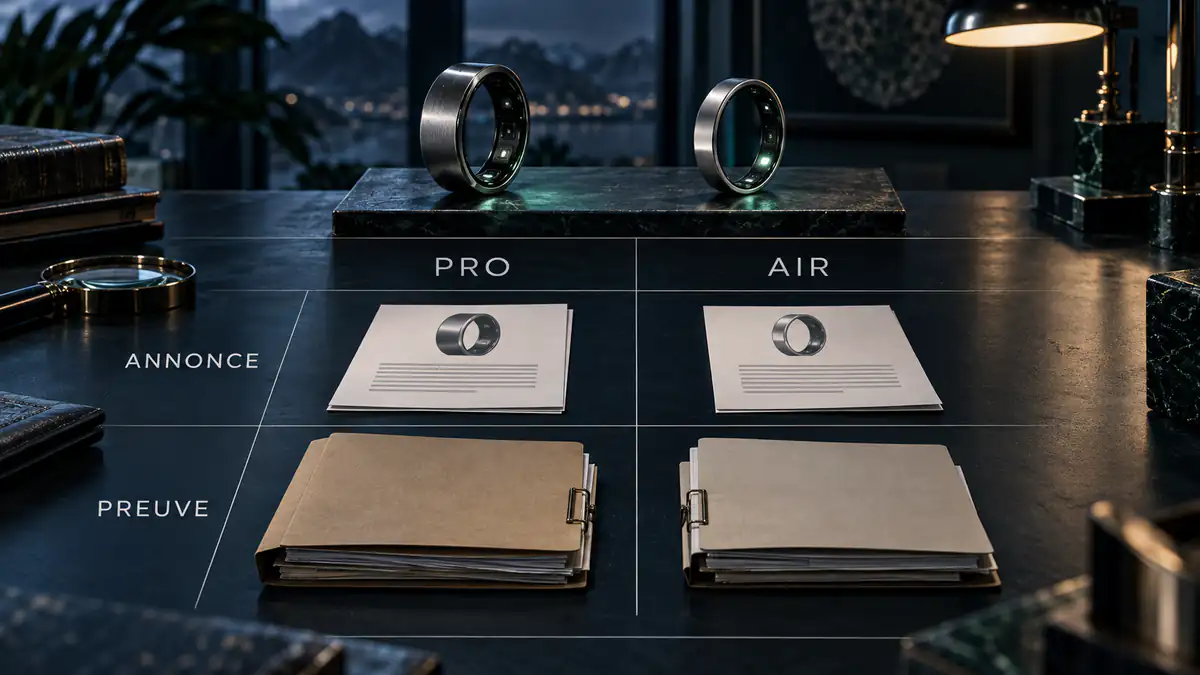
A result obtained with the Ring Air does not switch models just because a page now says “Pro”. The name of the sensor worn during the study matters more than the ring pictured above it.
Desk-based methodology: no personal testing
This article is a pre-purchase audit, checked on 16 October 2026. I have neither worn this ring nor measured its battery life. No personal charts, recorded nights or user testimonials have been invented. The opening image is a generated editorial illustration, not a photograph of a tested unit.
I cross-checked the French store, the available Pro FAQs, the terms of sale, the privacy policy, the science portal and a publication identifying the Ring Air. A bylined journalistic review also helps distinguish claimed battery life from available observations.
This research is not an exhaustive systematic review. In the documents examined, I did not identify any published independent validation of the Ring Pro against a clinical reference standard for overnight HRV or sleep stages. This indicates a limitation in the documentation as of that date, not proof that the product measures poorly.
Here is how to read the sources used in this review:
| Source | Model actually covered | What it supports |
|---|---|---|
| Official store and FAQs | Pro, with Air comparison | Stated offering and specifications, without independent confirmation of performance |
| Driller and colleagues, 2026 | Air explicitly named in the methods | Data on Air, with no automatic transfer to Pro |
| Matt Kollat’s review for T3 | Pro actually worn by the journalist | Observations on one unit and its settings, without clinical validation |
| Terms and conditions and privacy policy | Range or platform, depending on the section | Contractual points and stated data processing, to be matched to the offering purchased |
Verified Pro specifications and French price
The French Ring Pro store displayed €499, with the charging case and sizing kit included, on the date checked. The summary leaves shipping and taxes to checkout. This amount therefore does not confirm the total delivered price to your address.
The specifications relevant to the decision are as follows, all stated by Ultrahuman:
| Criterion | Ring Pro claims | Practical implications |
|---|---|---|
| Weight and thickness | 3.3–4.8 g depending on size, approximately 2.65 mm | Comfort needs to be tested on your finger |
| Sensors | Redesigned PPG, temperature, movement | The hardware changes; accuracy needs to be assessed |
| Battery life | Approximately 12 days in Turbo, more than 15 in Chill under the manufacturer’s conditions | The mode and active features matter |
| Storage | Up to 250 days on the ring | Storage and battery life are two different limits |
| Charging case | Up to 45 days before needing mains charging, depending on usage | The ring still needs to be recharged in it |
These claims do not justify promising every buyer fifteen full days. The shipping date should also be checked after selecting the size and finish.
To compare the hardware and uses of the two generations, see the Ring Pro versus Ring Air comparison. Here, the question remains what the available documentation tells us about the Pro before purchase.
Sleep and HRV: what model-specific validation is there?
An optical signal becomes an estimate
Photoplethysmography, or PPG, observes changes in blood volume in the finger. The app uses pulse, movement and temperature to estimate sleep. The displayed stages are algorithmic classifications: the ring does not directly measure brain activity.
The manufacturer’s technical documentation on sleep describes this process. It explains how the system is claimed to work, without demonstrating the Pro’s clinical accuracy on its own.
Heart rate variability, or HRV, describes variations in the intervals between beats. To interpret an overnight value, you need to know the metric calculated, the window analysed and how artefacts are handled. Accurate average heart rate does not automatically validate HRV, and accurate HRV does not validate a recovery score.
The 97% figure does not answer every question
The Ultrahuman science portal’s page on sleep duration highlights 97% agreement, based on twenty nights in four adults compared with an at-home EEG device. This metric expresses a duration difference relative to average night length, not 97% of sleep stages correctly identified.
The publication by Driller and colleagues identifies the Ring Air in its methodology and points to additional comparisons with Somfit. The authors thank Ultrahuman for providing the rings and helping with data extraction. This industry contribution deserves to be clearly disclosed.
The manufacturer itself links this small comparison to the Ring Air in its explanation of sleep duration. This result is therefore neither a general validation of the Pro nor evidence of its ability to detect disease. Four people do not represent all body types, sleep disorders or wearing conditions either.
The evidence needed for the Pro
Before calling the Pro more accurate, I would want a study specifying the exact model, software version, population, number of nights and missing data. It should compare each result against its reference: for example, polysomnography for sleep stages and an appropriate electrical measurement for cardiac intervals.
We would also need individual errors and limits of agreement, not just a correlation or an overall percentage. Two devices can rise and fall together while remaining consistently apart.
Keeping your Air history in the same account is convenient. That alone does not make two HRV data series interchangeable after switching hardware.
Battery life: claims and available observations
The Ring Pro review published by T3 on September 20, 2026 reports a battery still at 53% after around nine days in Chill, then dropping to 15% after around five additional days in Turbo. The journalist specifies wearing a large size and notes reduced stress tracking in Chill.
That is an encouraging sign for this particular unit’s endurance. However, the mode change means it cannot be treated as a complete cycle under consistent conditions or as average battery life for all buyers. This review contains commercial links: it remains an attributed journalistic account, not an independent study of medical accuracy.
Three questions are enough when reading a battery-life claim:
- Does the figure cover the ring alone or the ring and charging case together?
- Which mode was active, and which features were reduced?
- Does the measurement cover an actual cycle or an extrapolation from the remaining percentage?
For your purchase, focus on the number of nights recorded with the features you care about. A long-lasting battery that disables your favourite metric serves a different need.
Endurance after a few weeks does not establish battery lifespan after two years either. I am not putting a figure on this ageing, because the sources consulted lack longitudinal data specific to the Pro.
Total cost: “no subscription” needs clarification
Ultrahuman advertises access to basic data without a mandatory subscription. That does not mean all current or future add-ons are included.
The French configurator notably listed these options as of October 16, 2026:
| Optional item | Listed price | Check before paying |
|---|---|---|
| PowerPlug AFib | €49 for one year | Local eligibility, exact service and renewal |
| Cycle and Ovulation Plus | €39.99 for one year | Version offered, terms and renewal |
| UltrahumanX | €36 for one year or €54 for two years | Coverage, exclusions and territory |
These options are not medical recommendations. Any validations they may have apply to their specific function and conditions of use, not to all the ring’s scores.
To calculate your budget, add up the delivered total, the options you actually choose and their renewals. Do not factor in a hypothetical trade-in: that depends on eligibility and the advertised offer.
Over three years, the exact future cost remains unknown if prices or your choices change. An honest comparison uses the same assumptions for services, delivery and replacement on both sides. The Oura and Ultrahuman comparison helps broaden your perspective on this decision.
The Toll here also includes the cost in attention: an extra metric can take up your time without usefully changing your behaviour. First, choose the two or three metrics you actually want to check.
Returns and privacy: checks still worth making
Get the terms that apply to your purchase
The Pro FAQ available on the US version of the site advertises thirty days after delivery to return the product with its accessories and packaging, as well as free returns. However, the terms of sale accessible from the French site explicitly detail Air and Rare returns, with no equivalent Pro section in the version consulted.
This discrepancy does not justify unconditionally promising a free thirty-day trial in France. Get written confirmation of the applicable return window for the Pro delivered in France, whether wearing it during the trial is allowed, any fees and when the window starts. Keep the response and your order summary. These commercial details are not an analysis of your legal rights.
The same terms describe UltrahumanX as a manufacturer programme, not insurance. Do not infer its actual coverage from a label in your basket alone.
Read the data commitments
The privacy policy states that personal information is not sold. It also provides for service providers, international transfers, including to the United States, and the use of de-identified or aggregated data.
It describes requests for portable copies and deletion, with some possible data retention. These are stated commitments; no technical audit was conducted here. Before enabling integrations, an AI feature or a research programme, check what additional data is required and how to withdraw your consent. Storing data on the ring does not mean all processing stays local.
After purchase: a personal testing checklist
This monitoring assesses everyday usefulness, not clinical accuracy. Schedule your decision before the confirmed return window closes, rather than automatically waiting until the end of the fourteen-day calibration period announced by the manufacturer.
Define your criteria before reading the first scores:
| Criterion | What to note during the trial | Reason to reassess |
|---|---|---|
| Comfort | Discomfort, skin condition, ease of removal in the morning | Pain, irritation or compression |
| Continuity | Full nights, gaps and syncing | Repeated data loss unresolved by support |
| Battery | Size, mode, software, charging dates | Battery life incompatible with your use |
| Sleep | Bedtimes, wake-up times and awakenings you remember | Repeated obvious discrepancies |
| Usefulness | One simple action enabled by the data | Compulsive checking or no practical benefit |
Keep the mode consistent when comparing several days. An additional watch may reveal disagreements, but it cannot tell you which device is right. A subjective diary helps spot major inconsistencies without validating sleep stages.
See a doctor if sleepiness persists or breathing pauses are reported, even with a reassuring score. Do not try to induce a bad night’s sleep or change a treatment to test the ring. If you experience pain or irritation, stop wearing it. If it gets stuck or your finger swells and becomes painful, seek medical help without trying to cut off a battery-containing device yourself.