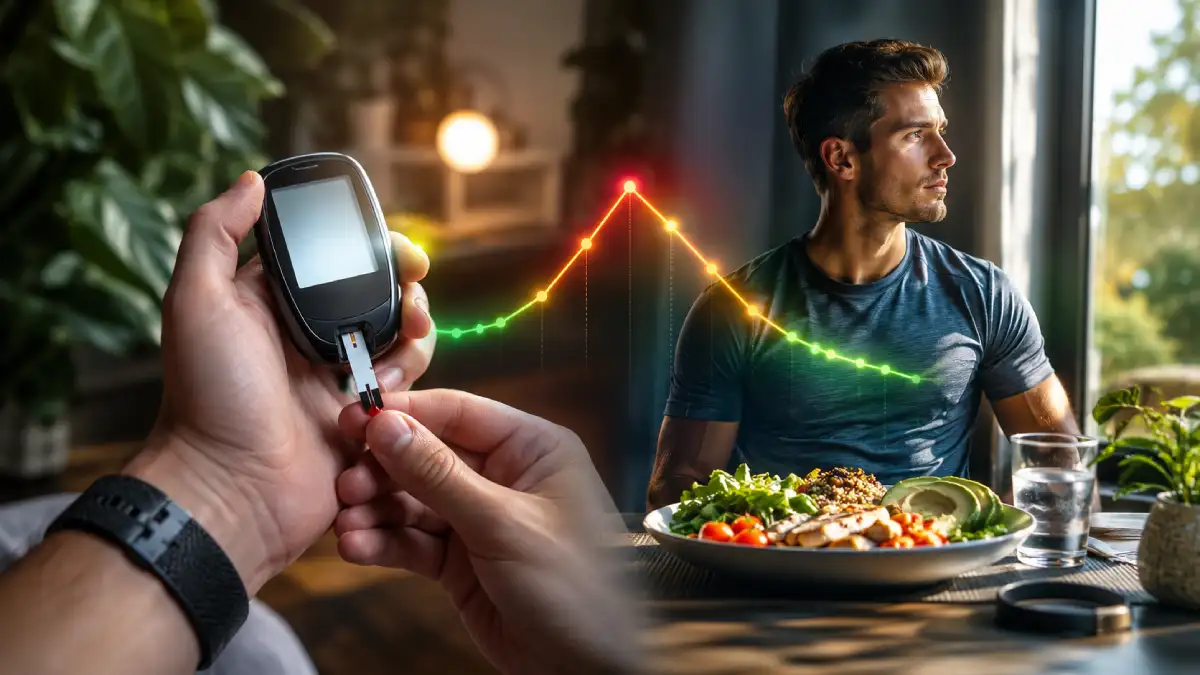
Blood glucose after meals is generally measured 1 or 2 hours from the first bite, depending on the question and your care plan. For many nonpregnant adults with diabetes, the ADA gives an individualized target below 1.80 g/L at this time, without making it a standard for someone without diabetes. To see how CGM compares with watches and rings, see the overview of health sensors and connected devices, which distinguishes interstitial measurement from a wrist display.
A single reading does not describe the whole curve. It diagnoses neither prediabetes nor diabetes, especially after an ordinary meal with nonstandardized amounts of carbohydrates, protein and fat. The useful protocol depends first on your goal: adjusting treatment with your care team, understanding symptoms or cautiously comparing two meals.
The trap is treating every bump as an abnormality. Blood glucose normally rises after carbohydrates. What changes a decision is a reproducible pattern, a standardized laboratory result or a value associated with concerning symptoms.
When to measure blood glucose after meals: start or finish?
In the American Diabetes Association’s recommendations, postprandial blood glucose is measured one to two hours after the start of the meal. In practice, use the first bite as time zero. This convention prevents two people from shifting the measurement depending on whether they eat in ten or forty minutes.
Meal duration still matters. If you finish a long meal fifty minutes after starting it, the one-hour reading comes only ten minutes after the end. So record the start time and, if the meal was unusually long, the end time.
An ordinary meal is not an oral glucose tolerance test, or OGTT. An OGTT uses a standardized amount of glucose after fasting, with a laboratory plasma measurement two hours later. The diagnostic thresholds for this test should not be applied to a dinner, pizza or mixed breakfast measured with a home meter.
The premeal value helps establish a starting point. Without it, 150 mg/dL at one hour could represent a rise from 85 or from 135 mg/dL—two different situations. It should not be considered a “fasting” reading if you snacked or had a calorie-containing drink shortly beforehand.
To make two observations comparable, record the following:
- time of the first bite and approximate meal duration
- blood glucose just beforehand if this measurement is part of the plan
- amount and type of carbohydrates, without requiring obsessive weighing
- physical activity, stress, illness and unusual sleep patterns
- medication or insulin taken around the meal
- symptoms during the following three hours
Finger-prick meter or CGM: what’s the difference?
A finger-prick meter analyzes a drop of blood at a specific moment. A CGM, or continuous glucose monitor, measures glucose in the interstitial fluid under the skin and builds a curve. The first gives you a snapshot. The second shows a movie, but that movie comes through a sensor and an algorithm.
| Tool | What it provides | Main limitation | Sensible use after a meal |
|---|---|---|---|
| Finger-prick meter | Blood glucose value at one moment | Does not show the exact timing of the peak between checks | Standardized readings beforehand, at 1 h or at 2 h |
| CGM | Trend, direction and apparent shape of the curve | Interstitial glucose, possible lag and artifacts | Identify a pattern across several comparable meals |
| Laboratory test | Standardized plasma measurement | Does not describe daily life minute by minute | Diagnose or confirm an abnormality |
When glucose changes rapidly, interstitial fluid and blood do not change at exactly the same time. The lag is not a constant you can subtract from every reading. It depends in particular on the sensor, signal processing and the rate of rise or fall. A CGM peak at 75 minutes and a finger-prick reading at 60 minutes therefore do not necessarily contradict each other.
The meter also has sources of error. In a study of volunteers who had peeled fruit, sugary residue on the fingers caused falsely high results. An alcohol swab did not always fix the problem, unlike washing with water. Before a finger-prick reading, wash and thoroughly dry your hands, use an unexpired test strip and follow the meter’s instructions.
If the CGM displays a value that does not match your symptoms or changes very quickly, follow your model’s instructions and the plan agreed with your care team. Some systems allow treatment decisions without a finger-prick check under their conditions of use, but that does not make the sensor infallible.
Readings at 1 h and 2 h, and how the peak changes
The postprandial peak does not happen at one universal minute. Gastric emptying, meal composition, insulin, activity and the premeal level shift the curve. A one-hour reading can fall before, during or after the actual maximum.
Use this table to choose the timing based on the question:
| Time from the first bite | Main question | What you can conclude | What you cannot conclude |
|---|---|---|---|
| Just before | Where does the curve start? | Starting level for this meal | Fasting blood glucose if fasting conditions are not met |
| 1 hour | Is the early response substantial? | Value at a reproducible time | Exact peak or diagnosis |
| 2 hours | Is blood glucose still high? | Persistence or relative return toward baseline | OGTT result or stage of diabetes |
| Beyond 2 hours | Is there a late response related to the meal or symptoms? | Targeted information if planned in advance | A need to extend every test without a reason |
Reading the timeline
One curve, several questions
- Time zeroFirst bite, with a premeal value if useful
- +1 hourEarly response, with no guarantee of capturing the actual maximum
- +2 hoursPersistent elevation or relative return toward the starting level
- DecisionInterpret recurring patterns, symptoms and clinical context, not an isolated point
For many nonpregnant adults who already have diabetes, the ADA cites a postprandial blood glucose treatment target below 180 mg/dL, equivalent to 1.80 g/L or 10.0 mmol/L, one to two hours after the start of the meal. This target is individualized according to treatment, age, hypoglycemia and comorbidities. It is neither a diagnostic threshold nor an optimization standard for someone without diabetes.
For someone without diabetes, there is no universally validated target for every ordinary meal or “ideal peak” on a CGM. A review of sensor use outside diabetes highlighted the lack of consensus on what defines an abnormal value and what action to take. The authors had several ties to device manufacturers, but this limitation is consistent with the broader finding: a CGM can generate a hypothesis, not a new personal diagnostic category.
So should you measure every meal? No, unless your treatment or care team requires it. To explore a pattern, select one or two frequent meals and repeat the same protocol over several days. If you change the portion, timing, walking, sleep and coffee all at once, the comparison becomes impossible to interpret.
What value is normal at 1 hour or 2 hours?
After an ordinary meal, there is no single threshold that lets you label every reading normal or abnormal. The often-cited figure of 1.40 g/L at two hours mainly belongs to the interpretation of a standardized OGTT, not a universal test after your dinner. The NIDDK distinguishes these diagnostic tests from home monitoring.
Read each number in context:
| Situation | Reference value in g/L | What it means |
|---|---|---|
| Ordinary meal, no known diabetes | No universal threshold at 1 or 2 hours | Recurring readings or symptoms may warrant testing |
| Known diabetes, nonpregnant adult | Often below 1.80 g/L at 1–2 hours | ADA target to adapt with your care team, not a diagnosis |
| OGTT with 75 g of glucose, outside pregnancy | Below 1.40 g/L at two hours | Normal category for this laboratory test |
| Same OGTT | 1.40 to 1.99 g/L | Impaired glucose tolerance, requiring medical interpretation |
| Same OGTT | 2.00 g/L or higher | Diabetes threshold, with confirmation depending on context |
1 g/L = 100 mg/dL ≈ 5.55 mmol/L. Thus, 1.40 g/L corresponds to 140 mg/dL and approximately 7.8 mmol/L. Check the unit before comparing two apps. Pregnancy uses different targets and criteria: ask your care team to clarify the protocol.
A spike does not directly measure your insulin sensitivity. To choose a test rather than make a diagnosis from a screenshot, the guide to insulin resistance and useful tests explains this distinction.
Common interpretation mistakes
Confusing a treatment target with a diagnostic threshold
The 180 mg/dL reference applies to many adults who already have diabetes. Diagnosis relies on fasting plasma glucose, HbA1c, a standardized OGTT or, when classic symptoms are present, random plasma glucose that meets the criteria. The NIDDK notes that an over-the-counter meter cannot diagnose diabetes.
Treating an isolated value as your metabolic identity
An unexpected result may come from the meal, a contaminated hand, a test strip, a sensor, illness, stress, a corticosteroid or a genuine abnormality. Start by checking the measurement and looking for recurrence. Don’t conclude “insulin resistant” from one spike, and don’t try to erase it with an improvised fast.
Comparing different timings
A reading one hour after the end of a forty-minute meal comes one hundred minutes after its start. Comparing it with another reading taken sixty minutes after the first bite mixes two time windows. Set time zero and stick to it.
Looking for the meal that produces the flattest line
A flat curve is not proof of an optimal diet. A meal without enough energy or carbohydrates may look “perfect” in the app while failing to meet your needs. The relevant outcome also depends on satiety, diet quality, blood lipids, blood pressure, weight and daily functioning.
Forgetting that CGM readings are not venous blood measurements
An interstitial number displayed with great precision is still an instrument-based estimate. For people without diabetes, the benefits of CGM use for cardiovascular prevention or clinical outcomes remain uncertain. If monitoring increases your fear of food or makes you check every bite, look at the data less often or take a break. The guide to counterproductive health tracking · FR helps you set that boundary.
If your next goal is to reduce a genuinely reproducible pattern, our article on blood glucose spikes after meals covers activity, food order and other approaches separately. Measure properly first before changing the meal. If you compare a starchy food hot versus cooled, the method for resistant starch in the fridge helps you change just one variable without overlooking storage.
When to seek medical advice
Make an appointment if high values recur, regularly exceed the target set for your diabetes or come with symptoms. Unusual thirst, frequent urination, unexplained weight loss, blurred vision or repeated infections warrant standardized testing, even if the CGM does not look dramatic.
Repeated readings close to or above 200 mg/dL, equivalent to 2.00 g/L or 11.1 mmol/L, after ordinary meals do not establish a diagnosis on their own, but they warrant a prompt medical discussion. This number has diagnostic significance only under the conditions defined for plasma tests, particularly random glucose in the presence of classic symptoms or an OGTT performed in a laboratory.
Ask for a specific plan in the following situations:
- pregnancy or plans for pregnancy, because timings and targets differ
- insulin, a sulfonylurea or another treatment that carries a risk of hypoglycemia
- corticosteroids or medication that may affect blood glucose
- acute illness, vomiting or difficulty staying hydrated
- symptoms two to five hours after a meal suggesting hypoglycemia that needs confirmation
- repeated disagreement between symptoms, meter and CGM
Low blood glucose with confusion, seizure or loss of consciousness is an emergency. High blood glucose accompanied by vomiting, abdominal pain, rapid breathing, dehydration, confusion or high ketones may also signal a metabolic emergency. Follow the emergency plan provided for your diabetes and contact emergency services immediately if the condition is severe.
The Verdict
Count from the first bite. Use one hour to observe the early response and two hours to see whether the elevation persists, without claiming that a single point always captures the peak. With a CGM, read the shape and recurring pattern. With a meter, standardize the timing and wash your hands.
My confidence is high in the timing protocol and the distinction between a treatment target and diagnosis. It is lower when interpreting an “optimal” curve in someone without diabetes, because no consensus turns every interstitial spike into a clinical risk.
A good measurement answers a question and anticipates a reasonable action. If it only adds anxiety to a meal, it produces more noise than prevention.