

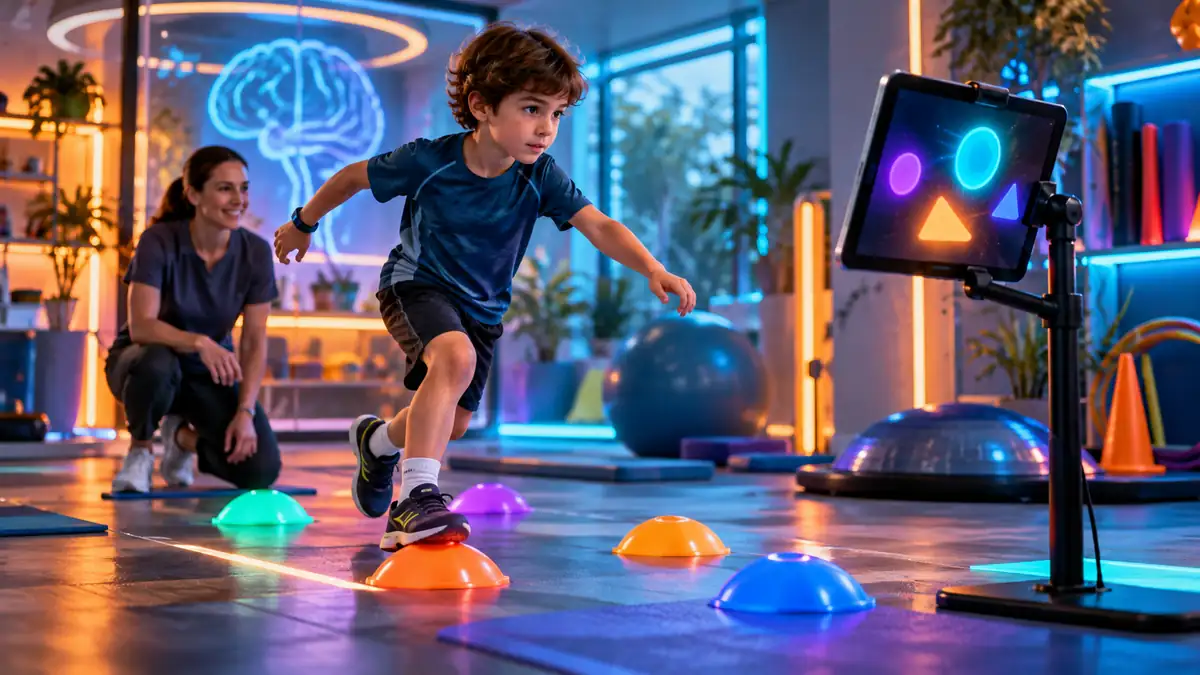
The same program delivered through an app or in person
Motor difficulties are common in children with ADHD. However, supervised in-person sessions can be difficult to access, particularly because of cost or availability. The study examines another way to deliver an exercise program, rather than a new drug treatment.
The researchers assigned 145 children aged 6 to 10 years to three groups: 53 followed the program through a WeChat app developed for the study, called LeDongYing, 45 attended in-person sessions supervised by a trainer, and 47 received a minimal intervention.
Both active programs combined physical and cognitive exercises over 12 weeks, with three weekly sessions lasting 45 to 60 minutes. These details describe the intervention studied and are not an individual recommendation.
Improvements across several aspects of motor skills
The assessments used two test batteries, the TGMD-3 and the MABC-2. They covered locomotor skills, ball skills, manual dexterity, aiming and catching, and balance.
Both exercise groups improved their scores across all motor domains assessed and performed better than the group receiving a minimal intervention. No statistically significant change was observed in the latter group.
However, the abstract provides neither the magnitude of the differences nor their confidence intervals. It therefore does not establish how noticeable the improvements were in the children’s daily activities.
A lack of difference does not demonstrate equivalence
No statistically significant difference was detected between the app-based program and the in-person sessions. This is not enough to demonstrate that the two formats are equivalent: the abstract does not describe an analysis designed to establish equivalence.
These findings support the potential value of digital support when access to in-person sessions is limited. They do not show that just any app would produce the same effect, or that the gains persist after the program ends.
This is an analysis of secondary outcomes from a randomized trial. The only document consulted was the Europe PMC abstract, not the full text. The precise supervision arrangements, adverse effects, funding, and conflicts of interest cannot be verified from the material provided.
Limitations to keep in mind
Secondary analysis, follow-up limited to the 12-week program, and no effect sizes in the available abstract. Whether the improvements carry over to daily life or are maintained remains undetermined. Full text, safety, funding, and conflicts of interest not verified.
What we can take away
A structured app-guided exercise program appears to improve short-term motor performance in children with ADHD. This study demonstrates neither equivalence to in-person sessions nor a benefit for symptoms of the disorder.
Sources and provenance
- Effects of a Multicomponent App-Based Exercise Program on Motor Skill Development in Children With Attention Deficit Hyperactivity Disorder: A Secondary Outcome Analysis of a Three-Arm Randomized Controlled Trial.
Source date: 2026-11-01.
Randomized Controlled Trial, Journal Article · Résumé Europe PMC uniquement, texte intégral non consulté