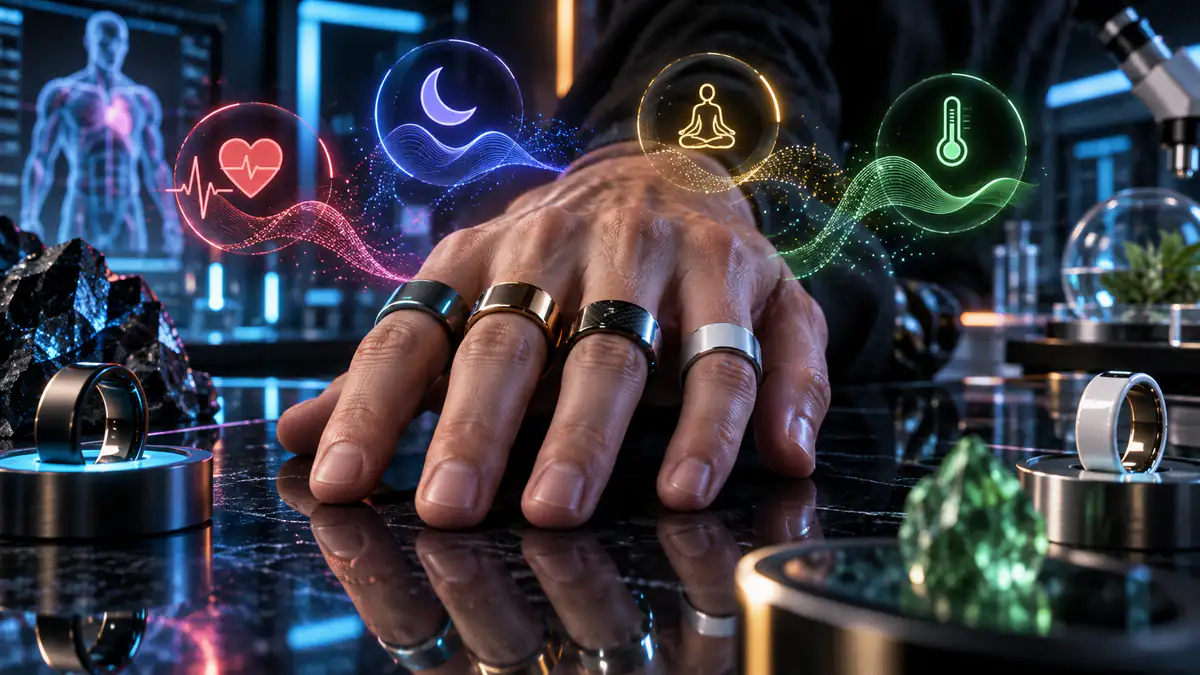
If battery life is your priority, RingConn Gen 2 has the edge on paper: the manufacturer claims 10 to 12 days and a charging case. If you want an app strongly focused on recommendations, daily rhythms and integrations, Ultrahuman Ring AIR offers the more intervention-driven ecosystem. For sleep or HRV accuracy, no scientific winner can be declared: we found no direct independent validation of both current models against the same reference standards. To expand your options to Oura, Samsung, Amazfit and wristbands, see the comparison of smart rings and sensors by user profile.
This verdict is less spectacular than the old “showdown,” but it avoids turning unpublished tests and two fake PMIDs into medical evidence. A ring is mainly useful for tracking trends using the same finger and algorithm. It is neither an electrocardiogram nor a sleep lab.
Quick comparison by user profile
| Priority | Most suitable choice | Why |
|---|---|---|
| Charging as rarely as possible | RingConn Gen 2 | Claimed battery life of 10 to 12 days and a portable charging case |
| Advice-rich app | Ultrahuman Ring AIR | Scores and recommendations feature more prominently in the ecosystem |
| Exploratory monitoring of respiratory signs | RingConn Gen 2 | Advertised apnea feature, with no standalone diagnostic value |
| Independent validation of the exact model | Neither | No robust comparison against PSG and ECG identified |
| Simple data without constant advice | RingConn Gen 2 | Presentation generally focuses more on measurements |
| No recurring subscription | Both | No fees for core features advertised as of the verification date |
Commercial specifications change quickly. This table reflects the official pages accessed on August 17, 2026, not a promise about future versions.
What a ring measures, and what it estimates
Both devices combine photoplethysmography, skin temperature and movement. PPG shines light into finger tissue and tracks changes in blood volume. From these signals, the algorithm estimates heart rate, intervals between pulses, breathing and sleep periods.
Three levels need to be distinguished:
- measured signal: reflected light, movement, surface temperature
- derived biomarker: heart rate, HRV, respiratory rate
- algorithmic interpretation: deep sleep, recovery, stress, circadian window
Uncertainty generally increases at each level. Overnight heart rate can be fairly stable while a sleep stage remains a probabilistic classification. A recovery score adds further brand-specific weightings.
Research on rings does not validate these two models
Studies have compared rings such as Oura or Happy Ring with actigraphy, EEG or polysomnography. They show that a finger-worn device can reasonably estimate certain parameters, particularly total sleep time, while struggling with sleep stages and periods of quiet wakefulness.
The 2023 study of a multisensor ring included 36 healthy adults, with 77 nights and a comparison against laboratory polysomnography or an EEG headband at home. It involved Happy Ring and several older wearables, not Ultrahuman Ring AIR or RingConn Gen 2.
A 2020 validation compared Oura and a Samsung watch with medical-grade actigraphy in daily life. It likewise cannot rank the two rings in this article. Citing these studies shows that wearable validation is possible, not that all rings with LEDs have the same accuracy.
The 2021 methodological recommendations emphasize standardized comparison against the reference standard, publication of errors and assessment by subgroup. Ideally, a manufacturer should publish performance data for the model and algorithm version used by the consumer.
HRV: useful for trends, shaky ground for rankings
HRV describes variation in the intervals between heartbeats, often summarized overnight using RMSSD. On a still, well-perfused finger, PPG can provide a usable signal. Movement, a loose ring, cold hands, local pressure, arrhythmia or poor optical quality can degrade it.
The previous version claimed that RingConn used a more accurate dual photodetector and that Ultrahuman smoothed out peaks. No verified publication supported this comparison. Without raw data paired with an ECG, it is impossible to know whether a more detailed curve is more accurate or simply less filtered.
To use HRV without overinterpreting it, follow these rules:
- wear the ring on the same hand and finger
- check that it does not spin freely or squeeze your finger
- compare medians across several nights
- interpret it alongside sleep, alcohol, illness, training and how recovered you feel
- ignore small day-to-day differences
Do not directly compare absolute values from two brands. Their measurement windows and filters may differ. For a spot measurement closer to the heart’s electrical activity, a validated ECG chest strap is preferable.
Sleep: duration is more credible than stages
Wearables generally identify sleep from stillness and cardiovascular signals. They can mistake motionless reading for sleep or miss quiet wakefulness. Light, deep and REM sleep stages are inferred without directly measuring brain activity, eye movements and muscle tone as polysomnography does.
The right approach is to look for trends: bedtime, consistency, estimated duration, overnight heart rate and repeated changes after alcohol or illness. A drop in “deep sleep” on a single night calls for neither supplements nor panic.
If tracking makes you more anxious, take the ring off for a few nights. Too much health data · FR can worsen sleep through orthosomnia, a pursuit of the perfect score that fuels hypervigilance.
Apnea: a triage signal, never an all-clear
RingConn highlights automatic sleep apnea monitoring. A ring can detect changes in SpO2, heart rate, movement and breathing consistent with events. But PPG quality varies, and a drop in oxygen saturation alone does not identify the cause.
Apnea is diagnosed based on symptoms, context and an appropriate medical recording. The practical limitations matter:
- a negative ring result does not rule out apnea
- a positive result alone does not determine the type or severity
- altitude, congestion, movement and poor perfusion can affect SpO2
- algorithms can change without any change in hardware
Seek medical advice if you have snoring with breathing pauses, gasping, morning headaches, hard-to-control high blood pressure or daytime sleepiness. Our guide to subtle signs of sleep apnea · FR explains the process. Do not drive if you are fighting to stay awake.
Ultrahuman Ring AIR: strengths and limitations
The official page advertises a ring weighing about 2.4 g, up to six days of battery life and no recurring subscription for core data access. The app emphasizes sleep, movement and recovery indices, along with recommendations on caffeine, light and daily rhythms.
This guidance suits you if you want to turn a trend into action quickly. It also has a limitation: a personalized recommendation can create an impression of precision beyond what the sensors support. A “caffeine window” remains a behavioral estimate, not a measurement of your adenosine or melatonin concentration.
Choose Ultrahuman if you prefer a proactive interface and accept more frequent charging. Check which integrations are available on your phone and in your country, though. No subscription today does not mean full ownership or perpetual operation without the manufacturer’s servers.
RingConn Gen 2: strengths and limitations
RingConn claims a thickness of 2 mm, a weight of 2 to 3 g depending on size, 10 to 12 days of battery life and up to 150 days with the case. These are manufacturer figures, not guaranteed values for every size, temperature and enabled feature.
Battery life offers a real advantage for consistent use. Fewer charges mean fewer missing nights. The respiratory feature may also prompt someone who was unaware of their symptoms to seek medical advice.
The catch is that continuity must not be confused with accuracy. A measurement recorded every night can still be biased. Choose RingConn if battery life and a more restrained presentation matter more than in-app advice.
Comfort, sizing and mechanical safety
The best ring on paper becomes a poor choice if it slips or squeezes your finger. Use the sizing kit for several days, including during sleep and a walk. Fingers swell with heat, salt, exercise and at night.
A good fit meets the following criteria:
- stable sensor contact with the palm side of the finger
- removal without pain or prolonged struggle
- no numbness, color change or deep indentation
- limited movement during sleep
Remove the ring during strength training, climbing, work with machinery and any activity where it could get caught. If sudden swelling occurs, remove it promptly. If your finger becomes pale, blue, very painful or numb and the ring will not come off, seek urgent help.
Privacy and service dependency
“Subscription-free” does not mean “your data under your control.” Read the privacy policy to find out what data is sent, where it is stored, how long it is kept and how to delete it. Also check data export, account deletion and what works if the servers go down.
Before buying, ask these questions:
- can you export raw data or only summaries
- does the app work without a constant connection
- what phone permissions are requested
- is the data used to train models or used by partners
- how many years of updates are promised
Sleep tracking contains intimate data about your schedule, health and habits. Convenience should not make you overlook that cost.
30-day trial protocol
Do not try to optimize ten scores in the first week. Use the ring to answer one question, such as the effect of late-night alcohol or a regular bedtime.
The trial can follow this plan:
- wear the ring for seven nights without changing your habits
- each morning, rate energy, sleepiness and perceived sleep quality out of 10
- change just one variable for two weeks
- compare medians for duration, heart rate, HRV and how you feel
- ignore isolated sleep-stage readings and reassess at the end, not every morning when you wake up
A ring is useful if it leads to simple, sustainable action. If all it does is add alerts, it is not improving your health.
Independent verdict
RingConn Gen 2 wins on claimed battery life. Ultrahuman Ring AIR wins on the breadth of its software guidance. Neither wins scientifically on accuracy, because there is no direct independent validation of the current models. An algorithm update can also change scores without any physiological change, another reason to keep dated notes on how you feel and accurately record every software version change.
For someone who wants to forget about charging and check trends, RingConn is the more suitable choice. For someone who wants recommendations and integrations, Ultrahuman may be more motivating. If you want to diagnose apnea, an arrhythmia or a sleep disorder, do not buy either as a substitute for medical care.