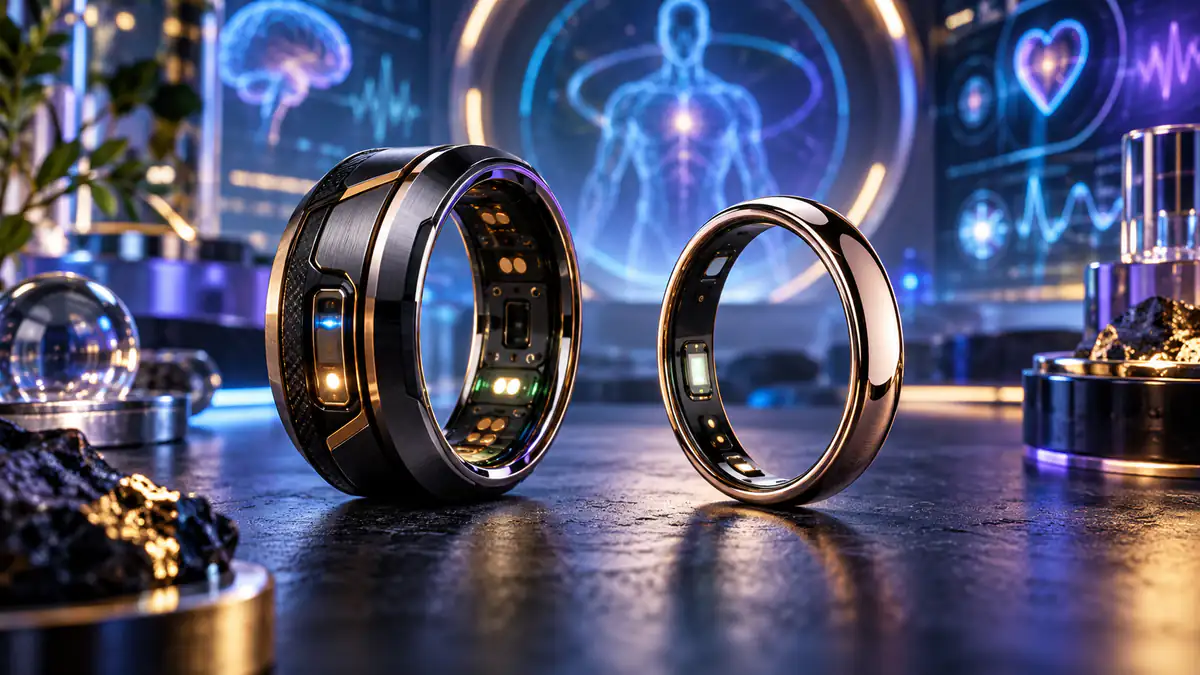
I have worn neither the Ring Air nor the Ring Pro, and this comparison makes no claim to hands-on testing. It is based on Ultrahuman’s official pages consulted on September 15, 2026, my two existing comparisons checked in July and August 2026, and wearable research read as a general framework. Prices and ordering status were rechecked on the French store on October 13, 2026. Prices, availability and firmware change quickly: recheck every figure before buying, then after each major update. To check whether either ring meets your needs better than a band or a watch, see the overview of connected devices and their costs.
Quick verdict: Pro or Air for your profile
The difference between these two rings comes down to one sentence: the Ring Air is a lightweight tracker with a mature user experience; the Ring Pro is a battery-life platform that makes you pay for its endurance in weight, thickness and euros.
Choose the Ring Air if you want to track sleep and recovery at the lowest cost, with the brand’s thinnest and lightest ring and no subscription for essential data. Choose the Ring Pro if you travel without a charger for two weeks, want months of offline storage on the ring, or see real value in a charger that stores a year of data.
In all other cases, the Air is enough. And if neither extreme battery life nor the lack of a subscription is your priority, the useful matchup is elsewhere: against competing rings, covered in my comparisons Oura Ring 5 vs Ring Pro and Ring Air vs RingConn Gen 2.
| Criterion | Ring Air | Ring Pro | Advantage |
|---|---|---|---|
| Status on October 13, 2026 | On sale, €379 listed | Add to cart, €499 listed | Tie |
| Weight | 2.4–3.6 g | 3.3–4.8 g | Air |
| Thickness | 2.45–2.8 mm | 2.65 mm depending on size | Air |
| Claimed battery life | 4–6 days | Around 12 days in Turbo, over 15 in Chill | Pro |
| Storage on the ring | Limited | Up to 250 days | Pro |
| Charger | Basic, portable optional | PRO Charger included, claimed 45 days | Pro |
| Essential data subscription | No | No, optional premium modules | Tie |
| Independent model validation | None identified | None identified | Tie |
Availability, price and total cost in France
As of October 13, 2026, the French store lists the Ring Air at €379 and the Ring Pro at €499, with the PRO Charger included. The Pro page offers “Add to cart,” with no mention of preorders. Shipping time and the final price including taxes and delivery still need to be confirmed for your chosen size and finish. Mentions of a sizing kit, returns within 30 days and Air trade-ins come from the September 15 check.
Total cost is calculated over three years, not on purchase day. Both rings advertise access to essential data without recurring fees, setting them apart from models with mandatory subscriptions. But the exact wording deserves a read: some specialized PowerPlugs modules cost extra, and the list of free features may change. Add the accessories you actually need: the Air’s portable Voyager charger is sold separately for around €42, while the PRO Charger is included with the Pro.
In practical terms, the initial €120 price gap between the two models pays for battery life, storage and the charger, not proven superior accuracy. If a discount brings the Air well below its official price, the gap widens further in its favor for standard use.
Dimensions, weight and nighttime comfort
A sleep ring should be judged at night first. Too thick, and it gets in the way when you close your hand. Too loose, and optical contact suffers. Too heavy, and it ends up in a drawer, and a sensor you’re not wearing measures nothing.
On the spec sheet, the Ring Air weighs 2.4–3.6 g depending on size, with a thickness of 2.45–2.8 mm. The Ring Pro rises to 3.3–4.8 g and is 2.65 mm thick, with a unibody titanium design. Both cover sizes 5–14. A difference of around 1 g may look small on paper, but on your finger for eight hours, sensitive sleepers notice it, especially in smaller sizes where the proportional difference is greatest.
Without a hands-on comparison, I won’t declare a universal comfort winner. The Air starts as the favorite for slender fingers, restless sleepers and people bothered by thick rings. The Pro remains slim for its capacity, and its weight is justified only if you really use the battery life. In either case, order the sizing kit, try two fingers over several nights, and don’t approve the fit based on a five-minute daytime try-on.
Battery life and charging: claimed gains and reality to check
This is the real gulf between the two models. The Ring Air claims 4–6 days of battery life, which means weekly charging and keeping a charger handy when traveling. The Ring Pro claims around 12 days in Turbo mode and more than 15 days in Chill mode, with up to 250 days of storage on the ring and a PRO Charger rated for 45 days of power and a year of data.
Keep three points in mind before comparing these figures. First, the word mode changes everything: maximum battery life assumes power-saving settings, not every measurement running at full capacity. Second, battery life varies with ring size, temperature, battery age and enabled features, so no independent median can yet be cited. Finally, extensive storage mainly benefits prolonged offline use: expeditions, periods without a phone, or simply not wanting to sync every day.
In practice, ask yourself a simple question: how many nights in a row do you want to go without thinking about the charger? If the answer is five, the Air is enough and its basic charger does the job. If the answer is fifteen, or you want a year of data in the case, the Pro is the only one of the two that keeps up. The rest of the marketing gap does not, by itself, justify the extra cost.
Sensors, metrics and app: what really changes
Both rings start with the same signals: photoplethysmography, skin temperature and movement. From these, the app estimates heart rate, heart rate variability and breathing, then sleep, recovery and daily rhythm scores. Neither directly measures sleep stages the way an examination recording brain activity and muscle tone does.
What changes is the package around the measurements. The Pro adds the ability to store months of data on the ring, a smart charger with a speaker, location tracking and wireless charging, and a platform designed for the Ultrahuman ecosystem. The app follows the same approach for both: essential data accessible without a subscription, à la carte PowerPlugs modules, some of which cost extra, and an AI interface that cross-references sources.
Two recurring misconceptions need to be shut down. The Ring Pro does not measure glucose: the M1 sensor is worn and purchased separately. And the app’s most spectacular scores remain algorithmic interpretations, not measurements, as the comparison of subscription-free rings explains. The extra cost buys endurance and an ecosystem, not proven superior physiological insight.
Sleep and recovery: which measurements are credible?
No peer-reviewed publication specifically validates these two models as of my verification date. The two PMIDs in the brief provide a general framework, and that is how they should be read. The 2026 meta-analysis of 16 randomized trials and 910 people with insomnia shows that wearable-based interventions reduce sleep-onset latency by around 4.5 minutes and slightly improve subjective sleep efficiency and duration. This result concerns programs using wearables, not the accuracy of an Ultrahuman ring.
The pilot study of another consumer device illustrates the hierarchy of credibility that applies to all rings. In 33 patients monitored for 24 hours against medical reference methods, heart rate closely tracked the reference, total sleep time and efficiency showed moderate agreement with wide margins, and REM sleep and oxygenation were substantially less reliable. Applied cautiously, the lesson is clear: track nighttime heart rate and sleep duration as trends, and treat sleep stages and exotic scores as estimates.
For serious use of either ring, follow these rules:
- wear it on the same finger, neither rotating nor squeezing, and confirm the size over several nights
- compare medians over seven to fourteen nights, never a single night
- always cross-check with how you feel, alcohol, illness and training load
- ignore daily score changes of a few points
- do not compare absolute values with another brand using different filters
If your goal is medical, such as suspected sleep apnea or a heart rhythm disorder, neither ring replaces a reference examination. The guide to sleep-tracking reliability · FR explains these limits.
When the Ring Air is more than enough
The Ring Air is enough for most real-world uses. You sleep with the lighter ring of the pair, charge it once a week next to your phone, check the same categories of scores, and pay the brand’s lowest entry price with no subscription for the essentials.
It makes particular sense for the following profiles:
- first-time ring buyers unsure about nighttime tolerance
- tracking sleep and recovery trends, with no need for offline use
- weekly charging is acceptable, with short trips taken with a charger
- a tight budget, especially if a discount or trade-in widens the gap
- slender fingers or sensitivity to weight at night
Its limits are known and accepted: four to six days of battery life, limited onboard storage, and a portable charger available at extra cost. If none of those limits bothers you, the Pro’s extra cost buys peace of mind, not proven additional data.
When the Ring Pro’s extra cost may be justified
The Pro makes sense when its endurance genuinely changes how you use it. The relevant user profiles are narrow but real.
The extra cost becomes rational in the following cases:
- trips and expeditions lasting more than a week without a reliable charger
- extended periods without syncing, with a need to retrieve the data afterward
- not wanting to think about weekly charging despite demanding daily tracking
- heavy use of an already established Ultrahuman ecosystem
- hands and finger shape that comfortably accommodate a slightly more substantial ring
Even in these cases, keep two requirements. Check the final price in euros including finish and taxes, starting from the €499 listed on October 13, 2026. Also read the ordering terms: shipping schedule, deposit, cancellation and warranty applicable in France.
Privacy, warranty and questions before buying
A sleep ring collects some of your most sensitive data: nights, heart rate, temperature, habits. Before paying for either model, check where the data is hosted, how long it is retained, what is shared with third-party modules, and how to exercise your rights to access and deletion. Promises of participatory research are no substitute for reading the current privacy policy.
As for buyer protections, the Air purchase page mentions returns within 30 days, something to confirm for the Pro too. Check the warranty duration, its coverage for battery wear, and whether after-sales support is reachable from France. For a purchase approaching €400 or more, these terms matter as much as the spec sheet.
Before deciding, answer the following questions in writing:
- what exact size, on which finger, after several nights of testing with the kit
- what final price in euros, including finish, taxes, any trade-in and accessories
- which features are included at no extra cost, and which require paid modules
- what actual battery life you get with your settings, not the most power-saving mode
- what ordering, shipping, return and warranty terms apply
If an answer is missing, wait. A ring bought while you’re unsure often ends up resold at a loss, and that is the dumbest total cost in this comparison.