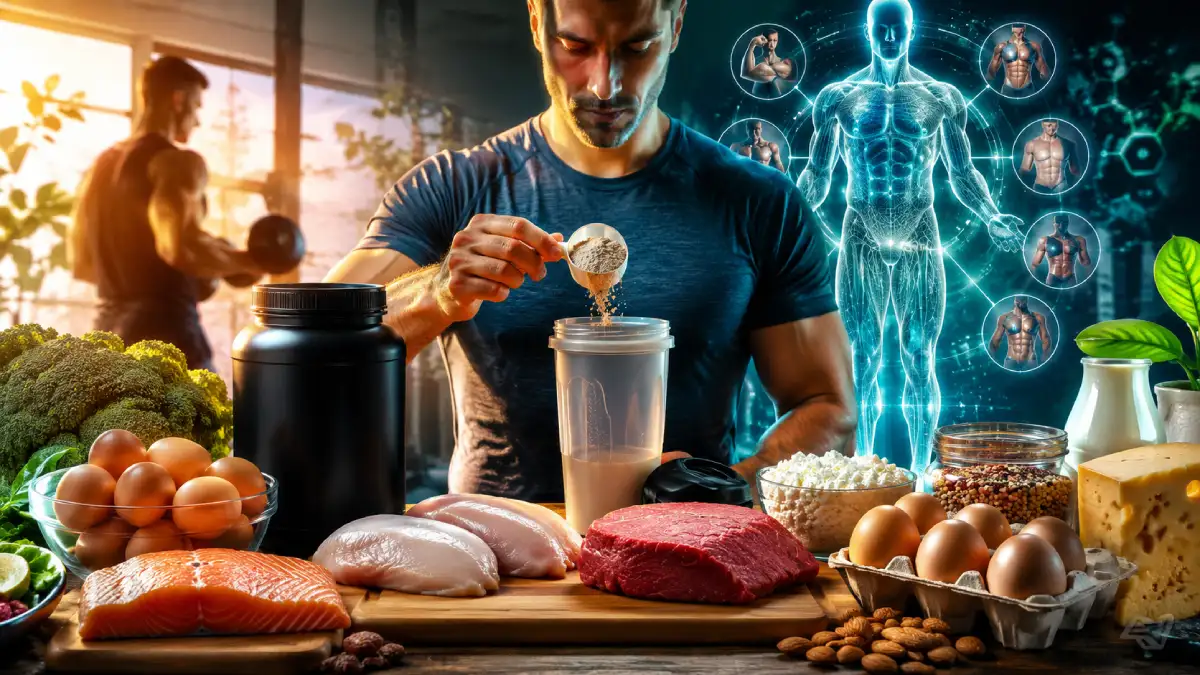
The best protein for weight loss is the one that helps you reach around 1.2 to 1.6 g of protein per kilo per day without adding unnecessary calories, and that you tolerate well enough to keep using for several months. Most often, that means food first: eggs, skyr, fish, poultry, pulses. Only then a simple whey or plant protein powder, without added sugar or a “fat-burning complex”.
No powder makes you lose weight. Weight loss comes from an energy deficit. Protein mainly changes what you lose: a little more fat, a little less muscle, often with hunger better controlled. That is already a lot, provided you do not expect it to do everything else.
My confidence in the role of total protein intake during a calorie deficit is high. My confidence in any difference in weight loss between two brands or two types of powder at equal intakes is low.
What protein really does during weight loss
Three mechanisms explain its benefits. None involves fat magically melting away.
Satiety: real but modest
A protein-rich meal increases feelings of fullness and certain satiety hormones. The review by Leidy and colleagues describes a “modest” effect in acute trials, with no demonstrated effect on how much is eaten at the next meal. In other words, protein helps you hold out; it does not switch off your appetite on demand.
That is why the benchmark of 25 to 30 g per meal comes up so often. It is not a magic threshold; it is roughly the amount in the meals tested in studies that observe an appetite benefit.
Thermogenesis: a bonus of a few dozen kilocalories
Digesting and storing nutrients takes energy. In Westerterp’s review of diet-induced thermogenesis, this cost represents 20 to 30% of the energy from protein, versus 5 to 10% for carbohydrates and 0 to 3% for fats.
Do the maths on a shake containing 30 g of protein, or 120 kcal. Digestion uses around 24 to 36 kcal, versus 6 to 12 kcal for the same energy from carbohydrates. The gain amounts to around twenty kilocalories. Useful over months; laughable next to a slice of cake.
Preserving lean mass
This is the most robust effect. In a calorie deficit, the body draws on fat, but also muscle. A higher protein intake, especially alongside strength training, limits that loss.
The meta-analysis by Wycherley and colleagues pooled 24 trials and 1,063 adults, over an average of around 12 weeks. At equal calories, the higher-protein diet produced an additional loss of 0.79 kg of body weight and 0.87 kg of fat, while preserving 0.43 kg of lean mass and some resting energy expenditure. The advantage is real. It remains modest.
In people over 50, a meta-analysis of 20 trials found the same pattern: more lean mass preserved and more fat lost with higher protein intakes during weight loss.
How much protein to aim for in a calorie deficit
For a healthy adult, the reference intake from ANSES is 0.83 g per kilo per day. It covers most people’s needs at energy balance, not the goal of retaining muscle while eating less.
During weight loss, a range of 1.2 to 1.6 g/kg/day is defensible for most adults. This is the range proposed by the Leidy review and the joint advisory from four American professional societies on GLP-1 treatments. At 70 kg, that works out to around 84 to 112 g per day, including food. My guide to how much protein to eat per day explains the calculation based on your weight.
Two situations change the target:
- In severe obesity, calculating from actual body weight overestimates needs. The GLP-1 advisory notes that there is no consensus on using actual weight, adjusted weight or lean mass: work with a dietitian to establish your reference weight.
- For an already lean athlete who strength-trains and is in a substantial calorie deficit, the ISSN discusses 2.3 to 3.1 g/kg/day to preserve lean mass, based on the Helms review, which calculates intake per kilo of lean mass.
The second case is often copied and pasted as advice for everyone. It does not apply to someone who wants to lose 8 kg before summer. The most cited trial on these high intakes, by Longland and colleagues, involved 40 young men over 4 weeks, with a deficit of around 40% and six weekly sessions of weight training and intervals. At 2.4 g/kg/day, they gained 1.2 kg of lean mass and lost 4.8 kg of fat, versus 0.1 kg and 3.5 kg at 1.2 g/kg/day. A clear result, in a very specific population.
The GLP-1 advisory also recommends not dropping below 0.4 to 0.5 g/kg/day and avoiding prolonged intakes of 2 g/kg/day or more without a justified context. More is not automatically better.
Why no powder “makes you lose weight”
Trials test intakes, not sachets. When whey is added to the diets of people with overweight, the Wirunsawanya meta-analysis of 9 trials finds an average of around 0.6 kg less body weight and 1.1 kg less fat mass than with a placebo or control. There is a signal, its size matches what you would expect from a slightly higher protein intake, and it depends on the rest of the diet.
The trap is simple: a shake added to an otherwise unchanged day means an extra 100 to 130 kcal. It only helps you lose weight if it replaces something or prevents snacking. The tub says “slimming”? The active ingredient is still the deficit, and deficits do not come by the scoop.
That is the Toll of the powder, in the sense used in the book Code Énergie: the hidden cost of a solution. Here, a tub to buy every month, one more habit to maintain, and the illusion of having taken action because you bought something. This toll is acceptable if the powder fills a real gap in your day. It is not if it gets piled on top of meals that already provide enough.
Which type of protein to choose for weight loss
At equal intakes, the type matters little for weight loss. It matters for protein density, tolerance and price. This table sums up the trade-offs:
| Type | What it offers in a calorie deficit | Main limitation |
|---|---|---|
| Whey isolate | Often more than 85% protein, very little lactose, carbohydrate or fat | More expensive per kilo |
| Whey concentrate | 70 to 80% protein, lower price, effective if you tolerate milk well | A little more lactose and calories per serving |
| Casein | Slower digestion, thick texture, convenient as an evening snack | No demonstrated advantage for fat loss at equal intakes |
| Plant-based (soy, pea–rice) | Dairy-free, suitable for vegans and people with milk intolerance | Serving size may need increasing; taste and texture vary |
To choose between two whey powders, my comparison of whey isolate versus concentrate · FR explores the lactose question. For digestion speed, read whey versus casein · FR. If you avoid milk, my guide to choosing a vegan protein powder · FR explains how to improve the amino acid profile.
In a calorie deficit, isolate has a concrete selling point: more protein for fewer calories in the same scoop. That is no reason to pay twice as much if a concentrate works for you. For specific product choices, my comparison of the best whey proteins remains the site’s reference. Here, the question is not the brand but the powder’s role in your weight loss.
“Fat-burning” add-ons to avoid
“Slimming” ranges often add active ingredients supposedly designed to speed up fat loss. This is Mitochondria Marketing: using a real biological mechanism to sell an unproven benefit. Here is what the strongest evidence reviews show:
- L-carnitine: a meta-analysis of 9 trials and 911 participants finds around 1.3 kg more weight lost than with a control, with an effect that decreases the longer it is taken.
- CLA (conjugated linoleic acid): in trials lasting at least 6 months, a meta-analysis finds a 0.7 kg difference, methodological weaknesses and digestive problems. The authors consider the effect clinically irrelevant.
- Concentrated green tea: the Cochrane review concludes that weight loss is small, non-significant and unlikely to be clinically important, excluding Japanese studies that were too heterogeneous to pool.
Concentrated green tea also raises a safety issue. In 2018, EFSA estimated that 800 mg per day of EGCG, the main catechin, taken as a supplement may be associated with early signs of liver damage, without being able to establish a safe dose. EU Regulation 2022/2340 has since required less than 800 mg per daily portion and warnings, including that it must not be taken on an empty stomach.
These add-ons cost money, complicate the label and add risk for a gain of one kilo at best. A protein for weight loss only needs protein. The rest is marketing sold at the price of protein.
Reading the label of a protein for weight loss
The label is enough to rule out most poor choices. Check these four lines for the exact flavour you are buying:
- Protein per 100 g: at least 70% for whey concentrate, more than 80% for whey or soy isolate.
- Calories per serving: around 100 to 130 kcal for 25 to 30 g of protein. Beyond that, the powder is carrying extra carbohydrates or fat.
- Sugars: a few grams per serving at most. A “slimming” powder with 10 g of sugar per serving is in the wrong line of work.
- Ingredients list: short, with no green tea extracts, guarana, L-carnitine, CLA or “thermogenic complex”.
To compare prices, convert everything to the same useful serving: price per kilo divided by grams of protein per kilo, multiplied by 25. A powder that is cheaper per kilo but more diluted can cost more per serving.
Sweeteners deserve a line of their own. Sucralose, acesulfame K and stevia reduce the calories in a shake. Since 2023, the WHO has recommended not relying on them for weight control, because the evidence does not show a lasting reduction in body fat. This is a conditional recommendation, based partly on observational studies, and it does not apply to people with diabetes. In practice, an unflavoured or lightly sweetened version remains an option if you want to reduce both.
Meal replacement or protein powder
They look similar on the shelf, but their roles differ. A protein powder supplements a meal. A meal replacement replaces a meal and also contains carbohydrates, fats, vitamins and minerals, with a composition regulated in Europe. In 2010, EFSA approved two uses for compliant meal replacements, summarised by Le Quotidien du pharmacien: replacing two meals a day in a calorie-restricted diet to lose weight, or one meal to maintain weight loss.
The evidence on meal replacements is stronger than you might think. The Astbury meta-analysis, covering 23 trials and 7,884 adults with overweight, finds 1.44 kg more weight lost at one year than with other diets, and up to 6.13 kg with enhanced support. Some authors received funding from weight-management programme companies, which calls for caution when reading these figures. The useful message still stands: structure and follow-up make the difference, not the shake.
A whey shake mixed with water does not make a lunch. If you replace a meal with a simple powder, you miss out on fibre, micronutrients and often the satiety that comes from chewing. So choose:
- A powder if your problem is a meal that is too low in protein.
- A compliant meal replacement, ideally within a supervised programme, if your problem is meal structure.
Whole foods first
A protein-rich food also provides volume, water, fibre in the case of pulses, and chewing that powder cannot offer. Before buying, check what the same serving costs from your fridge. Here are the usual candidates:
- Skyr or fromage blanc, compared in my article skyr versus fromage blanc · FR.
- Eggs, whose effect on satiety is analysed in do two eggs a day help you lose weight.
- Fish, poultry, lean meat, tofu, tempeh.
- Lentils, chickpeas and beans: less concentrated in protein, but rich in fibre.
My table of protein-rich foods · FR provides protein contents to help you build your meals. Powder becomes useful when the gap persists despite these efforts, or when practical constraints prevent you from eating properly.
Do not forget the other half of the equation. Protein supplies the building materials; strength training gives muscle a reason to stay. Without loading the muscles, much of the protective effect disappears. To decide how to spend your exercise time, read cardio or weight training for weight loss · FR.
The case of GLP-1 treatments
Semaglutide and tirzepatide suppress appetite, sometimes enough to make meeting protein needs difficult. The joint advisory published in 2025 in the American Journal of Clinical Nutrition gives a sense of the proportions: in a substudy of the STEP 1 trial, 62% of total weight lost was fat mass and 38% was lean mass, around half of which was muscle.
The same document proposes 1.2 to 1.6 g/kg/day during active weight loss and cites shakes or fortified products as ways to reach the target when food is no longer enough. It also notes that protein alone is probably insufficient: strength training remains essential. During GLP-1 treatment, a low-volume, well-tolerated powder may make more sense than for someone eating normally. My article on muscle loss during GLP-1 treatment explains the options.
Safety and special situations
A simple protein powder is a food, not a medicine, but some situations call for professional advice before increasing your intake:
- Chronic kidney disease or reduced GFR, a topic explored in my article on whey and kidneys.
- Diabetes under treatment, especially if you change your meals or replace a meal.
- GLP-1 treatment, bariatric surgery or supervised rapid weight loss.
- Pregnancy, breastfeeding, being under 18.
- A history of an eating disorder.
- Milk or soy allergy.
For digestion, try half a serving for a few days if you are sensitive to lactose or your powder contains polyols.