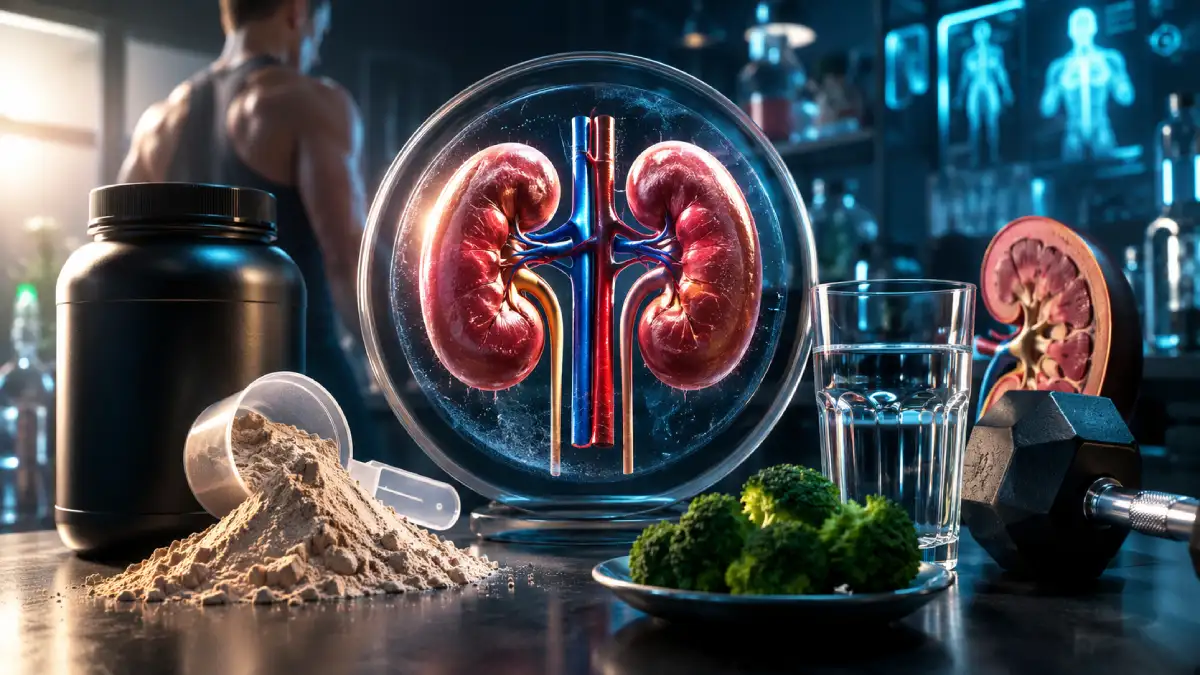
In an adult without kidney disease, a daily serving of whey has not been shown to destroy the kidneys. That answer does not apply to every dose or to someone whose GFR is falling or whose urine contains albumin.
The myth persists because it rests on a real number read the wrong way: a muscular lifter’s creatinine often comes back “high” on a blood test. That number reflects your muscles too, not just your kidneys.
The trap is reducing kidney health to a single creatinine result. A muscular athlete taking creatine or tested after a workout may have higher creatinine without kidney injury. Conversely, a GFR still above 60 can coexist with albuminuria revealing early damage.
So the shaker is rarely the whole story. Undiagnosed kidney disease, diabetes, high blood pressure, anti-inflammatory use, extreme exertion in the heat or dehydration affect the decision far more than a word on the bag.
Here are five misconceptions to clear up:
| Myth | Reality |
|---|---|
| Whey is an artificial substance that clogs the kidneys | it is concentrated milk protein, digested into peptides and amino acids |
| A rising GFR proves the kidneys are getting stronger | hyperfiltration can be an acute adaptation, not a health improvement |
| High creatinine diagnoses renal impairment | it also depends on muscle mass, diet, exercise and creatine |
| A normal GFR rules out all kidney disease | persistent albuminuria can indicate damage despite preserved GFR |
| Kidney disease means zero protein and zero whey | the target depends on disease stage, dialysis, activity and malnutrition risk |
Why does protein raise concerns about the kidneys?
After digestion, amino acids are used to renew and build the body’s proteins. Those exceeding immediate needs are not stored as a protein reserve. Their nitrogen is notably converted into urea, then excreted by the kidneys.
A high-protein meal also temporarily increases renal blood flow and glomerular filtration. This renal functional reserve allows an additional load to be excreted. Observing a higher GFR after a high-protein diet is therefore not enough to demonstrate injury.
The concern comes from a different situation. When disease has already reduced the number of functioning nephrons, the remaining units each filter more. Sustained high intraglomerular pressure can then contribute to the progression of certain kidney diseases. Extrapolating this mechanism from diseased kidneys to all healthy athletes is unjustified. So is ignoring the same mechanism in someone with albuminuria.
Whey follows this physiology, but it does not create a special kidney pathway. Twenty-five grams of protein from a shake join the total supplied by milk, eggs, fish, meat, soy or legumes. Digestion speed and other nutrients differ, but what mainly matters to the kidneys is the total nitrogen load and the person’s underlying health.
What the evidence shows in healthy adults
The most recent review pooled 22 randomized trials in adults without chronic kidney disease. Diets described as high-protein often provided 25–35% of energy from protein or at least 2 g/kg/day.
Compared with lower-protein diets, they increased estimated GFR, with substantial heterogeneity between studies. They did not significantly change creatinine in 19 trials totaling 1,044 participants and produced no consistent biochemical signal of kidney injury. The authors interpret the rise in GFR as a possible hemodynamic adaptation, not proof of improvement or deterioration.
The limitation matters: the trials were generally short and mainly used GFR estimated from creatinine. They tell us little about extreme consumption over twenty years and rarely measure structural damage.
A cohort study published in July 2026 adds a longer-term piece of evidence. In 1,324 adults with a mean age of 64, GFR was measured by iohexol clearance and measured again over a median follow-up of ten years. Mean intake was 1.2 ± 0.5 g/kg/day, with at least 1.4 g/kg/day in the highest quarter. Higher intake was not associated with a decline in measured GFR, an accelerated decline or the development of a GFR below 60.
This cohort avoids some creatinine-related bias, but remains observational and does not represent a bodybuilder consuming 2.5 or 3 g/kg/day. The verdict therefore comes down to two points:
- moderate confidence : the high intakes studied have not been shown to impair kidney function in adults without kidney disease
- persistent uncertainty : no study establishes an extreme dose as safe for life or useful for performance
The 2026 article in the American Journal of Kidney Diseases adds an often-overlooked nuance. Without resistance training, adding protein produces relatively modest gains in strength and performance. If you are inactive, the first muscle-building lever is not a second shake, but appropriate exercise.
Whey, diet and product quality
Whey helps bridge a gap between your diet and a useful target. It does not need to be automatically added at breakfast, after training and before bed. The number to track is total protein per day, not the number of scoops.
No kidney outcome data establish that isolate is more protective than concentrate at an equal protein intake. Isolate is mainly chosen for its concentration and low lactose content. A milk protein allergy applies to both forms.
Powder should not routinely displace food. Fish, eggs, dairy, soy and legumes provide different nutritional matrices. For people with kidney disease, KDIGO recommends a more plant-based, less ultra-processed diet, while tailoring potassium, phosphorus and protein to individual findings. Whey remains a convenience tool, not the foundation of the diet.
To limit risks unrelated to the protein itself, check these criteria:
- actual protein provided per serving and per 100 g
- a short ingredient list, without blends of stimulants, herbs or “fat burners”
- an identifiable manufacturer, accessible test results and a batch number
- relevant certification for an athlete subject to doping controls, particularly the EN 17444:2021 standard
- any creatine, amino acids, potassium or phosphate additives to report during a checkup or if you have kidney disease
Our guide to choosing whey based on composition and traceability explains these checks. The Anses warning about sports products concerns a broad category, often made up of blends and sometimes fraudulent products. It does not demonstrate that pure whey causes the reported cardiovascular events.
For athletes, the most credible acute kidney risk sometimes lies around the shaker. Prolonged or very intense exercise, heat, dehydration and nonsteroidal anti-inflammatory drugs can combine. The plan is not to “flush your kidneys” with an arbitrary number of liters. It is to adapt hydration to exertion and climate, avoid self-medicating with ibuprofen or ketoprofen around an event, and recognize the signs of rhabdomyolysis.
Special case: reduced GFR or albuminuria
Chronic kidney disease is not diagnosed from a value taken after a workout. KDIGO defines it as a GFR below 60 ml/min/1.73 m² or a marker of kidney damage, notably an albumin-to-creatinine ratio, or ACR, of at least 30 mg/g, equivalent to 3 mg/mmol, persisting for at least three months.
This leads to very different decisions depending on the profile:
| Profile | What the result means | Role of whey |
|---|---|---|
| Normal GFR and ACR, no known risk factors | no kidney-related warning sign identified at the time of testing | an option for meeting a need, without piling on servings |
| GFR 60–89 without albuminuria or other damage | not enough to define kidney disease | interpret according to age, context and trajectory |
| Very muscular athlete with low GFR calculated from creatinine alone | potentially biased estimate, but the abnormality needs confirmation | neither panic nor dismiss it; add ACR and a creatinine–cystatin C estimate |
| ACR persistently at least 30 mg/g or GFR persistently below 60 | consistent with chronic kidney disease | no high-protein diet or self-directed whey use before assessment |
| Dialysis, frailty, sarcopenia or malnutrition | requirements may be higher despite kidney disease | a product and an appropriate amount may help, but only within the care plan |
For adults with chronic kidney disease stages G3–G5 without another indication, KDIGO suggests around 0.8 g/kg/day and advises avoiding more than 1.3 g/kg/day when there is a risk of progression. These are clinical benchmarks, not instructions to cut back your diet on your own.
Very-low-protein diets require close monitoring and sometimes essential amino acids or ketoanalogues. They should not be improvised. In an older person who is frail, malnourished or on dialysis, excessive restriction can accelerate muscle loss. The recent AJKD article specifically highlights this tension between nitrogenous waste and anabolic resistance.
If you have albuminuria, a single kidney, a transplant, diabetes, high blood pressure or recurrent kidney stones, ask a nephrologist and a dietitian trained in renal nutrition for an individualized target. The question is no longer “whey or no whey,” but total quantity, diet quality, phosphorus, potassium, sodium, calories and treatment.
Which tests and warning signs warrant medical advice?
Kidney function is assessed using several complementary measures:
| Measure | What it tells you | Main pitfall in athletes |
|---|---|---|
| Blood creatinine | marker used to estimate filtration | muscle mass, cooked meat or fish, exercise, creatine and a high-protein diet |
| Creatinine-based estimated GFR | practical estimate, not a direct measurement | may underestimate GFR in a very muscular bodybuilder |
| Creatinine–cystatin C GFR | generally more accurate estimate when available | cystatin C also has biases, particularly with corticosteroids, thyroid disease or cancer |
| Urine ACR | detects albumin leakage, sometimes at an early stage | exercise, blood in the urine, menstruation or infection can temporarily raise it |
| Blood urea | partly reflects catabolism and nitrogen load | also rises with protein intake and dehydration, without diagnosing injury on its own |
| Blood pressure | identifies a common cause and consequence | a single reading after exercise is difficult to interpret |
If a checkup is planned, make the conditions reproducible. KDIGO notes that a meal of cooked meat or fish can increase creatinine and recommends waiting at least twelve hours before blood sampling to avoid this effect. Avoid an intense workout just beforehand, report whey, creatine, medications and supplements, and do not stop treatment without instructions.
For albuminuria, the first morning urine sample is preferable. An abnormal result should be repeated, as exercise can temporarily increase urinary protein. Chronic kidney disease generally requires persistence for at least three months, but a severe abnormality or rapid deterioration should be assessed without waiting that long.
Kidney disease can remain silent for a long time. The following situations warrant a medical appointment even without pain:
- reduced GFR or rising creatinine across several tests
- persistently very foamy urine, blood in the urine or high ACR
- swelling of the ankles or face, high blood pressure, an unusual reduction in urine output
- diabetes, high blood pressure, a history of acute kidney injury or a family history of kidney disease
- regular use of anti-inflammatory drugs or stacking poorly identified supplements
After intense exercise, cola-colored urine accompanied by significant muscle pain, weakness, vomiting or a sharp reduction in urine output may notably suggest rhabdomyolysis and requires urgent assessment. Difficulty breathing, confusion or almost no urine output means you should call 15 or 112.
Verdict: no consistent clinical signal shows kidney toxicity specific to whey in healthy adults when total intake remains reasonable. Serious concern starts with a persistent GFR abnormality or albuminuria, not a shaker in the kitchen. Conversely, attributing creatinine to muscle too quickly can delay a real diagnosis. Measure GFR and ACR, look at their trajectory and tailor protein to your health profile rather than a viral dose.