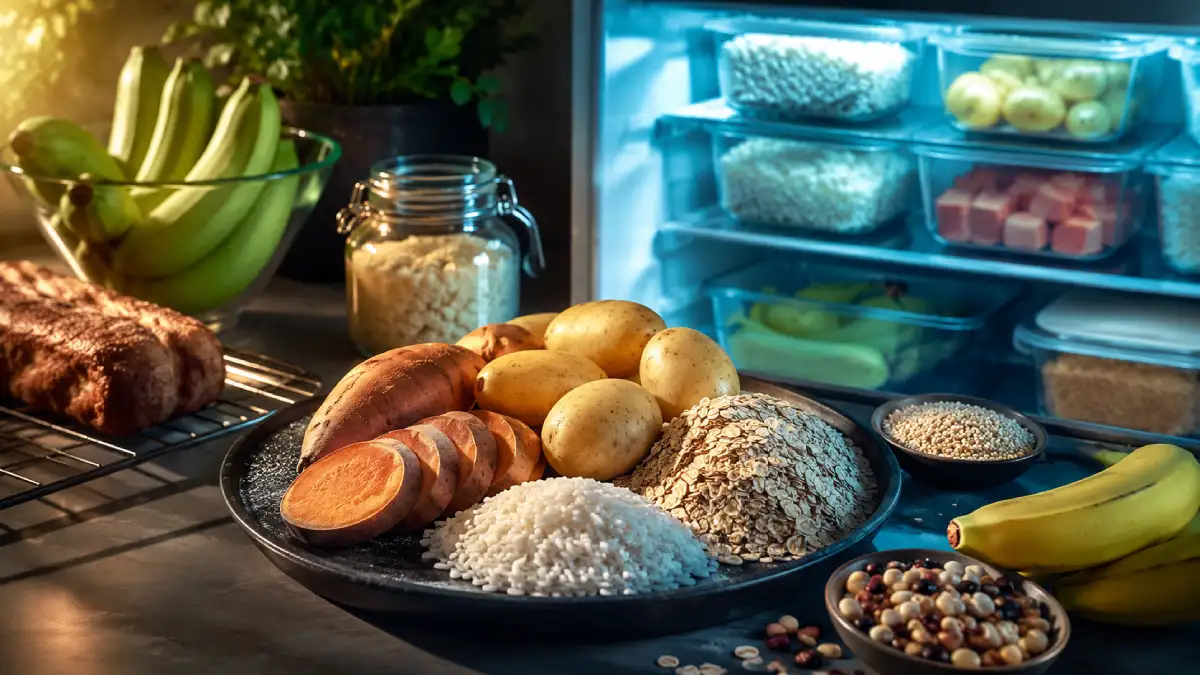
Resistant starch partly escapes digestion: to form it in a cooked starchy food, trials have used 24 hours in the fridge at 4 °C, followed by reheating. In a trial using a specific rice, its content rose from 0.64 to 1.65 g per 100 g, with a lower glycemic response in 15 adults—not a promise of halving carbohydrates.
But the dish becomes neither low-carb nor automatically prebiotic for everyone. Rice variety, cooking, duration, temperature, portion size and your microbiota all affect the result. The best evidence on food preparation comes from small acute trials, while many metabolic benefits are studied using concentrated powders.
The cautious approach comes down to four ideas: cool quickly, refrigerate overnight, reheat only once if you wish, and start with a small portion if your gut is sensitive.
What is resistant starch?
Ordinary starch is broken down into glucose in the small intestine. Resistant starch partly escapes this digestion and reaches the colon, where certain bacteria can ferment it into short-chain fatty acids, including acetate, propionate and butyrate. The article on C15:0 and its production from propionate shows why these metabolites also complicate the interpretation of dietary biomarkers.
The term covers several structures:
| Type | Why it resists digestion | Examples |
|---|---|---|
| RS1 | starch trapped in a plant matrix that is difficult to access | whole or coarsely ground grains, legumes |
| RS2 | naturally resistant granules before cooking | green banana, raw potato starch, high-amylose corn |
| RS3 | starch gelatinized then retrograded during cooling | rice, potatoes, pasta or grains cooked then cooled |
| RS4 | starch modified through an industrial process | functional ingredients in certain breads, bars or powders |
| RS5 | complexes formed between amylose and lipids | certain cooked preparations containing starch and lipids |
The fridge method mainly targets RS3. During cooking, water and heat gelatinize starch and generally make it easier to digest. As it cools, some amylose chains, followed by amylopectin chains, reassociate into more ordered structures: this is retrogradation.
You cannot judge the amount produced by sight. High-amylose rice, a floury potato and legume pasta do not respond like their counterparts. “Cooled” describes a process, not a guaranteed dose.
Which foods contain resistant starch?
RS2 powders are the most concentrated per gram, but they are not necessarily the best first choice. On your plate, legumes and underripe bananas provide naturally resistant starch. Rice, potatoes and pasta gain some after cooking and cooling.
Here is a useful comparison without pretending there is one universal content:
| Food | Dominant type | Useful preparation | Likely tolerance | Level of human evidence |
|---|---|---|---|---|
| Lentils, chickpeas, beans | RS1, RS2 and RS3 | cook thoroughly; cooling is optional | gas possible because of several fibers and GOS | good for overall glycemic response; RS-specific contribution uncertain |
| Green banana or underripe plantain | RS2 | raw if edible, or a dedicated flour | bloating or constipation in some people | metabolic findings vary by product and dose |
| Potato | RS3 after cooling | cook then cool for 12 to 24 h | often straightforward to test; watch large portions | small trials, mixed glycemic results |
| Rice | RS3 after cooling | cook, cool for 24 h at 4 °C, reheat once | generally well tolerated; safe storage is the priority | small crossover trials with favorable acute glycemic findings |
| Wheat or legume pasta | RS3 after cooling | cook al dente, cool for 24 h, reheat | wheat or legumes may trouble a sensitive gut | favorable early acute studies, small samples |
| Potato starch or high-amylose corn | RS2 | use as directed on the label, without heating if RS2 is the goal | easier to concentrate fermentation and gas | many supplementation trials; limited applicability to foods |
Legumes do not owe their effect to resistant starch alone. Protein, fiber, cell structure and slowly digestible starch also contribute to their glycemic response. Cooling them can be practical for a salad, but it is not a requirement for them to be worthwhile.
Cooking, refrigeration and reheating: what actually changes
Overnight chilling is a practical compromise. Trials on rice, potatoes and pasta often use 24 hours at 4 °C. That does not prove that 24 hours is optimal, or that 48 hours doubles the effect.
The trial by Sonia and colleagues on rice compared fresh rice with rice cooled for 24 hours at 4 °C then reheated. Resistant starch rose from 0.64 to 1.65 g per 100 g in this specific preparation. In just 15 healthy adults, the glycemic response over two hours was lower after the cooled and reheated rice.
Potatoes are less predictable. In a trial in 30 women with overweight, each ate hot or cold potatoes. The 2022 reanalysis found a lower incremental glycemic response with the cold version, whereas the total glucose area under the curve did not differ in the earlier analysis. The calculation method matters as much as the “hot versus cold” story. Funding included the Alliance for Potato Research and Education, and one author disclosed a financial interest in MicrobiomeDX.
For chickpea pasta, a study in 12 adults saw RS rise from 1.83 to 3.65 g/100 g after cooling and reheating, with a glycemic index of 33 versus 39. This is an acute signal, not proof of diabetes prevention.
The 2023 study by Kaur and colleagues mainly concerned Indian wheat-based products, including chapati and dalia. Storage for 24 hours at 4 °C increased RS, and glycemic testing involved only ten adults. Some results also came from rats. It supports the principle of retrogradation without establishing a universal method for rice, potatoes or pasta.
The fridge method and food safety
Retrogradation never justifies leaving a starchy food on the counter overnight. Anses states that beyond two hours after cooking, the risk of microbial growth increases, and recommends a refrigerator temperature between 0 and 4 °C.
For rice, follow the Food Standards Agency’s stricter rule :
- Divide cooked rice into small, shallow portions
- Cool it quickly and ideally refrigerate it within one hour
- Keep it between 0 and 4 °C overnight, and eat it within 24 hours
- Eat it cold or reheat it only once until steaming hot throughout
- Throw it away if it has spent a long time at room temperature, even if it smells normal
Spores of Bacillus cereus can survive cooking. The main risk comes from bacterial growth and toxins produced during poor storage. Reheating therefore does not undo several hours spent at room temperature.
Reheating preserves some of the RS3 in the small trials available, while making the meal more enjoyable.
Does cooled rice help you lose weight or lose its calories?
Cooling does not turn a portion of rice into an all-you-can-eat food. The trial reporting 0.64 versus 1.65 g of RS per 100 g measures an increase of around 1 g in that preparation. It measures neither the calories in every variety nor long-term weight loss.
A lower acute glycemic response is not proof of weight loss. Keep your portion appropriate for your meal rather than doubling it because the rice spent the night in the fridge. For the whole plate, the guide to eating with insulin resistance covers food quality and meal distribution options.
Measured effects on blood glucose, microbiota and butyrate
Blood glucose: a secondary lever, not a carb free pass
A review identifying 36 trials and 982 participants, with 31 trials in the meta-analysis involving people with prediabetes or type 2 diabetes observed improvements in some markers with RS1 and RS2. The authors highlighted the lack of data on RS3, RS4 and RS5. You therefore cannot credit cooled rice with all the results of a high-amylose corn powder.
Another meta-analysis of 19 trials found an average reduction in fasting blood glucose of around 0.09 mmol/L and an improvement in HOMA-IR, with no significant effect on several other insulin measures. Effects were more apparent at high doses or over longer periods—conditions far removed from an occasional potato salad.
If you have diabetes, keep counting carbohydrates. In 32 people with type 1 diabetes, cooled then reheated rice reduced the glycemic response, but also increased hypoglycemia with the usual insulin dose. Do not change your dose or timing without your doctor or healthcare team. To compare meals, start by measuring blood glucose at the right time. Our guide to post-meal blood glucose spikes distinguishes an acute response from a diagnosis of prediabetes or diabetes.
Microbiota: starch type favors different responders
The 2026 publication by Piperni and colleagues is a secondary analysis of a crossover trial with RS2, RS4 and digestible starch. The two resistant starches produced distinct and transient microbial changes. RS2 notably favored Ruminococcus bromii, while RS4 enriched other species and carbohydrate-degrading functions.
The important result is not “more good bacteria.” It is that starch type and baseline microbiota alter the response, and that the changes then recede after the intervention. The study measured composition and functional potential, not a cure for digestive problems.
Butyrate and satiety: signals more modest than the marketing
A meta-analysis of trials in healthy adults associated resistant starch supplementation with greater stool wet weight and a higher fecal butyrate concentration. It found no significant increase in stool frequency.
For satiety, a 2025 review of cereal fibers concludes that resistant starch has a small effect on feelings of appetite and subsequent energy intake. A mechanism involving butyrate, GLP-1 or PYY remains plausible, but cold rice is not a proven appetite suppressant.
Gas and constipation: how to increase gradually
Gas shows that fermentation is happening, not that benefits rise in proportion. Increasing too quickly can cause distension, cramps, looser stools or, in some people, constipation.
No trial validates a universal progression. Use this two-week tolerance test:
| Period | Test | Measurement | Decision |
|---|---|---|---|
| Days 1 to 3 | replace a quarter of your usual portion of hot starchy food with the same food cooled | gas, pain and bloating from 0 to 10, stool form | stay at this level if symptoms increase slightly |
| Days 4 to 7 | move to half the portion if the first step is comfortable | same measurements, without adding powder | return to a quarter if pain or bowel habits worsen |
| Week 2 | test a usual portion at just one meal | comfort, satiety and regularity | keep the smallest amount that is useful and tolerated |
Replacing avoids adding calories and several fibers at once. Drink normally and regularly. Forcing down several liters of water will not neutralize excessive fermentation.
Take extra care if you have irritable bowel syndrome. Resistant starch is not a classic FODMAP, but it is still fermentable. The 2026 microbiome trial excluded people with a history of gastrointestinal disease or surgery. Start with a food you already tolerate, not a concentrated powder. Our guide to fibermaxxing and gradually increasing fiber · FR provides general rules for stopping.
Seek medical advice if bloating or constipation persists despite cutting back, or if you have blood in your stools, weight loss, vomiting, fever or significant pain. Pain, a very distended abdomen and inability to pass stools or gas warrant urgent assessment.
Food or powder: which should you choose?
For a cooking goal, foods win. They provide water, protein, micronutrients and other fibers while naturally limiting the dose. Cooling changes only a fraction of the starch, reducing the risk of turning a meal into an experimental fermentable load.
A powder may make sense in a clinical trial or for a monitored goal, but three differences must remain clear:
- studies often use 15 to 40 g of resistant starch per day, far more than the increase obtained in a portion of cooled rice
- RS2, RS3 and RS4 do not produce the same microbial or glycemic responses
- “potato starch,” “potato flour” and “measured resistant starch” are not synonyms
If you choose a powder, check the RS type, the amount of resistant starch per serving, other fibers and traceability. Start below the stated serving size, increase only one product at a time, and stop if pain or bowel habits worsen. Cooking can gelatinize the RS2 in raw starch and reduce the intended effect.
The Verdict
The fridge is a real but modest lever. For rice, one night at 4 °C followed by a single reheating can increase RS3 and reduce the acute glycemic response. Potatoes and pasta also seem to respond, though with greater variability. Start in the kitchen, keep leftovers safe, and judge the result by your tolerance rather than the promise of an “optimized” microbiome.