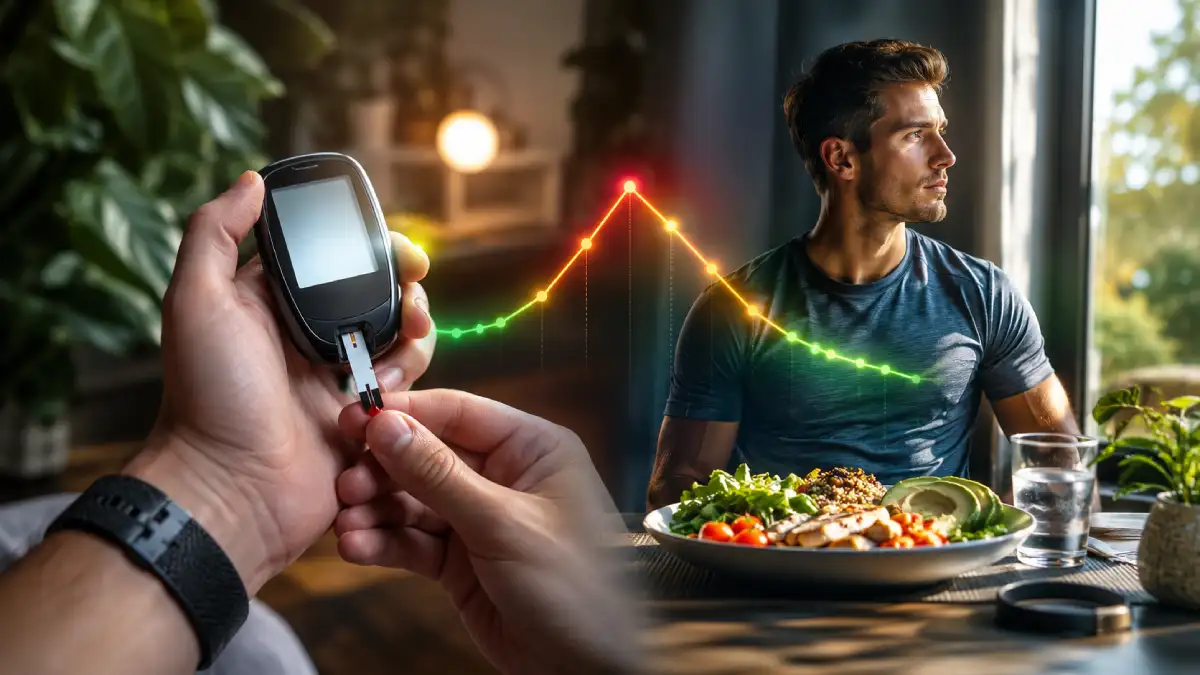
HbA1c is the best simple summary of your blood glucose over the past three months, and a very poor judge of your day yesterday. Below 5.7%, the benchmark is normal. From 5.7 to 6.4%, the ADA calls it prediabetes. At 6.5% or above, confirmed by a second test, it is a criterion for diabetes according to the WHO and ADA.
These thresholds only apply if the number is reliable. Iron deficiency can inflate it, recent bleeding can drag it down, and a hemoglobin variant can interfere with certain methods. Before you panic or congratulate yourself, check what might be throwing it off.
What HbA1c actually measures
Hemoglobin carries oxygen in your red blood cells. Glucose in the blood attaches to it spontaneously, without an enzyme. The more glucose circulating, the higher the proportion of “sugar-coated” hemoglobin, known as glycated hemoglobin. The laboratory reports this proportion as a percentage or in mmol/mol.
A red blood cell lives for about 120 days on average, according to the NGSP, the US organization that standardizes this test. HbA1c therefore integrates the glucose exposure of all circulating red blood cells, from the youngest to the oldest. It is not an evenly weighted average: the last 30 days count significantly more than the period three to four months ago.
The practical consequence: you do not need to fast, and the test can be done at any time, as the WHO notes. Last night’s meal does not substantially change it.
That is also its weakness: if the lifespan of your red blood cells changes, the number changes, even with identical blood glucose.
HbA1c is not a measure of glycation throughout the body, either. The article on glycation and AGEs · FR explains why that shortcut does not hold up.
Normal levels, prediabetes, diabetes: the thresholds
The most frequently cited benchmarks come from the American Diabetes Association (ADA) Standards of Care 2026 and the WHO’s 2011 report:
| HbA1c in % | HbA1c in mmol/mol | ADA interpretation |
|---|---|---|
| Below 5.7% | Below 39 mmol/mol | Normal |
| 5.7 to 6.4% | 39 to 47 mmol/mol | Prediabetes |
| 6.5% or above | 48 mmol/mol or above | Diabetes, requiring confirmation |
The WHO uses the same 6.5% threshold for diabetes, with two explicit caveats. The test must be standardized and quality-controlled. And a value below 6.5% does not rule out diabetes diagnosed through blood glucose testing. For the intermediate range, the WHO considered the evidence insufficient for a formal recommendation. It cites the international expert committee, which considered people between 6.0 and 6.5% at particularly high risk, and the ADA, which sets the lower threshold at 5.7%.
A result of 5.8% is therefore “prediabetic” according to the ADA, but below the international committee’s threshold. That is not a contradiction: it is a cutoff placed on a continuous risk spectrum.
Why one result is not enough
In someone without symptoms, the ADA requires two abnormal results: either the same test repeated or two different tests. If HbA1c exceeds 6.5% while fasting blood glucose is normal, the ADA still considers the person to have diabetes once the elevated result is confirmed, after ruling out interference with either test.
What about France?
The criteria published by Assurance Maladie rely on fasting blood glucose: 1.26 g/L (7 mmol/L) or above on two tests, or 2 g/L at any time with symptoms. HbA1c is not included. The historical Anaes guideline, published in 1999 and still available on the HAS website, did not recommend HbA1c for diagnosis. It is mainly used for monitoring, while the ADA and WHO thresholds remain the international benchmarks.
For people living with type 2 diabetes, the HAS reiterated in 2024 a target of 7% or below for most patients, with stricter or more relaxed targets depending on age, complications and the risk of hypoglycemia. That target is set with your doctor, not with a table.
Converting your HbA1c: %, mmol/mol and average blood glucose
The percentage comes from the US NGSP system, aligned with the DCCT trial. The mmol/mol unit comes from international IFCC standardization. The master equation published by the NGSP connects the two:
mmol/mol = (% − 2.152) ÷ 0.09148
In practice, (% − 2.15) × 10.93 gives the same result to the nearest whole number.
Estimated average glucose, or eAG, comes from the ADAG study published in 2008. It followed 507 adults with type 1 diabetes, type 2 diabetes or no diabetes for about three months, using continuous glucose monitoring and finger-prick measurements. The resulting relationship is: average blood glucose in mg/dL = 28.7 × HbA1c − 46.7. Divide by 100 to get g/L.
| HbA1c | mmol/mol | Estimated average blood glucose | 95% interval in ADAG |
|---|---|---|---|
| 5% | 31 | 0.97 g/L (5.4 mmol/L) | not published for this value |
| 6% | 42 | 1.26 g/L (7.0 mmol/L) | 1.00 to 1.52 g/L |
| 7% | 53 | 1.54 g/L (8.6 mmol/L) | 1.23 to 1.85 g/L |
| 8% | 64 | 1.83 g/L (10.2 mmol/L) | 1.47 to 2.17 g/L |
Look at the last column before using the third. At 7%, a person’s actual average may fall between 1.23 and 1.85 g/L. The calculator displaying “1.54 g/L” to two decimal places is selling you precision that no study has given it.
The analysis by Beck and colleagues, published in Diabetes Care in 2017, shows the same problem using continuous glucose monitors in 387 adults, most with type 1 diabetes. For an HbA1c of 8%, the prediction interval for average blood glucose ranged from 1.55 to 2.18 g/L. Their conclusion: reading HbA1c alone means applying a population average to an individual.
ADAG excluded people with anemia, pregnant people, people on dialysis or with hemoglobin disorders, and children: precisely the situations in which HbA1c is most likely to mislead.
The limitations: when HbA1c lies to you
The WHO groups factors that alter HbA1c into five categories: red blood cell production, altered hemoglobin, glycation, red blood cell destruction and testing method. Here are those most often relevant to routine blood work.
Iron deficiency and anemia
This is the most common pitfall. The systematic review by English and colleagues, published in Diabetologia in 2015, included 12 studies in nonpregnant adults without known diabetes. Most showed that iron deficiency, with or without anemia, increases HbA1c without a parallel rise in blood glucose. Anemia from other causes appeared to lower it instead, although the evidence was more limited.
The NGSP also reports that correcting iron deficiency lowers HbA1c, and recommends other monitoring methods until significant iron-deficiency anemia is treated. A “prediabetic” HbA1c in someone with iron deficiency therefore warrants fasting blood glucose testing and iron studies before drawing conclusions. The WHO also lists vitamin B12 deficiency among causes of an increase.
Red blood cells that live longer or shorter lives
Anything that shortens red blood cell lifespan or makes the circulating population younger lowers HbA1c, regardless of the method, according to the NGSP. This includes recovery after bleeding, hemolysis, a transfusion or treatment with erythropoietin (EPO). Conversely, the WHO lists splenectomy, which extends their lifespan, among causes of an increase.
So tell the doctor interpreting your result about any recent bleeding or transfusion.
Hemoglobin disorders and variants
Sickle cell trait (HbS), hemoglobins C, E or D, or a high level of fetal hemoglobin can interfere with certain methods. The effect depends on the variant and the technique, and the NGSP maintains an up-to-date table by method. These variants may cause no symptoms.
The NIDDK notes that HbA1c may be unreliable in people of African, Mediterranean or Southeast Asian ancestry who carry a variant or have a family history of sickle cell disease or thalassemia. For sickle cell trait, the ADA recommends a testing method without interference. In sickle cell disease (HbSS) and HbSC or HbCC disease, the NGSP urges caution and mentions other markers, such as glycated albumin or fructosamine. The ADA also mentions G6PD deficiency: a common genetic form is associated with an HbA1c about 0.8 percentage points lower in homozygous men.
Renal impairment, dialysis, liver
In renal impairment, several mechanisms overlap: anemia, EPO treatment and carbamylated hemoglobin that interferes with certain tests. The NGSP reports that HbA1c tends to underestimate blood glucose in patients on dialysis. The ADA also lists cirrhosis, and the WHO chronic liver disease, among causes of lower values.
Pregnancy
The ADA lists pregnancy among situations in which the relationship between HbA1c and blood glucose changes. Faster red blood cell turnover tends to lower it, while iron deficiency, common late in pregnancy, can raise it. The NIDDK notes that an HbA1c early in pregnancy may reflect the period beforehand, and that it is not used to diagnose gestational diabetes. The ADA states that between 24 and 28 weeks, it performs less well than glucose load tests.
Test interference and medications
The appendix to the WHO report lists other factors, often undetectable depending on the method used:
- upward: alcoholism, high doses of aspirin, chronic opioid use, hyperbilirubinemia
- downward: vitamins C and E, hypertriglyceridemia, certain antiretrovirals, ribavirin and dapsone
Tell your prescriber what you take, without changing treatment to “correct” the number.
An average hides the highs and lows
Two people at 6% can have very different days: one stable, the other a roller coaster. HbA1c cannot tell the difference. To see these fluctuations, you need spot checks or continuous monitoring: the article on blood glucose after meals explains when to measure, and the one on glucose monitors explains what a monitor actually adds.
The reverse is true, too. HbA1c does not measure insulin. Blood glucose that is still normal may be maintained at the cost of high insulin: that is the question HOMA-IR · FR tries to address, with its own limitations.
What to do with your result
The interpretation depends on the range and context:
- Below 5.7% with no interfering factors : reassuring for average blood glucose, but says nothing about your blood pressure, lipids or insulin
- 5.7 to 6.4% : a risk range to discuss with your doctor, with fasting blood glucose testing and assessment for iron deficiency if the context warrants it
- 6.5% or above : confirm promptly with a second HbA1c test or a blood glucose test, without waiting three months to “see if it comes down”
- HbA1c and blood glucose do not match : look for interference first, as the ADA recommends, rather than picking the number that suits you
A 5.9% result in someone with iron deficiency and a 5.9% result in someone with a growing waistline and signs of insulin resistance do not tell the same story.
When to retest
The interval depends on your situation. Published benchmarks are as follows:
- Normal result without any particular risk factor : the ADA suggests screening from age 35, then at least every 3 years, or sooner in cases of overweight with a risk factor, symptoms or weight gain
- Prediabetes : at least once a year according to the ADA
- Diabetes : at least twice a year according to the NIDDK, more often if targets are not being met. The 1999 French guideline called for testing every 3 to 4 months
- After a change in habits or treatment : about three months, since the number mainly reflects recent weeks but remains influenced by the preceding period
If possible, use the same laboratory, as Anaes already recommended, and check that the method is NGSP-certified or IFCC-traceable. The NIDDK notes that rapid office-based tests should not be used for diagnosis.
Testing every month does not make the information more precise. You pay a Toll, that hidden cost in money and anxiety, to watch a number move before it has finished reflecting the previous month.
Lowering your HbA1c: do not confuse the number with health
The HAS states in black and white in its 2024 guideline that HbA1c is a surrogate endpoint. It correlates well with the risk of complications, but lowering it does not guarantee a clinical benefit, and two treatments that lower it equally do not have the same cardiovascular or renal effects. If that is true for medications evaluated in cardiovascular trials, it is true for a powder bought online.
Aiming for an “optimal” HbA1c of 4.8% when you are already at 5.2% without diabetes has no identified clinical basis in the sources consulted. The levers that make sense remain those that affect actual blood glucose: movement after meals, meal composition, sleep and losing visceral fat if you have too much. The strategies for smoothing blood glucose spikes explain what has and has not been tested. To put HbA1c in context alongside other tests, the five-biomarker blood panel · FR puts each marker in its place.
When to seek medical advice
Some situations call for medical advice without waiting for your next checkup:
- an HbA1c of 6.5% or above, even as a single result
- unusual thirst, frequent urination, unexplained weight loss or blurred vision, whatever the number
- an HbA1c in the prediabetes range with a family history, previous gestational diabetes or overweight
- a result that does not match your blood glucose readings, known anemia, kidney disease or pregnancy
- a sudden, unexplained drop in HbA1c, which may signal blood loss or hemolysis rather than progress
If you take glucose-lowering medication, never change your doses based on an HbA1c result or an app. That is the doctor’s or pharmacist’s job.