The quick verdict by user profile
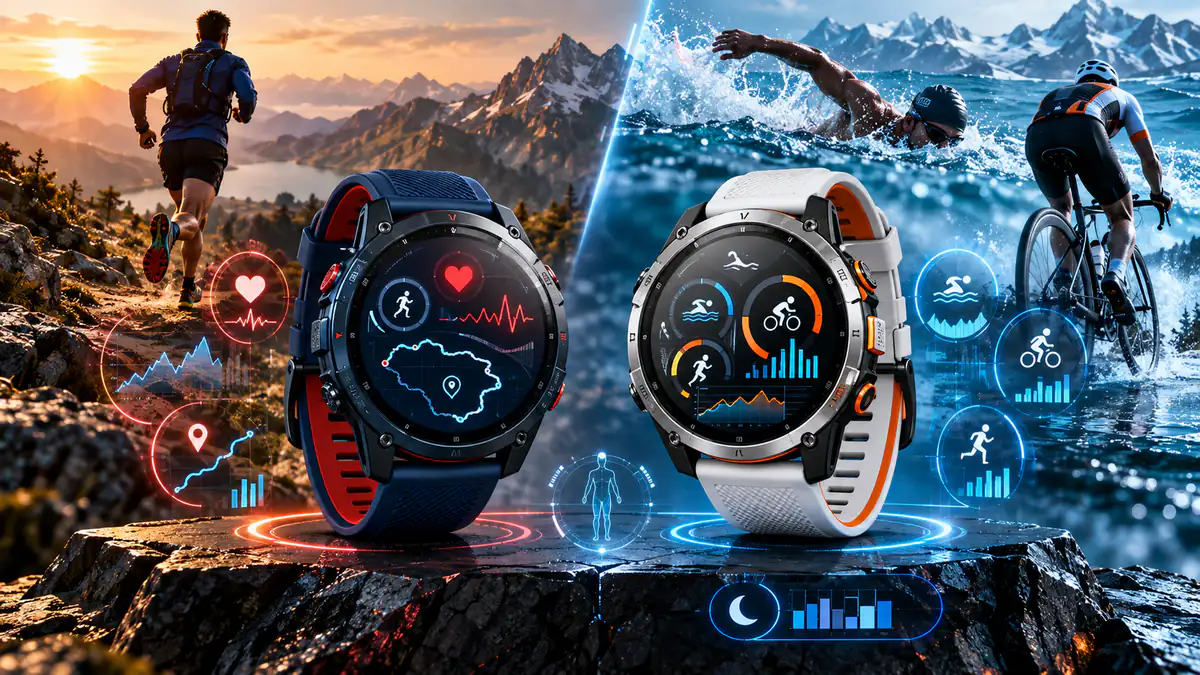
Garmin and Polar do not sell medical accuracy. They sell two complete training ecosystems, with no mandatory subscription and opposing philosophies: Garmin piles on features and covers every sport; Polar focuses on training load, recovery and aggressive value for money. To see how these watches compare with recovery rings and bands, see the guide to connected devices by the metric you want to measure.
The most suitable starting choice by use case, with moderate confidence:
| Your profile | Starting choice | Why |
|---|---|---|
| Running, triathlon, trail with navigation | Garmin Forerunner or fēnix | Mapping, multisport profiles and the broadest ecosystem |
| Running on a tight budget | Polar Pacer Pro or Ignite 3 | Advanced training tools from €210 to €340 |
| Clear training load and recovery data | Polar Vantage | Clear Training Load Pro and Nightly Recharge, wrist-based power |
| Ultras and extreme outdoor activities | Garmin with mapping or Polar Grit X2 Pro | Decide on exact GPS battery life and maps, not the brand |
| Gym and mixed sports | No automatic winner | Your wrist moves: plan for a chest strap or armband |
| One purchase for three years | Either works | Neither requires a subscription for the essentials |
The French prices below were recorded on 19 September 2026 on polar.com, except for Garmin prices recorded on 17 September in our Garmin and Apple Watch comparison. The Ignite 3 (Greige Sand) was rechecked on 13 October 2026 at €339.90 on polar.com/fr/ignite3; the €239.90 in that page’s carousel refers to the Ignite 2. Promotions and software features change quickly: check again before paying. For interpreting sleep and recovery scores, also read what wearables really measure · FR.
Buy Garmin Forerunner 970
Buy Polar Pacer Pro
Evidence chain
From sensor to score
- Measurement: optical signal, GPS position, acceleration
- Estimation: filtered heart rate, calories, sleep stages
- Proprietary score: training load, recovery, readiness, never a diagnosis
Two opposing philosophies
Garmin builds a Swiss Army knife: dozens of sport profiles, onboard mapping on high-end models, music storage depending on the model, payments and an app store. The trade-off is a sprawling range where two Forerunners priced €250 apart do not do the same things, and menus that can feel like a maze.
Polar builds a coach’s notebook: fewer models, clear ranges (Pacer for running, Ignite for everyday fitness, Vantage for performance, Grit for the outdoors), and the same analysis tools across almost the entire range. The trade-off is a narrower ecosystem: music controls but no storage on the watch, no payments and fewer third-party apps.
Neither sells an analysis subscription. Polar Flow, the web and mobile analysis tool, is free. Garmin offers an optional paid tier, Connect+, without locking away core training and recovery features. Over three years, the total cost therefore comes down to the purchase price plus any sensors, as detailed in our WHOOP and Garmin comparison · FR.
Heart rate and GPS accuracy: what validation studies show
At the wrist, both brands use the same physics: LEDs illuminate the skin, photodiodes track changes in blood volume, and an algorithm filters out movement. Independent validation studies compare watches with an ECG or a reference chest strap, and their conclusions apply to both brands.
A meta-analysis of 44 papers and 15 brands finds acceptable validity at rest, during sleep and on a treadmill, with a mean difference of less than one beat per minute. Things get worse when your wrist moves or tenses: around 7 bpm mean difference during strength training and 4 to 5 bpm when cycling, with errors increasing as intensity rises. In other words, your easy run is measured well; your thruster session, much less so.
The Polar studies illustrate the sensor hierarchy better than the brand hierarchy. Worn on the arm, the Verity Sense closely matches the H10 chest strap, with a bias of 0.05 bpm and a mean error of 1.35% across 9 activities. At the wrist, the Vantage V2 shows a bias of 2.56 bpm and an error of 6.8%, with reliability varying widely by activity. In adolescents doing HIIT, the Verity Sense maintains a mean error of 4 bpm compared with the H10. And in water, everything deteriorates: a mean difference of 13 to 56 bpm for wristwatches during swimming, with water and arm movements disrupting the signal.
Keep two limitations in mind. First, estimated energy expenditure is neither valid nor reliable at the wrist: errors of 19 to 28% depending on the devices tested, even when heart rate was accurate. Second, in real life, a Polar Vantage replaces neither a research accelerometer for activity nor a carefully maintained sleep diary, even when correlations are good.
For GPS, I found no recent independent comparison between the two brands’ current models. Official specifications list dual-frequency GPS on both sides in the mid-range and high-end segments, including Polar’s Vantage V3, Grit X2 Pro and Vantage M3. In practice, error increases in urban canyons, dense forests and tight turns, regardless of brand. The honest protocol is personal: run a known, measured route, compare the displayed distance, and repeat with the chest strap if you manage your pace to the nearest tenth of a kilometre.
To set your heart rate zones once you have chosen your watch, the principles behind setting zones on Garmin · FR also apply to Polar: personal thresholds, not default zones.
Training load, recovery and coaching: two readings of the same effort
This is where the brands differ most, and where scores become most misleading if you treat them as measurements.
With Polar, the breakdown is explicit. Training Load Pro separates cardiovascular, muscular and perceived load. Nightly Recharge combines sleep, autonomic nervous system activity and regulation to indicate whether you have recovered. Recovery Pro, Sleep Plus Stages, the orthostatic test and FitSpark, which suggests daily workouts, round out a coherent picture even on the Pacer Pro. Wrist-based running power is available across the entire current range, with no external sensor.
With Garmin, the picture is richer and more scattered. Training Status, acute load, recovery time, Training Readiness and Body Battery combine sleep, heart rate variability, stress history and recent load using proprietary formulas. The features exist, but their availability and presentation vary by model and generation.
None of these scores is a medical measurement, and none is validated as one. They are summaries of estimates: filtered heart rate, inferred sleep, calculated load. Two brands can show opposite colours after the same night because they do not combine the same time windows, personal baselines or weightings. The sensible approach is detailed in our investigation into wearable stress sensors · FR: raw signals first, colours second.
Mapping, music and connected features
For navigation, both brands offer offline maps on high-end models: Vantage V3 and Grit X2 Pro at Polar, with sapphire glass and military standard MIL-STD-810H for the Grit, plus route guidance with return-to-start navigation. The Vantage M3 brings colour topographic mapping down to €399.90. Check each model: neither Garmin nor Polar offers mapping across its entire range.
For music, the difference is clear and verified: Polar watches offer playback controls, not onboard storage. If running without a phone but with music is non-negotiable, this is a deal-breaker to check on the exact specification sheet of the Garmin model you are considering.
For durability, both brands list 50 m water resistance on mid-range models, with Polar listing 100 m on its high-end outdoor models. Neither turns your wrist into a swimming lab: validation studies show that water seriously degrades optical heart rate readings, and swimming metrics remain estimates with room for improvement.
App, chest strap and armband: the rest of the ecosystem
Polar Flow is enough and costs nothing: planning, training, activity and sleep tracking, without a subscription. Garmin Connect covers the same ground for free, with an optional Plus tier for additional features. In either case, stick with the same app for a full training cycle: changing ecosystems midway through a training plan creates an algorithmic break that masks your actual progress.
For accuracy, both brands sell the solution: the €99.90 Polar H10 chest strap serves as an ECG reference in validation studies, and the Verity Sense optical armband at the same price offers an alternative validated to within 1 to 4 bpm. This accessory makes the biggest difference to the quality of your zone-based training, well before your choice of watch. In strength training and short intervals, no wristwatch, Garmin or Polar, replaces this duo.
Battery life, durability and total cost across three budgets
Advertised battery life can only be compared in equivalent modes. The Vantage M3 claims 30 h in performance mode, 70 h in eco mode and 7 days in watch mode. The Vantage V3 claims up to 140 h of training in power-saving mode. At Garmin, the Forerunner 570 claims up to 18 h with GPS and the 970 up to 26 h. Always compare the exact model’s GPS mode, not watch mode, and halve the figure in winter with music and dual-frequency GPS.
Three-year cost, with no mandatory subscription on either side:
| Budget | Polar option | Garmin option | Recommended sensor |
|---|---|---|---|
| Around €210 to €340 | Pacer Pro at €209.94 or Ignite 3 at €339.90 | Entry-level Forerunner, check details | H10 or Verity Sense at €99.90 if zones matter |
| Around €400 to €500 | Vantage M3 at €399.90, mapping included | Forerunner 570 at €499.99 | Armband for the gym, chest strap for intervals |
| Around €600 to €750 | Vantage V3 at €599.90 or Grit X2 Pro at €749.90 | Forerunner 970 at €749.99 | Put the remaining budget into the sensor, not extras |
Polar prices recorded on 19 September 2026, except the Ignite 3 at €339.90, rechecked on 13 October 2026; Garmin prices recorded on 17 September 2026. For equivalent features, Polar is consistently around €100 cheaper in this snapshot: mapping at €399.90 versus a high-end Garmin at €749.99. The trade-off is in the ecosystem, not the sensors.
Which brand for running, cycling, triathlon or the gym
For road running, both work from 10 km to the marathon. Polar offers wrist-based power and clear tools from the entry level upwards. Garmin offers more advanced programmed workouts and richer tracking across multiple seasons. Mapping is often the deciding factor: essential for trail running, optional on marked roads.
For cycling and triathlon, Garmin retains the ecosystem advantage: more profiles, broader compatibility with power meters and indoor trainers, and well-established multisport transitions. Polar covers everyday needs, but check your sensors’ exact compatibility before changing brands.
For the gym, neither measures external load or counts repetitions reliably. Pick the cheaper one you like on your wrist, add a chest strap for metabolic circuits, and record your weights in a notebook. The notebook will drive your progress, not the score.
And what about Suunto? The Race and Vertical ranges exist and target trail running and outdoor activities, but this comparison sticks to Garmin and Polar to remain verifiable. Apply the same checklist to Suunto: dated pricing, mapping included or not, actual GPS battery life, a free app and chest strap compatibility.
The accuracy protocol below gives you a clearer answer for your own use than ten comparisons, with the watch you already own or one borrowed for a week.
Test on a measured 5 km route you know: run it twice at a steady pace, once with the watch alone and once with the chest strap paired. Record the difference in total distance, average and maximum heart rate, and the time to acquire a GPS fix at the start. Repeat the test with short intervals and, if you swim, in a pool. Keep the brand whose numbers vary least between repetitions, not the one whose error flatters you.
Stop rule: if differences exceed 5% for distance or an average of 5 bpm during steady efforts, look at the protocol or fit before blaming the brand. Tighten the strap one notch, position the watch higher on your forearm and repeat before drawing conclusions.
Buy Garmin Forerunner 970
Buy Polar Pacer Pro
Le Biohacker’s verdict
I’m not buying a logo or a score. I’m buying an ecosystem I’ll keep for three years, maps if I venture off the beaten track, and a chest strap if my zones determine my workouts.
For the same budget, Polar often offers more features for less money, with a crystal-clear view of training load. Garmin offers the most complete ecosystem, at the cost of a complex range and higher prices. Accuracy does not separate them: at the wrist, both brands share the same physics and limitations, and an external sensor makes the difference.
If you remember just one sentence: choose the ecosystem, check the mapping, and put the rest of your budget into a chest strap.