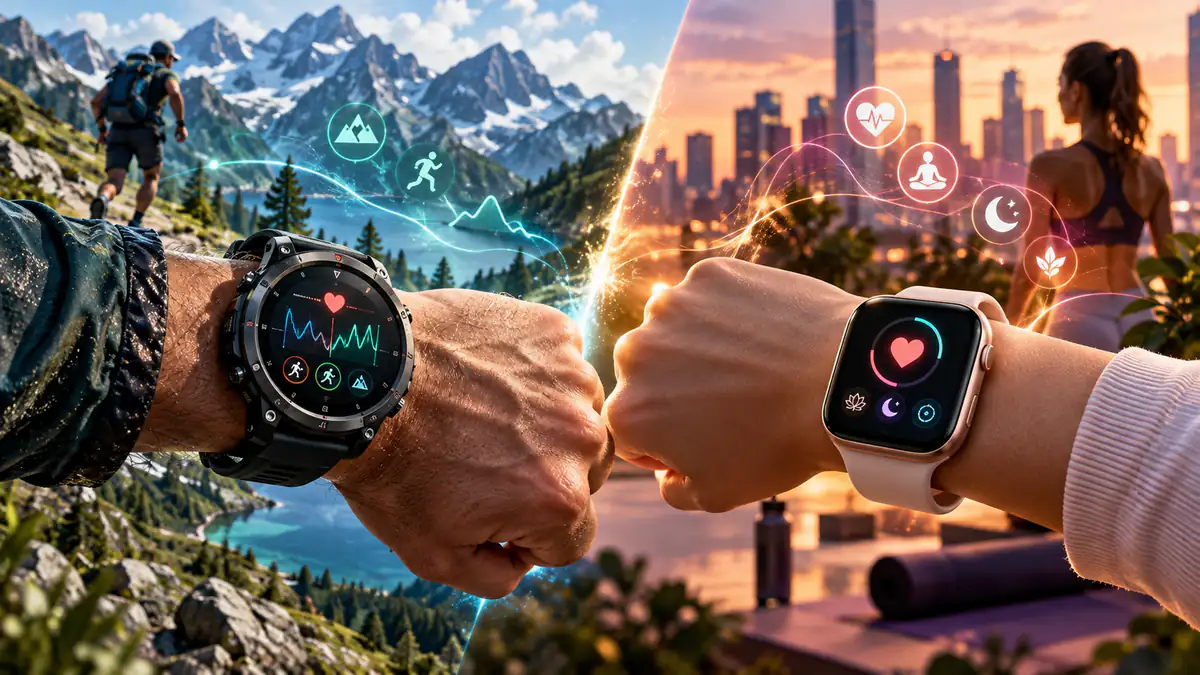
Choose Garmin if your watch’s main job is to guide training, last several days and work with Android or iPhone. Choose the Apple Watch if you own an iPhone and mainly want a seamless extension of your phone, with connected and health features taking center stage. For pure strength training or medical diagnosis, neither deserves a purchase based on its scores alone. To compare screen-free devices and rings too, see the general comparison of health and sports wearables.
The detail that really changes the choice isn’t the advertised accuracy. It’s the point at which the watch becomes useless. An Apple Watch without a compatible iPhone cannot get going as a personal ecosystem. A Garmin that runs out of battery halfway through an ultra loses its sporting advantage. And a sleep score, whatever the brand, remains an estimate.
This comparison therefore pits ecosystems against each other, not two arbitrary watch cases. French features and prices were checked on September 17, 2026. Apple had just announced the Series 12 and Ultra 4, still listed for preorder on its French page. The Ultra 4’s starting price was checked again on October 13, 2026, on the Apple Store France: from €800. Models, promotions and regulated features will need to be checked again at checkout.
A 30-second verdict for five profiles
Here is the most sensible choice by main use:
| Your profile | Starting choice | Why | Caveat to check |
|---|---|---|---|
| Runner, cyclist or triathlete with structured training | Garmin Forerunner | Buttons, workouts, load, recovery and battery life geared toward sport | Mapping depends on the model |
| Trail runner, hiker or ultra athlete | Garmin with mapping | Navigation, multisport profiles and less frequent charging | Compare exact GPS battery life, not watch mode |
| iPhone user wanting an everyday watch | Apple Watch | Apps, calls, payments, safety and Health integration | Incompatible with Android |
| Someone interested in wrist ECG | Apple Watch Series or Ultra | Single-lead ECG and supported rhythm notifications | The SE 3 has no ECG app, and no result establishes a diagnosis |
| Strength training, CrossFit or intermittent sport | No automatic winner | The wrist moves, and external load and repetitions remain imperfectly captured | Test comfort and use a training log |
Garmin isn’t a single watch. A €499.99 Forerunner 570 and a €749.99 Forerunner 970 do not offer the same navigation. At Apple, the SE 3 starts at €269, the Series 12 at €449 and the Ultra 4 from €800. Comparing “Garmin” with “Apple Watch” without specifying your sport and budget is therefore like comparing two entire store aisles.
Buy Garmin Forerunner 970
Buy Apple Watch Ultra 3
Sensors and data: what is measured or estimated
Both families use an optical wrist sensor. LEDs and photodiodes track changes in blood volume to estimate heart rate. An accelerometer, gyroscope, altimeter and satellite receiver add movement, elevation change and position, depending on the model.
The data layers are not equivalent:
- GNSS position and the optical signal are instrumental observations with a margin of error
- heart rate is calculated from the filtered optical signal
- HRV depends on the intervals retained, filtering and the chosen time window
- sleep stages, calories, VO2 max, load and recovery are algorithmic estimates
- a final score combines several estimates using a proprietary formula
Good resting heart-rate accuracy therefore validates neither calories, deep sleep nor a workout recommendation. The living review published in 2026 on the Apple Watch included 82 studies and 430,052 participants. It found a low average heart-rate bias, but limits of agreement of approximately −7.19 to +6.64 bpm, moderate accuracy for sleep and steps, and often substantial errors in energy expenditure. This result helps put Apple Watch use in perspective, without establishing that it beats every current Garmin.
A 2026 validation study involving 45 adults also illustrates the problem with ranking by brand. Among other devices, it tested the Apple Watch SE, Garmin Vivosmart 5 and Vivoactive 5 against an ECG reference across several temperatures and activities. Errors varied by device and increased during intermittent walking for several models. Findings for these models do not automatically extend to the Series 12, Ultra 4, Forerunner 570 or 970.
For intervals where an error of a few beats changes the session, connect a compatible chest strap. For resting trends, keep the same watch and placement. Switching brands halfway through a training cycle can create an algorithmic discontinuity larger than your physiological change.
Running, strength training and multisport: the real advantages
Running, cycling, triathlon and trail running
Garmin retains the functional advantage for structured endurance training. Profiles, physical buttons, data fields, programmed workouts, recovery times and load metrics are designed to be checked before, during and after exercise. The Forerunner 970 adds more advanced map-based navigation, while the 570 focuses primarily on running and courses.
The Apple Watch isn’t a bad sports watch. It records GPS, pace, zones, laps and multisport workouts. The Ultra 4 adds dual-frequency GPS and a claimed battery life longer than the Series 12’s. It becomes a sensible choice if you want one watch for running, making calls and using your iPhone apps.
The difference is mainly in the depth of built-in features. Garmin builds the experience around the training plan. Apple builds its experience around watchOS, then lets specialist apps fill more advanced needs. If your use requires a paid app on Apple, add it to the total cost.
Strength training and CrossFit
No watch automatically knows the load on the bar, range of motion, proximity to failure or quality of technique. An elevated heart rate after squats does not measure mechanical tension in the quadriceps. The load score then underestimates some of the muscular work or translates it into cardiovascular strain.
Garmin can count repetitions and record sets in supported profiles. Apple offers strength workouts and numerous third-party apps. In both cases, a log with exercise, load, sets, repetitions and perceived difficulty remains more informative for making progress. Wrist movements, kettlebells and tight grips can also disrupt the sensor or make the watch uncomfortable.
Sleep, recovery and health features
Garmin turns recovery into several tools, including HRV Status, recovery time, Body Battery and Training Readiness on supported models. Apple displays sleep, Vitals, training load and, on newer supported models, recovery HRV. Garmin generally provides more built-in sporting context. Apple concentrates more data in the Health app.
Do not compare their scores point by point. Apple Health notably stores SDNN samples, while Garmin uses nighttime RMSSD for its HRV Status. Windows, operational units and aggregations differ. To interpret this data correctly, the guide to nighttime HRV explains why an Apple value cannot be transferred to a Garmin reference.
The available direct validation remains dated. In 2022, 53 healthy young adults wore an Apple Watch Series 6 and a Garmin Forerunner 245 Music for one night in a laboratory. Sleep-versus-wake agreement reached 88% for Apple and 89% for Garmin, but agreement on wakefulness and sleep stages fell to 53% and 50%. Another study published in 2025 found only low-to-moderate agreement with polysomnography for six wearables, although the Apple Watch Series 8 had the highest kappa in the tested group.
The useful conclusion is limited: both can track sleep timing and duration over several nights, but neither should dictate your sleep needs minute by minute. The meta-analysis of 24 studies and 798 participants published in 2025 found significant differences between wearables and polysomnography for total sleep time, efficiency, latency and wake after sleep onset. Read the guide to watch reliability for sleep tracking · FR before optimizing a single stage.
Medical features: check the model and country
In France, the Apple Watch Series 12 and Ultra 4 offer an ECG app, irregular rhythm notifications and other health features subject to age, model and availability requirements. The SE 3 has no ECG app. Apple’s ECG is a single-lead recording intended, among other things, to look for signs of atrial fibrillation, not a medical 12-lead ECG.
In the 2026 living review, Apple Watch atrial fibrillation detection was more specific than sensitive, with pooled specificity of 0.91 and sensitivity of 0.79. The absence of an alert therefore does not rule out a disorder. Chest pain, feeling unwell, unusual shortness of breath or persistent palpitations warrant medical advice, whatever the screen says.
Some Garmin watches also offer an ECG in specific countries and on specific models. This is not a uniform capability across the range. Check the exact combination of model, region and software rather than the logo.
Battery life, phone, privacy and cost over two years
Battery life is the least ambiguous criterion, but manufacturers do not always use the same scenario. Apple claims up to 24 h of general use for the Series 12, 18 h for the SE 3 and 50 h for the Ultra 4. Garmin claims up to 18 h of GPS for the Forerunner 570 and up to 26 h of GPS for the 970. In watch mode, Garmin battery life is generally measured in days, depending on the display, SpO2, GPS, music and notifications.
Do not compare “24 h Apple” with “26 h GPS Garmin” as if they were identical measurements. Instead, ask whether the watch survives your real scenario: a night’s sleep, a normal day, then your longest session without recharging in between.
Compatibility may settle the choice before anything else. The Apple Watch Series 12, Ultra 4 and SE 3 require an iPhone 11 or later running iOS 27 or later. Garmin Connect is available on iOS and Android. However, some message replies and integrations vary with the phone.
For privacy, both ecosystems require an account, sync data and allow third-party integrations. Apple states that the user controls which data enters Health and which apps or people can read it. Garmin publishes a dedicated Connect policy. No brand promise replaces your settings. Turn off unnecessary permissions, enable strong authentication, limit integrations and test data export. The guide to wearable health data · FR provides the full checklist.
French prices recorded on September 17, 2026, except for the Ultra 4’s starting price, checked again on October 13, 2026, give the following hardware cost over two years:
| Representative model | Starting or list price | Hardware cost over 2 years | What is not included |
|---|---|---|---|
| Apple Watch SE 3 | €269 | €269 | Cellular option, carrier plan, paid apps |
| Apple Watch Series 12 | €449 | €449 | Finish, Cellular, plan and apps |
| Apple Watch Ultra 4 | From €800 | €800 | Apps and any accessories |
| Garmin Forerunner 570 | €499.99 | €499.99 | Chest strap, optional Connect+, accessories |
| Garmin Forerunner 970 | €749.99 | €749.99 | Chest strap, optional Connect+, accessories |
Garmin also displayed promotional prices of €469.99 and €649.99 on the day prices were recorded. I keep list prices in the calculation because a temporary discount does not describe the cost available in 30 days. No mandatory subscription is added. A degraded battery, damage or a change of phone can obviously alter the total.
Buy Garmin Forerunner 970
Buy Apple Watch Ultra 3
Decision matrix and pre-purchase trial protocol
Buying decision
The filter that quickly rules out the wrong ecosystem
The current Apple Watch requires a compatible iPhone.
Both ecosystems remain options.
Prioritize workouts, navigation and less frequent charging.
Prioritize apps, communication and compatible Health features.
A training log may offer more value than a new score.
Choose a medical assessment rather than an ecosystem.
Before keeping a watch, run a 14-day trial if the seller allows returns. The protocol is as follows:
- Write down a single decision you want it to support, such as following an interval workout, navigating a trail run or tracking bedtime.
- Wear the watch for three nights and during your three most frequent types of workout.
- Before opening the app, note your perceived sleep, fatigue and any pain.
- Check data gaps, comfort, readability, battery life and the number of decisions actually changed.
- For exercise heart rate, compare two sessions against a chest strap, not a second watch.
- After 14 days, keep the device only if its benefit outweighs charging, notifications and analysis time.
Stop tracking a score if it increases anxiety, delays bedtime or pushes you to systematically cancel sessions despite reassuring body signals. The article on counterproductive health tracking · FR provides thresholds for regaining control.
Independent verdict
Garmin wins for endurance sport, navigation, integrated recovery and battery life. Apple Watch wins for iPhone, apps, communications and supported health features. There is no proven accuracy winner across all metrics and all generations.
If you’re still undecided, stop comparing marketing scores. Choose your phone first, then your most demanding workout, and finally how often you’re willing to recharge. The best buy is the watch that survives these three filters without turning an estimate into a medical verdict.