The short answer
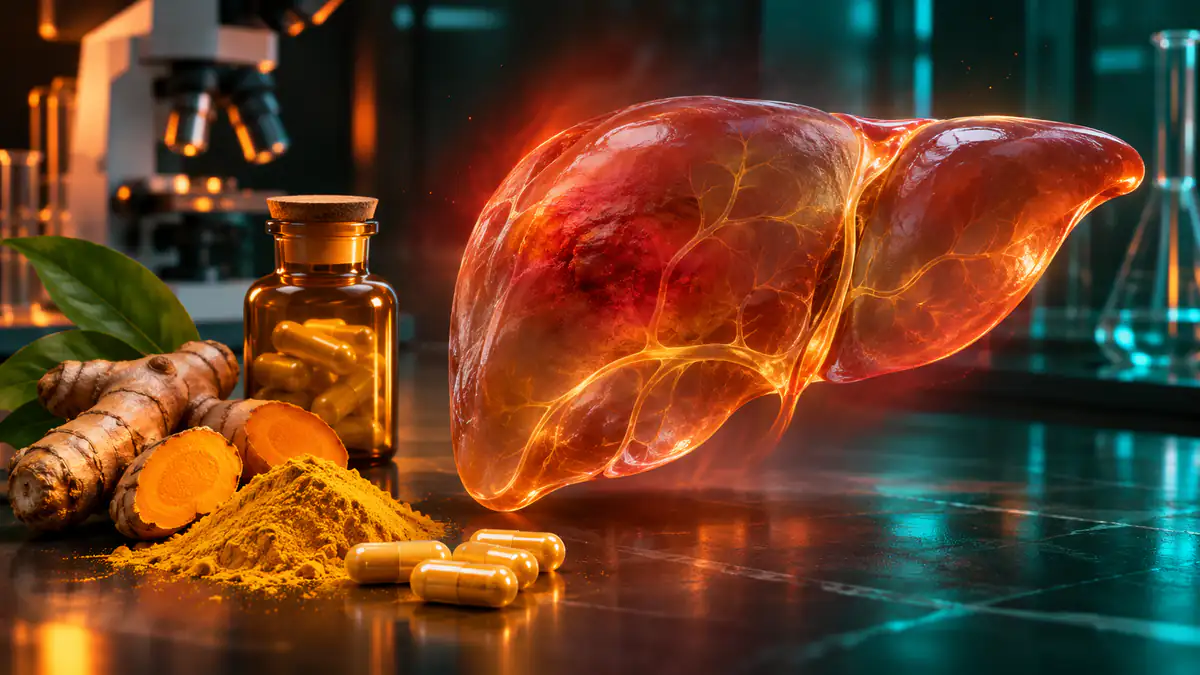
Yes, turmeric supplements can cause hepatitis. It’s rare—around one case per 10,000 to 100,000 people exposed, according to the US LiverTox database—but it is now a well-documented cause. In the United States, turmeric even appears to have become the leading cause of herb-related liver injury.
The irony is hard to beat for a spice sold for years as a way to “detox” the liver.
Culinary turmeric is not implicated. The risk concerns capsules, especially at high doses and in “boosted” formulations—with piperine, phytosomes, micelles or nanoparticles—that increase absorption manyfold. French, Italian, US and Australian agencies have reached the same conclusion by different routes.
Meanwhile, the best-studied benefit remains modest. A Cochrane review published on November 19, 2026 finds that, in knee osteoarthritis, the average reduction in pain is less than half the change a patient can perceive.
What ANSES found in France
In June 2019, the French Agency for Food, Environmental and Occupational Health & Safety (ANSES) took up the issue on its own initiative. Its May 2022 opinion starts with a market finding: more than 1,600 turmeric or curcumin products were notified to the authorities between May 2016 and March 2021.
Its nutrivigilance system, which collects reports of adverse effects from supplements, received 120 reports between 2009 and August 2021. The agency analyzed 67 of them and identified:
- 15 cases of liver injury, including 7 cases of cytolytic hepatitis, which destroys liver cells, one case of cholestatic hepatitis, which blocks bile flow, and 5 mixed cases
- a link considered highly likely in 2 cases, likely in 7 and possible in 4
- one severe case, which was life-threatening
- 64% women, with a median age of 55 years
The dose breakdown is the most telling part. For the 31 cases where it was known, the curcumin dose ranged from 9 mg to 1.2 g per day, with a median of 163 mg. In 21 cases, the product was an enhanced-absorption formulation, including 17 with black pepper. By comparison, ANSES estimates that even the highest consumers of turmeric-containing foods do not exceed 27 mg of curcumin per day. Your Sunday curry is nothing like a daily capsule.
ANSES also reiterates the acceptable daily intake set by international experts and EFSA: 3 mg of curcumin per kilogram of body weight per day, or 180 mg for a 60 kg adult. To leave room for dietary intake, it recommends that supplements provide less than 153 mg per day. But it adds a crucial caveat: this dose was established using conventional curcumin, and it does not apply to enhanced-absorption formulations.
In Italy, a series of 28 hepatitis cases
The clearest signal came from Italy. Between November 2018 and June 2019, the Italian phytovigilance system received 28 reports of acute hepatitis, mostly cholestatic, following the use of turmeric supplements. The Italian National Institute of Health analysed them in detail :
- 86% women, with a median age of 55 years
- 89% of people hospitalized
- 67% of cases with high-dose curcumin combined with piperine
- use lasting 8 days to 8 months, with a median of 2 months
- a link considered probable in 61% of cases, and possible in 36%
- doses exceeding the European reference level by a factor of 1.6 to 7 in two out of three cases
Tests found no contaminants, according to the Italian Ministry of Health. One clue remains troubling: around 60% of samples did not contain the two minor curcuminoids found in the root, suggesting synthetic curcumin rather than a plant extract.
Italy responded through labeling. Since January 1, 2020, these supplements have been required to carry a warning. A July 2022 decree reinforced it: the product is not recommended for people with liver or bile duct disorders, or gallstones, and should not be used during pregnancy or breastfeeding, or for long periods without medical advice. The ministry describes the mechanism as likely idiosyncratic: an unpredictable reaction specific to certain people, rather than toxicity that would affect everyone above a certain dose.
In Tuscany, another team described 7 cases, all involving high-dose, high-bioavailability formulations, and identified 23 cases already published worldwide.
United States and Australia: a now-established risk
In the United States, DILIN, the network studying drug-induced liver injury, published a series of 10 cases in 2023 linked to turmeric, all enrolled since 2011, including 6 since 2017:
- 8 women, with a median age of 56
- 9 out of 10 liver injuries were hepatocellular, destroying liver cells
- 5 hospitalizations and 1 death from acute liver failure
- turmeric confirmed in all 7 products analyzed, with piperine in 3
- symptoms appeared after 1 to 4 months
The LiverTox entry from the US National Institutes of Health, updated in June 2025, gives turmeric a likelihood score of A, reserved for well-documented causes of liver injury. It estimates the frequency at between 1 in 10,000 and 1 in 100,000 people exposed. Recovery generally occurs within 1 to 3 months after stopping, and the product must never be taken again.
In August 2023, Australia’s medicines regulator, the TGA, issued its own warning. Of 18 reports, 9 suggested liver injury caused by the product. In 4 of those cases, no other ingredient could have been responsible, and 2 were serious, including 1 fatal case. The TGA considers that the risk may be higher with enhanced-absorption formulations and high doses, and sees no apparent risk at usual dietary amounts.
A genetic clue
The most intriguing finding from the US case series is genetic. Seven of the ten patients carried a variant of an immune system gene, HLA-B*35:01. According to LiverTox, it is found in more than 70% of cases, compared with 10–15% of controls.
This association points to an immune reaction specific to certain people, which could explain cases occurring at very different doses. It still cannot tell you in advance whether you are at risk: the variant is carried by 10–15% of controls, the vast majority of whom will never develop hepatitis.
Why “boosted” forms are on the front line
Conventional curcumin is poorly absorbed. That is why the industry has been racing to multiply absorption, a topic covered in detail in the article on bioavailable curcumin. ANSES lists these forms: curcumin combined with piperine or turmeric essential oil, phytosomes, micelles, nanoparticles, and cyclodextrins. It reports their bioavailability as 4 to 185 times higher.
The problem is arithmetic. If a formulation is absorbed 20 times better, a 150 mg capsule can produce the same exposure in the bloodstream as 3 g of conventional curcumin. The label rarely mentions this, ANSES notes, leaving you at risk of unknowingly taking a potentially toxic dose.
This is Mitochondria Marketing applied to the liver: a real biological mechanism used to sell an unproven benefit. The increased absorption is real. The additional clinical benefit, however, is unproven, and the risk rises with exposure.
Piperine: a booster that also affects medications
Piperine, the pungent compound in black pepper, is the most widely used booster. ANSES cites an older study in which 20 mg of piperine increased the absorption of 2 g of curcumin twentyfold. The same mechanism applies to other compounds. In laboratory studies, piperine inhibits CYP3A4 and P-glycoprotein, an enzyme and a pump that clear a large proportion of medications. ANSES adds two other elimination pathways: CYP2D6 and glucuronidation.
There is a safety signal involving anticoagulants, though it remains weak. In France, a 56-year-old woman taking fluindione, a vitamin K antagonist anticoagulant, saw her INR, a measure of blood clotting, rise from a range of 2–3 to 6.5 after 5 days of taking 2.5 g of turmeric per day, with no bleeding. By contrast, a small 2018 trial found no change in INR with 1 g per day of a phytosome formulation for 10 days in 14 patients taking warfarin. ANSES advises against taking turmeric without medical advice if you are taking anticoagulants, anticancer drugs or immunosuppressants.
63 recalls in France, but not because of liver concerns
The dietary supplement recall observatory lists 63 recalls of supplements containing turmeric, covering 31 brands. None concerns the liver: all are due to ethylene oxide, a pesticide banned in Europe:
- 61 recalls published in 2021 and 2 in 2022, between May 2021 and May 2022
- 11 mandated by prefectural order, the others voluntary
- 18% of the 354 recalls linked to ethylene oxide in the observatory
Several fact sheets specify that the contamination came from the black pepper extract added to the product, not the turmeric. The booster meant to improve absorption sometimes brought the contaminant with it. The article on ethylene oxide in supplements explains why this wave was so widespread.
Turmeric as a spice has its own problem: lead
Another risk mainly concerns turmeric powder sold as a spice. In Bangladesh, researchers showed in 2019 that lead chromate, a yellow pigment, was being added to turmeric in 7 of the 9 major producing districts, with up to 1,152 µg of lead per gram of powder. Following an enforcement campaign, the proportion of contaminated market samples fell from 47% to 0% between 2019 and 2021. A 2024 investigation still found lead in 14% of 356 samples collected in India, Pakistan, Sri Lanka and Nepal.
US authorities have been detaining turmeric from a Bangladeshi exporter at the border without examination since 2014 because of lead. Unusually bright yellow turmeric bought outside regulated channels therefore warrants suspicion.
The benefit side of the equation: a brand-new Cochrane review
To assess a risk, you need to look at the benefit. The best-studied benefit concerns knee osteoarthritis. The Cochrane review published on November 19, 2026 included 9 trials and 1,245 participants, with treatments lasting no more than 90 days:
- pain decreases by 0.72 points on a 10-point scale compared with placebo, while the threshold for a patient to notice a difference is 1.5 points
- function and quality of life change little or not at all
- the level of evidence is low, and very low for adverse effects
In other words, turmeric may provide a little relief, but on average, not enough for a patient to notice, and for no more than three months. Claims about inflammation, brain health or longevity rest on even shakier evidence.
If you take it
Turmeric used in cooking poses no known problem. For capsules, a few rules can limit the risk:
- read the curcumin dose, not the fresh-root or powder equivalent printed in big letters on the box
- with a standard formulation, stay below 153 mg of curcumin per day for a 60 kg person, the ANSES threshold
- with an enhanced formulation, using piperine, black pepper, phytosomes, micelles or nanoparticles, be aware that no safe dose has been established
- don’t stack them several supplements containing turmeric or piperine, as advised by ANSES
- keep an eye out during the first few months: liver injury generally appears between 1 and 4 months after starting use
- mention it to your doctor and pharmacist, especially before starting a new treatment
Avoid use if you have bile duct disease or gallstones, during pregnancy or breastfeeding, or if you have current or past liver disease. On this last point, ANSES does not issue a specific warning, but the Australian agency advises against it, as does the Italian label in cases of liver injury. When in doubt, caution wins. For other ways to protect your liver, the guide taking care of your liver · FR details what really helps.
Signs that mean you should stop taking it
Hepatitis caused by turmeric often starts quietly, with fatigue, nausea and loss of appetite, before dark urine and jaundice appear, according to LiverTox. The TGA advises stopping the product and seeking medical advice promptly if you experience:
- yellowing of the skin or whites of the eyes
- dark urine
- nausea or vomiting
- unusual fatigue or weakness
- abdominal pain
- loss of appetite
Bring the packaging to your doctor, and never take the product again after liver injury. You can also report the adverse effect through the official reporting portal, which feeds into ANSES’s nutrivigilance system. Other supplements that carry this risk, such as green tea extract or certain weight-loss products, are covered in the article on supplements and the liver · FR.