The short answer
Milk thistle is one of the best-known supplements “for the liver.” Yet trials show no benefit for survival, complications, or the liver’s condition on biopsy, whether in hepatitis, cirrhosis, or fatty liver disease. The only consistent effect is a small reduction in transaminases, with very low-certainty evidence.
The good news is that it is very safe. The bad news is that a safe but ineffective plant takes the place of what works: less alcohol, less belly fat, and a medical checkup.
Its only real place in medicine is in the hospital: an injectable derivative, silibinin, is used to treat death cap mushroom poisoning. Nothing to do with your morning capsule.
Where its reputation comes from
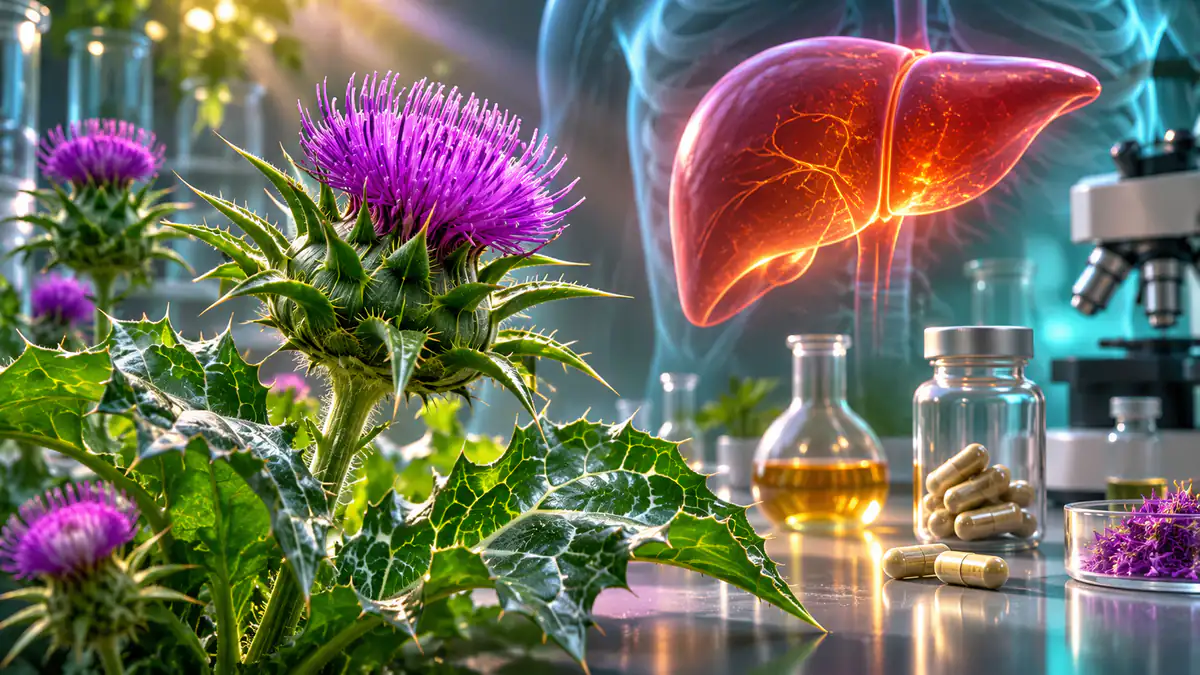
Milk thistle, Silybum marianum, is a plant in the Asteraceae family. Its fruits contain a mixture of compounds called silymarin, the main one being silibinin. It has been used for centuries for digestive and liver problems, and is credited with antioxidant properties, mainly on the basis of laboratory studies.
It is an appealing story, and that is exactly the problem. A compound that protects cells in a culture dish does not necessarily protect a human liver. To find out, you need trials in patients—and there are plenty.
What the trials show
Hepatitis and alcohol: the Cochrane review
The 2007 Cochrane review brought together 18 randomized trials and 1,088 patients with liver disease related to alcohol or hepatitis B or C viruses. Its findings are clear:
- no effect on mortality from any cause
- no effect on complications of the disease
- no effect on biopsy findings in the liver
- no more side effects than placebo
A signal emerges for liver-related mortality when all trials are included, but disappears in good-quality trials. Only 28.6% of the trials had the characteristics of good quality. The authors conclude that the benefit is called into question.
Hepatitis C: an unambiguous US trial
In 2012, a trial published in JAMA tested silymarin in 154 patients with chronic hepatitis C whose treatment had failed. They received 420 mg, 700 mg, or a placebo three times a day for 24 weeks. The primary outcome, normalization or a substantial reduction in transaminases, was reached by only 2 patients in each group, about 4%, including placebo. There was no effect on viral load or quality of life either.
This was one of two trials funded by the US agency for complementary medicine, NCCIH. Both were negative, its fact sheet summarizes.
Cirrhosis: one positive trial, then a negative one
The main historical argument comes from an Austrian trial from 1989 in 170 patients with cirrhosis: 4-year survival was 58% with silymarin versus 39% with placebo, particularly in alcohol-related cirrhosis.
Nine years later, a Spanish trial sought to confirm this in 200 patients with alcohol-related cirrhosis. The result: 15 deaths with silymarin, 14 with placebo, and no effect on disease progression. A positive trial followed by a larger negative trial is rarely a sign of a robust effect.
Fatty liver: transaminases, not a repaired liver
Metabolic fatty liver disease, or steatosis, is now the main reason people buy milk thistle. Trials in its inflammatory form, steatohepatitis, are disappointing:
- a 2019 US trial in 78 patients, over 48 weeks: improvement in the activity score in 15% and 19% of patients taking silymarin, depending on the dose, versus 12% with placebo, a non-significant difference, and fibrosis improved slightly more with placebo
- a 2017 Malaysian trial in 99 patients, over 48 weeks: primary outcome negative, 32.7% responders versus 26.0%, with a signal for fibrosis as a secondary outcome that the authors say needs confirmation
The most recent synthesis is a 2025 Cochrane review of 17 trials and 2,069 adults with metabolic fatty liver disease. Silymarin alone lowered ALT, a transaminase, by about 7 units per liter compared with placebo, with very low certainty. Combined with other ingredients, such as vitamin E or phosphatidylcholine, it did no better than placebo. No trial reported mortality or quality of life. The authors consider the benefits and risks uncertain.
A small drop in a transaminase does not prove the liver is healthier. It is a blood test number, not an outcome that matters to the patient.
What Europe actually recognizes
The European Medicines Agency monograph (EMA), adopted in 2018, is revealing. The “well-established use” column, for plants with demonstrated efficacy, is empty. Only traditional use is recognized, based on longstanding use:
- relief of digestive disorders, such as a feeling of fullness and indigestion
- support of liver function, after a doctor has ruled out serious disease
Even that wording was not unanimous. According to the committee’s opinion, adopted by 21 votes out of 25, the British and Irish members argued that “supporting liver function” is not a recognized medical indication. In 2023, the EMA reviewed 427 new publications and found nothing to justify revising its text.
In France, milk thistle—its above-ground parts and fruit—is permitted in food supplements without specific restrictions under the order of June 24, 2014. A medicine also exists on paper: Légalon 70 mg, authorized since 1989 for “functional digestive disorders observed in liver diseases.” The public database lists it as not marketed.
A safe plant, at least
On safety, the data are reassuring. The LiverTox fact sheet from the US National Institutes of Health gives it a rating of E, the category for products never implicated in liver injury. According to the EMA and NCCIH, side effects remain mild:
- digestive problems : bloating, nausea, gas
- headaches
- allergies, sometimes severe, particularly in people allergic to Asteraceae plants, such as ragweed, chrysanthemums, marigolds, or daisies
Drug interactions appear limited. Several studies in volunteers found no notable effect on the main enzymes that break down medicines. One study showed increased exposure to losartan, a blood pressure medication, in some volunteers. LiverTox reports little evidence of clinically significant interactions. Telling your pharmacist is still a good habit.
The EMA advises against milk thistle under 18, during pregnancy, and while breastfeeding, due to a lack of data. A few small studies suggest an effect on blood sugar in type 2 diabetes, notes NCCIH, but do not allow a conclusion.
Its only real use: death cap poisoning, in the hospital
There is one area where a milk thistle derivative has a real medical role: poisoning by the death cap, one of Europe’s most dangerous mushrooms. Injectable silibinin is used in hospitals for this.
In France, Legalon SIL 350 mg is supplied under an ANSM compassionate access authorization, for hospital use only, for confirmed or suspected poisoning by death caps or deadly dapperlings. It is administered by infusion four times a day, at a dose calculated by body weight.
The evidence remains at the level of case series. A review of 877 published cases found 90% survival with silibinin versus 59% with supportive care alone. But the difference disappeared when only confirmed poisonings were included, and published cases are not an unbiased sample. There are no controlled trials, LiverTox points out.
Above all, this is neither a supplement nor prevention. A milk thistle capsule before mushroom picking will not protect you from anything. If you have any doubts after a mushroom meal, call 15 in France or a poison control center without waiting; for emergencies, call 911 in the United States, 999 in the UK, 112 in the EU, or your local emergency number in other countries.
9 recalls, including a wave involving pesticides
The food supplement recall observatory lists 9 recalls of milk thistle supplements across 9 brands:
- 7 for pesticides in 2023, including 6 published in March
- 2 for ethylene oxide in 2021, one of which came from an added raw material, bamboo, rather than the plant itself
The November 2023 notice names the pesticide involved: chlorpyrifos. The European Union did not renew its authorization in 2020, under Implementing Regulation 2020/18. It then lowered its maximum residue limits to the detection threshold, 0.01 mg per kilogram, based on EFSA’s assessment: the compound is toxic to children’s brain development.
The March 2023 recalls were part of a broader wave. Between mid-February and late April 2023, the observatory recorded 66 supplement recalls for pesticides across 41 brands. Five of the seven brands that recalled milk thistle for this reason also recalled St. John’s wort, within days of each other. On April 4, a supplement simply called “Foie” was recalled for the presence of two pesticides. NCCIH also flags this: milk thistle products can be contaminated with pesticides, microbes, or molds.
Your liver does not need a detox
Milk thistle is often sold as a “detox course,” after the holidays or in spring. The idea assumes that the liver accumulates toxins that a plant could flush out. A 2015 critical review of detox programs found no randomized trials showing that a commercial product removes toxins in humans. Hepatologists at Johns Hopkins Hospital do not recommend liver cleanses.
This is the Pill Cupboard in all its glory: piling up supplements without knowing which one does what. One capsule for the liver, another to keep you regular, a third to “flush things out.” What the liver mainly wants is less work. The measures with proven benefits are detailed in the guide taking care of your liver · FR and, for fatty liver disease, in the article on hepatic steatosis · FR :
- cut back on alcohol, or stop drinking if your liver is already affected
- lose weight if you are overweight, particularly belly fat
- get vaccinated against hepatitis B, and get tested for viral hepatitis if you are at risk
- be wary of supplements that can themselves damage the liver, such as turmeric capsules at high doses or green tea extract
One practical detail matters: if your transaminases are elevated, adding milk thistle can muddy the investigation. The article on supplements that pose a risk of hepatitis · FR recommends stopping nonessential products, not adding another one.
When to seek medical advice
Milk thistle must never delay a diagnosis. The EMA itself sets the limits of self-medication:
- seek medical attention immediately if you develop jaundice, meaning yellowing of the skin or the whites of the eyes
- see a doctor if your digestive symptoms last more than 2 weeks
- ask for a medical assessment if a blood test shows elevated transaminases, rather than starting a course of supplements
- call 15 in France or a poison control center (for emergencies: 911 in the United States, 999 in the UK, 112 in the EU, or your local emergency number in other countries) after a suspect mushroom meal, even without symptoms