The short answer
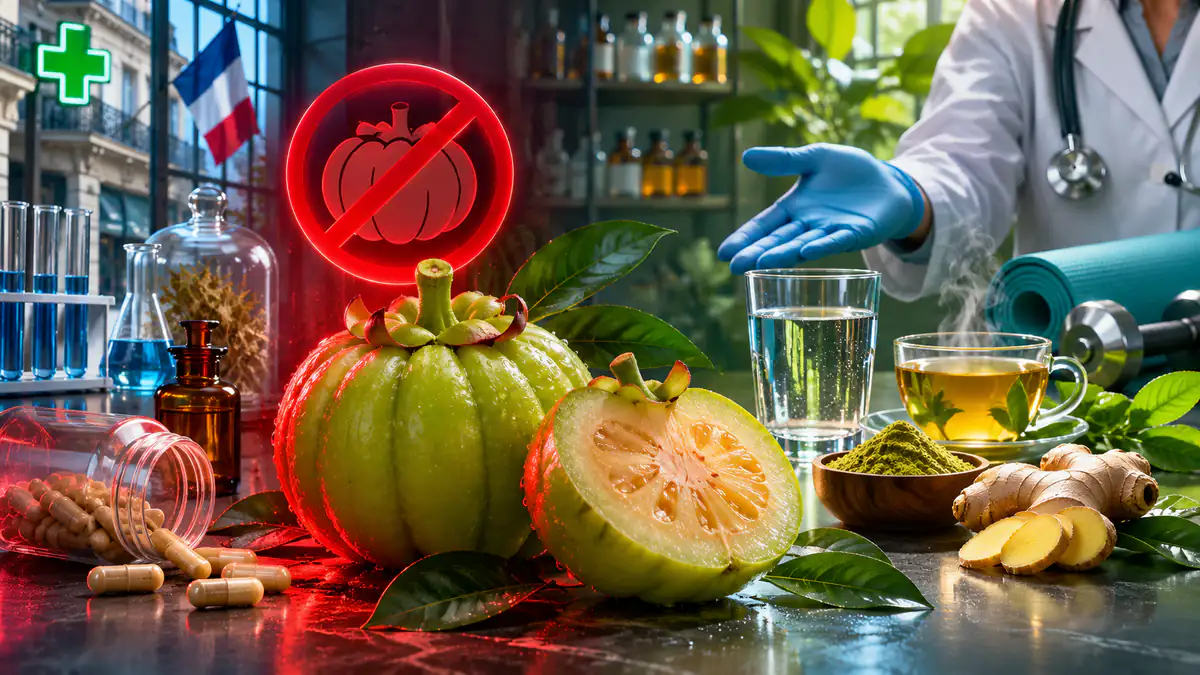
Yes, garcinia cambogia is banned in dietary supplements in France. Sales have been suspended since April 18, 2025, and the suspension has been renewed until April 18, 2027. The reason: acute hepatitis, rare but sometimes severe, and other adverse effects reported by Anses, including in healthy people.
Set against this risk, the benefit is almost nonexistent. Trials find, at best, a one-kilogram difference compared with placebo, and nothing robust when only the best trials are included.
If you still have a box in a cupboard, stop taking it. This is one of the rare times when the decision is simple.
What the order actually says
The order dated April 15, 2025, published in the Journal officiel on April 17, suspends for one year “the import, introduction and placing on the market, whether free of charge or for payment” of dietary supplements containing the plant Garcinia cambogia, also known as Garcinia gummi-gutta, and all preparations derived from its parts.
Three points matter to you:
- the scope is broad: powder, extract, blends with other plants—the form makes no difference, as long as garcinia is an ingredient
- products must be taken off the shelves and recalled from consumers who have them, at the companies’ expense
- free distribution is covered too: samples and gifts fall under the suspension
The order is based on an Anses assessment concluding that there is an acute risk, both in people with medical histories and in healthy people. It notes that a European procedure was underway, with no conclusion at the time.
The suspension was renewed by an order dated April 16, 2026, for one year from April 18, 2026. Vidal concluded that it runs until April 18, 2027.
One historical detail sheds light on the issue. Back in 2012, Afssaps had banned garcinia in pharmacy-compounded preparations, including homeopathic ones, considering that it met the definition of a medicine because of its hydroxycitric acid. So for thirteen years, the same plant was too active for a pharmacist’s preparation, yet freely available in weight-loss capsules.
118 recalls in one year: what the data show
The dietary supplement recall observatory links 118 RappelConso notices to garcinia, covering 87 different brands. Of these, 116 relate to the suspension. The other two, in 2021 and 2022, concerned ethylene oxide found in the garcinia used in a product.
The timeline speaks for itself:
- April 18, 2025, the day the suspension took effect: the first notices appeared
- April 2025: 65 recalls
- May, June and July 2025: 24, then 7, then 19 recalls
- February 2026: one final product, Black fire by Black Protein, was still being recalled, nearly ten months after the suspension
Of the 136 supplement recalls published in 2025 within the observatory’s scope, 115 involved garcinia, or 85%. The 2025 spike does not measure a general decline in quality. It measures a single decision that affected an entire sector.
These figures have a limitation. The Anses assessment identified 340 products containing garcinia on the French market, according to Vidal. A recall notice can cover several product references, but the gap is a reminder of a simple rule: a garcinia product without a recall notice is not therefore authorized. The suspension covers all supplements containing it.
Why Anses sounded the alarm
In March 2025, Anses issued an unequivocal recommendation: do not consume dietary supplements containing garcinia, applicable to the entire population. Its nutrivigilance system had received 38 reports of adverse effects between 2009 and March 2024.
The effects involved several organs:
- the liver, particularly acute hepatitis
- the nervous system, including psychiatric disorders
- the pancreas, including pancreatitis
- the heart
- the muscles, including rhabdomyolysis, a breakdown of muscle fibers
The expert review was launched following a fatal case of fulminant hepatitis. In an appendix to the assessment, one of the six French cases of liver injury describes a 71-year-old woman with hypertension who was taking a weight-loss blend containing around thirty ingredients, purchased in Italy. Her hepatitis developed after three to four months. A liver transplant was considered, then ruled out, and she died in hospital in May 2019.
Anses identifies people at higher risk: those with a history of psychiatric disorders, pancreatitis or hepatitis, diabetes, obesity or hypertension, and those taking treatments that affect the liver, antiretrovirals or antidepressants. But it stresses that severe effects have also been reported in people with no medical history.
The blended-product objection
One criticism comes up often: many cases involve blends containing caffeine, green tea or piperine. That is true. The UK Committee on Toxicity notes that 24 of the 29 well-described products in published cases contained other ingredients.
That does not clear garcinia on its own. In the American drug-induced liver injury monitoring network, 5 of the 22 cases linked to garcinia involved the plant alone. And in its draft assessment, EFSA, the European Food Safety Authority, included 17 cases in which garcinia was the sole ingredient and causality was judged probable.
The liver: a rare but unpredictable risk
The American reference database on liver toxicity, LiverTox, estimates that these injuries are probably rare, affecting fewer than one person in 10,000. They generally appear after one to four weeks, sometimes after three to twelve months. Some cases have progressed to acute liver failure, resulting in death or emergency transplantation.
The key word is “idiosyncratic.” These cases of hepatitis do not strike those taking the highest dose, but those whose bodies react badly, with no way to predict it.
The best description comes from the team led by Vuppalanchi, in 2022, using the American DILIN network. Of 1,418 cases of hepatitis linked to medicines or supplements between 2004 and 2018, 22 were linked to garcinia, alone or combined with green tea or ashwagandha. The patients were aged 17 to 54. The median time to injury was 51 days, ranging from 13 to 223 days. Hospitalization was required in 91% of cases, one patient needed a transplant and one died.
The study found a genetic clue: an immune marker, the HLA-B*35:01 allele, in 55% of patients with garcinia-related injury. It was found in only 19% of patients with injury from other supplements, and 12% of those with injury from conventional medicines. The risk therefore seems concentrated in certain people who do not know they are susceptible. The EFSA draft assessment draws the conclusion: no safe dose can be defined for these people.
To compare it with other supplements that pose a liver risk, such as green tea extract or kava, the article on supplements that genuinely pose a hepatitis risk · FR provides risk levels and symptoms to watch for.
Other reported effects
These effects are based on isolated cases, which suggest a link without proving one:
- serotonin syndrome: a 35-year-old woman taking an antidepressant developed serotonin toxicity after two to three months of taking garcinia
- mania: a series of three cases of manic episodes, including two in people with known bipolar disorder
- heart: severe acute myocarditis, an inflammation of the heart muscle, two weeks after starting a garcinia extract
Their significance comes from their recurrence and their consistency with the reports received by Anses. This is why the agency lists antidepressants and a history of psychiatric disorders among the risk situations.
And does it work for weight loss?
Garcinia contains hydroxycitric acid, or HCA. It blocks an enzyme, ATP-citrate lyase, involved in making fat from carbohydrates. In rats, it reduces appetite and weight. In humans, according to LiverTox, these effects have not been found consistently.
This is a textbook case of Mitochondria Marketing: using a real biological mechanism to sell a product whose benefit has not been demonstrated. The enzyme is real, the blocking is real; the weight loss is still missing in action.
Here is what the trials say:
- the largest controlled trial, published in JAMA in 1998, gave 135 people 1,500 mg of HCA daily for 12 weeks. The garcinia group lost 3.2 kg, the placebo group 4.1 kg, with no significant difference
- the meta-analysis by Onakpoya, in 2011, covering 12 trials and 706 participants, found 0.88 kg more weight loss than with placebo, about 1% of body weight. When only the two most rigorous trials were included, the difference was no longer significant
- a broader 2020 meta-analysis covering 54 trials of herbal weight-loss products found no effect for garcinia
- a favorable meta-analysis, published the same year, reported 1.34 kg of weight loss across eight trials, with a 4 cm reduction in waist circumference
The trials lasted 2 to 12 weeks, with small sample sizes. Even the most optimistic reading gives you one kilogram over a few weeks, with no evidence that the effect lasts. The marketing promised to block fat. In the largest trial, the placebo group lost the most weight.
If the goal is satiety, the dietary strategies in the article on “natural” GLP-1 · FR at least have the advantage of not putting your liver at risk.
Elsewhere in Europe
France moved faster than its neighbors, but it is not alone:
- European Union: EFSA has prepared a draft assessment of hydroxycitric acid, found in garcinia and other plants, following an alert from the Spanish agency. The procedure could lead to an EU-wide ban, conditions of use or monitoring. As of November 2026, no European ban is in force
- Italy: since late 2021, labels must warn users to stop taking the product and see a doctor if liver or nervous system problems occur
- Denmark: back in 2018, the National Food Institute deemed the fruit unacceptable in supplements, partly on the basis of testicular toxicity in rats
In other words, a box bought from a foreign website is no safer. It simply falls outside French oversight.
If you still have some
There are just a few steps:
- Stop taking it, even if you have no symptoms and even if your brand has no recall notice.
- Look up your brand in the recall observatory or on RappelConso. The notices generally ask you to stop consuming the product, contact customer service and destroy it, with a refund provided.
- Do not give it away or resell it: the suspension also covers free distribution.
- Watch for signs of liver trouble if you have taken it in recent months. Dark urine, yellow eyes or skin, unusual fatigue, nausea or pain beneath the ribs on the right side warrant prompt medical attention; tell the doctor you have taken garcinia. A blood test to measure transaminase levels can check for liver injury.
- Report an adverse effect through the Anses nutrivigilance portal, ideally with your doctor or pharmacist.
Garcinia isn’t the only trap on the weight-loss shelves. Some “detox” coffees and teas actually contained a drug withdrawn from the market: that’s the subject of the article on hidden drugs in slimming coffees and aphrodisiac honeys.