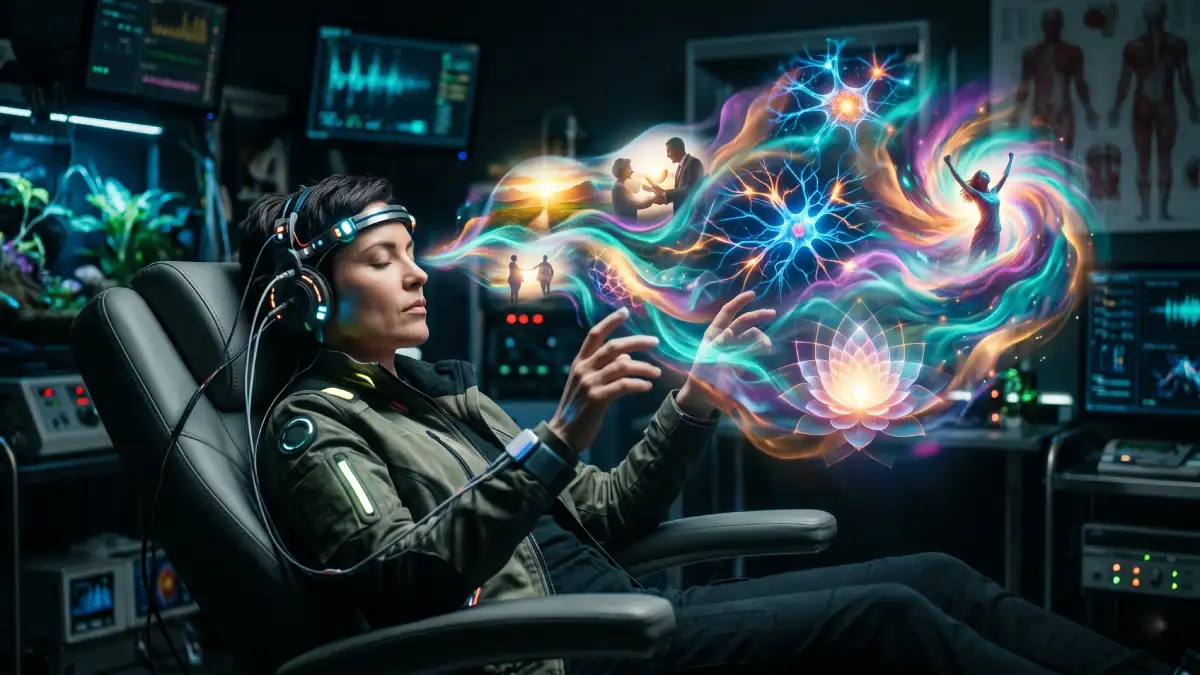
Visualizing a specific movement improves performance. Savoring the end result in your mind, however, can make you act less. Generating an ultra-realistic AI image of yourself at the top does not change that rule, and may even reinforce the wrong kind of visualization.
The pitch is tempting: paper vision boards are supposedly outdated, and AI can supposedly create “hyper-realistic anchors” that “force your subconscious” to execute your goals. No study has tested this promise. Yet existing visualization studies offer clear answers, and they do not support the marketing.
Two completely different kinds of visualization
The word “visualization” covers two opposing practices.
Mentally rehearsing a movement. An athlete running through their race, a musician playing a piece in their head. This kind of mental imagery activates circuits similar to those used in action. In a trial published in 2004, volunteers who imagined contracting a finger muscle for twelve weeks gained 35% in strength, compared with 53% for those who actually performed the exercise and no gain for the control group. Mental training does not replace physical training, but it has a measurable effect.
Dreaming about the outcome. Seeing yourself rich, slim, applauded. Here, the evidence is less flattering. In a series of experiments published in 2011, participants asked to imagine an idealized future positively subsequently showed less energy, measured through blood pressure and self-reported energy, than those who imagined a more realistic future. The brain savors part of the reward in advance.
An AI-generated image showing you having already made it clearly belongs in the second category.
The problem with “false memories of the future”
Some guides promote creating “false memories” as the ultimate hack. This is precisely a known bias. The landmark 1996 experiment on imagination inflation shows that imagining a childhood event increases confidence that it actually happened.
A memory that more easily confuses imagined and lived experiences is not a brain “reprogrammed” for success. It is a less reliable memory. And feeling as though you have already made it is the best way to skip the steps still ahead.
What really works: the outcome, the obstacle, the plan
The best-supported method combines three stages:
- The desired outcome, expressed in one precise, realistic sentence.
- The main internal obstacle that might stop you: evening fatigue, the urge to check your phone, fear of rejection.
- An “if–then” plan : “if I get home tired, then I do just ten minutes.”
The third step has the strongest evidence behind it. A meta-analysis of 94 studies on these implementation plans finds a medium effect on goal attainment across various areas: health, education, sport, and diet.
The first stage gets you moving, the second keeps you clear-headed, and the third makes your response automatic at the critical moment. The WOOP method · FR organizes these steps into four stages. It is less flashy than a Lamborghini poster, but it is what the studies measure.
If you still want to use AI
The tool is not the problem; what you ask it to generate is. A few uses consistent with the evidence:
- Movement imagery : an image or short animation of the technical movement you are working on, for mental rehearsal before a session.
- The obstacle scene : an image of the risky situation, your couch at 7 p.m., to mentally rehearse your “if–then” plan.
- A concrete reminder : an image of today’s step rather than the end result.
Avoid generating images of yourself having already made it, especially photos that imitate memories.