Magnesium L-threonate or bisglycinate: the verdict
For most people looking to supplement their intake or test an effect on sleep, bisglycinate is the most pragmatic choice. Its advantage is not spectacular: a recent trial shows only a small subjective benefit for insomnia. To see how this choice compares with other cognitive supplements, check out our evidence-based nootropics comparison.
For an experimental cognitive goal, L-threonate is the form most directly studied, with a few positive signals for memory and reaction speed. But it has never demonstrated superiority over bisglycinate, and several trials were funded or designed with the company that owns the product studied.
| Criterion | Magnesium L-threonate | Magnesium bisglycinate | What this means |
|---|---|---|---|
| Cognition | A few positive human trials, still limited and specific to a patented formulation | No identified trial demonstrating a cognitive benefit specific to this form | More evidence for L-threonate, but no proof of superiority |
| Sleep | Mixed results, with a subjective signal but no objective improvement in the 2026 trial | Small subjective benefit after four weeks in a trial of 155 adults | No clear winner |
| Evidence of reaching the brain | Increased brain magnesium demonstrated mainly in rats | No direct human data | Do not turn an animal mechanism into a promise for humans |
| Elemental magnesium | About 250 mg per 3 g of the compound evaluated by EFSA | Amount varies by product | Compare the “magnesium” line, not the compound’s weight |
| European framework | Authorized for adults, excluding pregnancy and breastfeeding, with a maximum of 250 mg of magnesium per day | Check the exact form and label statements | Count all supplemental sources |
| Practical choice | An option to test if cognition is the sole, measurable goal | A reasonable option for general intake or a sleep-focused trial | Start with just one form |
You can use the Magnesium Score to review your intake and risk factors, then the Sleep Analyzer if your main goal is overnight recovery.
Why L-threonate has not “crushed” bisglycinate
The idea of a form that exclusively targets the brain comes from a study published in 2010. In rats, magnesium L-threonate increased brain magnesium and improved performance on several memory tasks. This study justified moving on to human trials, but it proved neither a benefit in humans nor superiority over all other forms.
An EFSA assessment published in 2024 concludes that the magnesium in L-threonate is bioavailable. It does not conclude that this form crosses the blood–brain barrier more effectively in humans or improves memory. The distinction is essential: bioavailable in the body does not mean clinically superior for the brain.
The broadest review of magnesium and cognition, published in 2024, found only three randomized trials across all forms. Its authors considered the evidence insufficient to conclude that supplements affect cognitive health.
What human trials of L-threonate show
The most recent signal comes from a six-week randomized trial published in January 2026. One hundred adults aged 18 to 45 who were dissatisfied with their sleep received 2 g of Magtein per day or a placebo. The L-threonate group showed greater improvements in the NIH Toolbox overall cognitive score, working memory and reaction speed.
These findings still require caution. Raven’s Matrices test results did not differ between groups. Objective sleep measures from an Oura ring did not show improved sleep either. Only a subjective measure of sleep-related impairment improved. The study was funded by Threotech, which provided the intellectual property, participated in its design and supplied the product.
An earlier trial in 44 adults aged 50 to 70 with cognitive difficulties also reported an improvement in a composite score after twelve weeks. Its small size and the involvement of researchers linked to Neurocentria limit generalizability.
Finally, a frequently cited 2022 study tested a formula combining L-threonate, phosphatidylserine and vitamins C and D. Even though memory improved, this design does not allow the effect to be attributed to L-threonate alone.
Bottom line for the brain: L-threonate has preliminary evidence in humans. Presenting it as the only form “that enters the brain” or as a proven nootropic still goes too far.
What bisglycinate actually shows
Bisglycinate binds magnesium to two glycine molecules. This structure does not establish that glycine acts as a sedative once the supplement is swallowed. The effects of a dose of free glycine do not automatically carry over to a chelate.
The absorption data are also less triumphant than the marketing. A small 1994 trial in twelve patients who had undergone ileal resection found better tolerability than with oxide, but no difference in absorption across the group as a whole. This very specific population does not justify declaring bisglycinate “perfectly absorbed” in all adults.
Its strongest current argument concerns sleep. In 2025, 155 adults reporting poor sleep received 250 mg of elemental magnesium as bisglycinate or a placebo for four weeks. The insomnia score fell by 3.9 points versus 2.3 with placebo. The difference was borderline statistically significant and the effect was small, with a Cohen’s d of 0.2. No significant improvement was found in the other psychological variables, and the study used no objective sleep measure.
Bottom line for sleep: bisglycinate now has an encouraging trial specifically testing it, but the average benefit remains modest. It guarantees neither deep sleep nor increased heart rate variability.
The first real head-to-head comparison has no results yet
As of July 2026, no published trial directly answers “L-threonate or bisglycinate?” A UCLA trial was registered in June 2026 to compare glycinate, L-threonate and a placebo in 150 college athletes.
The study is set to measure sleep, recovery and reaction time over four weeks. Recruitment had not yet begun at the time of this update, and its direct comparison between the two forms is described as exploratory. Results are expected no earlier than 2027. Until they are published, any definitive ranking relies on indirect comparisons between different studies.
How to choose without falling for the label
If your goal is to correct an inadequate intake
Start with your diet, possible losses and medications that affect magnesium status. Choosing a form does not fix a missed diagnosis, and serum magnesium is an imperfect reflection of total stores. If you first want to explore whether inadequate intake might be the issue, start with the possible signs of low magnesium · FR.
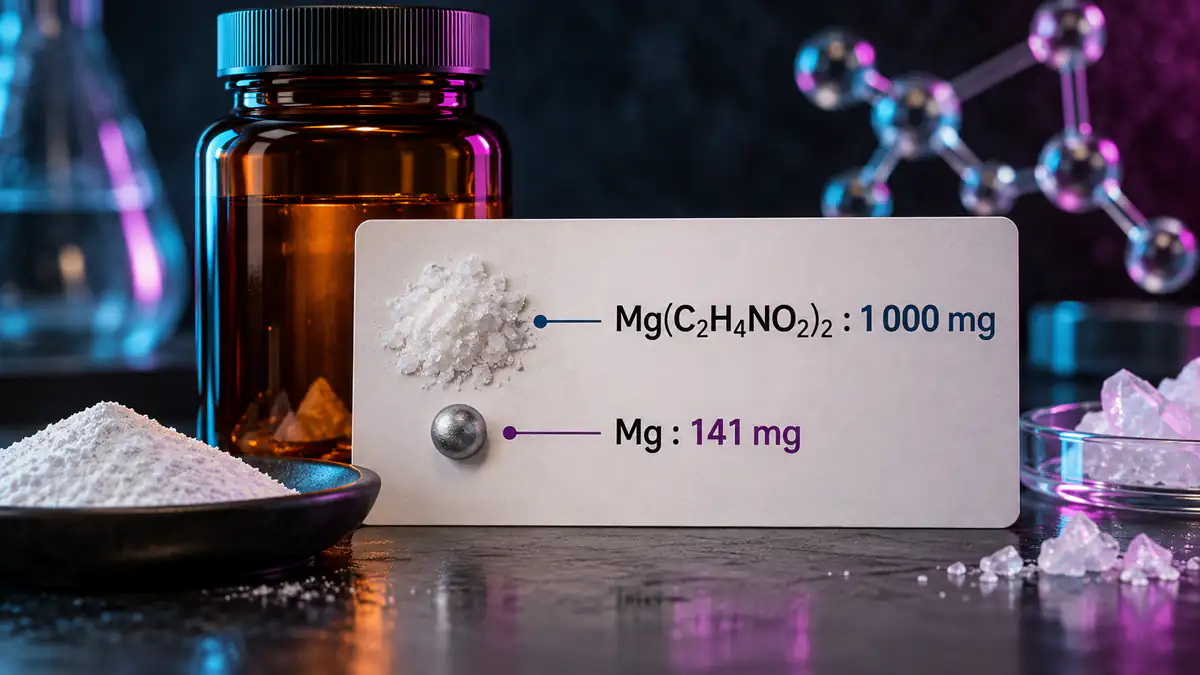
On the supplement label, look for the amount of elemental magnesium. A label advertising 2,000 mg of L-threonate does not provide 2,000 mg of magnesium. Likewise, “1,000 mg of bisglycinate” is not enough to compare two products. For a full overview of forms beyond these two, see how to choose the right form of magnesium · FR.
If your goal is cognition
L-threonate can be a defensible choice for a supervised personal trial, since it is the only one of the two forms with direct cognitive trials. Before taking it, define a measurable outcome, such as a memory or reaction-time test repeated under the same conditions. Without reproducible improvement, its proposed mechanism is no reason to continue.
If your goal is sleep
Bisglycinate is a simpler first choice, but keep your expectations modest. Track how long it takes you to fall asleep, awakenings and daytime sleepiness for four weeks, the duration of the 2025 trial. If insomnia persists or affects your daytime functioning, medical assessment and sleep care are more useful than repeatedly switching magnesium forms.
If you want to combine the two
I see no evidence-based reason to do so. No study has demonstrated that the combination improves cognition or sleep more. It also makes effects harder to attribute and increases total intake. Before stacking more products, also review the limitations of combining L-theanine and ashwagandha.
Dose, tolerability and interactions
In the European Union, magnesium L-threonate is authorized as a novel food in supplements for adults, excluding pregnant or breastfeeding women. The maximum authorized level corresponds to 250 mg of magnesium per day. This safety authorization is not evidence of cognitive efficacy.
Magnesium supplements can cause diarrhea, nausea and abdominal cramps. The risk of accumulation increases with renal impairment. Kidney disease, pregnancy, breastfeeding or regular medication use warrant medical advice before supplementation.
Magnesium can notably reduce the absorption of certain medications. Checking with a pharmacist is particularly useful for the following categories:
- tetracycline or quinolone antibiotics
- bisphosphonates used for osteoporosis
- diuretics that alter magnesium excretion
- long-term treatment with proton pump inhibitors, which can lower magnesium status
Final verdict
The bisglycinate form is the most rational choice for general supplementation or a sleep-focused trial, without promising a major effect. L-threonate becomes relevant if you have a specific cognitive goal and accept that the evidence is still preliminary and tied to a patented formulation.
The table therefore does not name an absolute winner. It reflects the best current evidence: more direct cognitive relevance for L-threonate, greater simplicity for bisglycinate, and no published evidence of superiority between the two.