My view on magnesium bisglycinate: a form worth considering to make up for an insufficient intake, with a possible tolerability advantage. Its superiority over other forms for fatigue, stress or sleep remains to be demonstrated. A recent trial suggests a small effect on insomnia symptoms, not a guaranteed perfect night’s sleep.
The word “absorbable” only answers part of the question. You still need to know whether you need magnesium, whether the product delivers the stated dose and whether the benefit justifies the cost.
This review is based on published sources: I am not inventing personal supplementation experiences or testimonials. It assesses the chemical form. The guide to comparing magnesium bisglycinate products · FR comes next, if buying one seems worthwhile.
Bisglycinate: identity and elemental magnesium
Bisglycinate combines one magnesium ion with two glycine-derived ligands. It is a chelate. This structure describes a source of magnesium, not a miniature sleeping pill.
Magnesium is involved in energy metabolism and nerve and muscle function. These physiological roles do not demonstrate that a supplement further improves these functions in someone whose intake is already sufficient. The NIH magnesium fact sheet distinguishes between dietary sources, supplementation and the risk of deficiency.
The compound and the element do not weigh the same
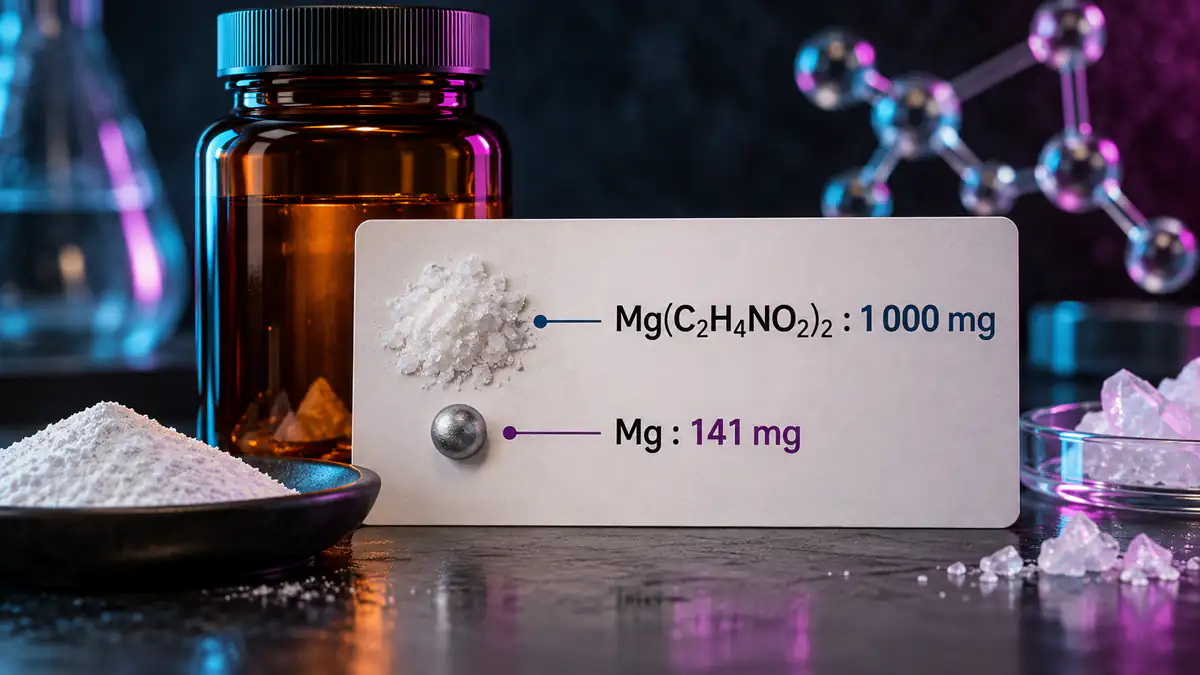
The weight of bisglycinate includes magnesium and its ligands. The useful figure for comparing intakes is the amount of elemental magnesium, not the total weight of the compound.
Here is a theoretical example, not linked to any brand:
| Label statement | Meaning |
|---|---|
| 1,000 mg of pure anhydrous bisglycinate | Mass of the entire compound, without water of crystallization |
| Approximately 141 mg of magnesium | Magnesium content of this theoretical amount |
| Amount per daily serving | Intake provided by all the capsules in the serving, not necessarily just one |
The theoretical proportion of approximately 14.1% appears in a 2021 chemistry publication. It does not replace a product label: hydration, excipients and blends alter the proportion in the finished product. The image in this article illustrates this distinction, not an analysis of a commercial batch.
So note both the “bisglycinate” and “magnesium provided” lines, then check how many capsules they refer to. A huge number on the front may simply refer to a heavy compound.
Pure, buffered or blended: read the ingredients
If the ingredients list includes several sources, the total magnesium dose does not necessarily come from bisglycinate alone. A formula described as “buffered” may include oxide. Ask about the sources and their proportions rather than treating this word as a certification of purity.
A blend is not automatically ineffective. It simply makes it harder to attribute good tolerability or an effect to bisglycinate itself. Adding vitamin B6, herbs or melatonin does not mean all the formula’s effects can be attributed to magnesium either.
Absorption: what do comparisons really show?
An absorption study may measure magnesium in urine or track an isotope. It does not directly establish that the participant will sleep better. That is the difference between an indicator of absorption and an outcome that matters in your life.
A 1994 crossover trial compared diglycinate with oxide in twelve patients who had undergone ileal resection. Overall absorption did not differ significantly between the two forms. An advantage appeared in the subgroup of four patients with the poorest absorption of oxide, and the chelate was better tolerated.
This finding is interesting for this particular population. It does not justify claiming a universal absorption rate for bisglycinate in healthy adults, let alone a superior effect on stress.
My standard is therefore more demanding than “well absorbed”: promising a clinical advantage would require trials comparing the forms at equivalent elemental doses, for the same outcome, over a relevant duration. The studies cited here are not enough to establish such a ranking.
Fatigue, stress, sleep: evidence by outcome
Fatigue: need matters more than form
Magnesium has an authorized European health claim for contributing to the reduction of tiredness and fatigue, subject to conditions of use. The EU register of health claims concerns the nutrient; it is neither evidence of bisglycinate’s superiority nor a treatment for all fatigue.
Correcting an insufficient intake and looking for a boost when your intake is sufficient are two different decisions. Persistent fatigue warrants an assessment of its causes rather than one course of supplements after another. The possible signs of magnesium deficiency · FR are not enough for a diagnosis.
I would not buy this form just because an advert turns its role in energy metabolism into a promise of instant vitality. That is Mitochondria Marketing: using a genuine biological mechanism to sell a benefit that has not been demonstrated in the advertised context.
Stress: suggestive evidence, but no medal for bisglycinate
The 2017 systematic review by Boyle and colleagues included eighteen studies involving people vulnerable to anxiety. The results suggested a possible benefit, but the quality of the evidence was low. Formulations and populations varied.
A 2024 review found favourable signals for some anxiety or sleep outcomes. It highlighted small sample sizes, study heterogeneity and the other ingredients sometimes included. It could not determine the best form.
These data therefore do not justify a blanket promise that “bisglycinate lowers cortisol”, or its use instead of anxiety care. If a formula contains several active ingredients, any improvement does not tell you which one deserves the credit.
Sleep: a direct trial, a modest effect
The randomised trial by Schuster and colleagues, published in 2025, included 155 adults aged 18 to 65 who complained of poor sleep. For four weeks, they received either a placebo or 250 mg of elemental magnesium daily as bisglycinate.
The ISI insomnia score fell by 3.9 points in the supplemented group, compared with 2.3 with placebo: an average difference of 1.6 points, with a small effect size, d = 0.2. Statistical significance was close to the conventional threshold, p = 0.049. This is not a measure of extra minutes of deep sleep.
The result relies on questionnaires, without objective sleep measurements. The preparation also provided around 1.5 g of glycine daily. Without “glycine only” and “another magnesium salt” groups, their contributions cannot be separated, nor can one form be declared superior. The other psychological outcomes showed no significant difference.
The declared funding was academic, and one author disclosed professional ties to the nutraceutical industry. This signal needs confirmation before anyone promises a major effect.
What customer reviews are worth
A review can tell you about capsule size, taste, delivery or digestive discomfort someone experienced. It does not measure whether a deficiency has been corrected or isolate the effectiveness of bisglycinate.
People often start taking a supplement when they are sleeping particularly badly. Any later improvement may reflect natural symptom fluctuations, positive expectations, more regular schedules or a change in caffeine intake. Even an honest testimonial cannot distinguish between these explanations.
To assess reviews systematically, look for these details:
- Do the product and its composition match the version currently on sale?
- Is the dose stated as elemental magnesium, along with the number of capsules?
- Are the duration, initial goal and other changes described?
- Do the reviews explain a specific problem, or just repeat an advertising promise?
Consistent testimonials can flag tolerability issues. Piling up stars does not turn them into a clinical trial.
Tolerability, interactions and kidney function
Unabsorbed magnesium can draw water into the intestine and cause diarrhoea or cramps. The form, amount and individual sensitivity all play a part. Bisglycinate does not guarantee freedom from digestive problems.
The European safety benchmark is 250 mg per day for the additional sources covered, notably readily dissociable salts and oxide added to supplements, water or foods. It excludes magnesium naturally present in food. Based on digestive tolerability, this benchmark is neither a target dose nor a uniform legal maximum for all products. I use it as a cautious ceiling for unsupervised supplementation, even when a product is marketed as gentle.
Add up all your supplements and mention any medicines containing magnesium, including certain laxatives or antacids. Medical doses may fall under a different framework. Do not apply them to self-directed supplementation.
The interactions listed by the NIH include certain antibiotics and oral bisphosphonates. Magnesium can reduce their absorption. With tetracyclines and quinolones, the required interval may differ depending on which is taken first: do not assume a universal two-hour rule. Have a pharmacist check the leaflet and dosing schedule. Also mention diuretics and proton pump inhibitors, which can affect magnesium status.
Reduced kidney function increases the risk of accumulation. Seek advice before starting if you have kidney disease, take regular medication, are pregnant or breastfeeding, or are under 18. Stop and seek medical advice if you develop persistent diarrhoea or new symptoms. Marked weakness, feeling unwell, breathing difficulties or an unusual heart rhythm warrant prompt assessment.
Buy, switch forms or take nothing
The decision guide
This guide summarises the level of evidence, expected benefit and cost considerations. It does not rank brands:
| Situation | Evidence and expected benefit | Tolerability checks | Decision and cost |
|---|---|---|---|
| Intake probably insufficient, with no worrying symptoms | Meeting a need makes sense, with no established superiority for bisglycinate | Total dose and bowel function | Review your diet, then compare the price per amount of elemental magnesium |
| Mild sleep problems | Small clinical signal versus placebo, still limited | Digestion and other ingredients | A trial may be worth considering after checking precautions, without paying for a deep-sleep promise |
| Persistent stress or anxiety | Heterogeneous data, no established form-specific advantage | Treatments and full formula | Prioritise assessment and care, not a dose increase |
| Another form already works and is well tolerated | No established additional benefit from switching | Tolerability already known | No demonstrated reason to pay more for the bisglycinate name |
| Kidney disease or possible interaction | Individual benefit–risk balance needs assessment | Risk of accumulation or interaction | Professional advice before any purchase |
Compare the cost of elemental magnesium
First calculate the amount of magnesium in the pack: number of capsules × elemental magnesium per capsule. Then calculate the price per 100 mg of elemental magnesium: pack price ÷ total amount in mg × 100. This cost is a comparison unit, not a dose recommendation.
Here are two hypothetical examples, excluding shipping:
| Hypothetical pack | Elemental magnesium | Price per 100 mg | Cost over 30 days at 200 mg/day, calculation example |
|---|---|---|---|
| A: €24, 120 capsules | 100 mg per capsule | €0.20 | €12 |
| B: €18, 60 capsules | 100 mg per capsule | €0.30 | €18 |
The box with the lowest purchase price works out more expensive here for the same quantity. However, the calculation does not tell you how many milligrams you will absorb. Don’t turn an advertised absorption estimate into a “price per milligram absorbed”.
If you decide to try a course
Check dietary sources first, especially legumes, seeds, nuts and whole grains. If you opt for supplementation, choose a clearly labelled formulation and a single observable goal. The dose depends on your needs and precautions, not the largest amount on sale.
For a sleep-related goal, a baseline week followed by reassessment after four weeks provides a practical framework, based on the trial’s duration—not a universally validated course. Record your estimated time to fall asleep, awakenings, next-day functioning and tolerability. Keep other habits as stable as possible.
If there is no noticeable benefit, reconsider whether the product is worthwhile rather than automatically continuing. A personal improvement is still useful for making a decision, but does not on its own prove the mechanism behind it. To compare products after making that decision, use the bisglycinate comparison chart · FR.
The Verdict
Main sources
The full texts of the 2025 trial and the 2024 review were consulted, along with the composition table in the chemistry publication. The results of the 1994 trial and the 2017 review were checked against their indexed abstracts: