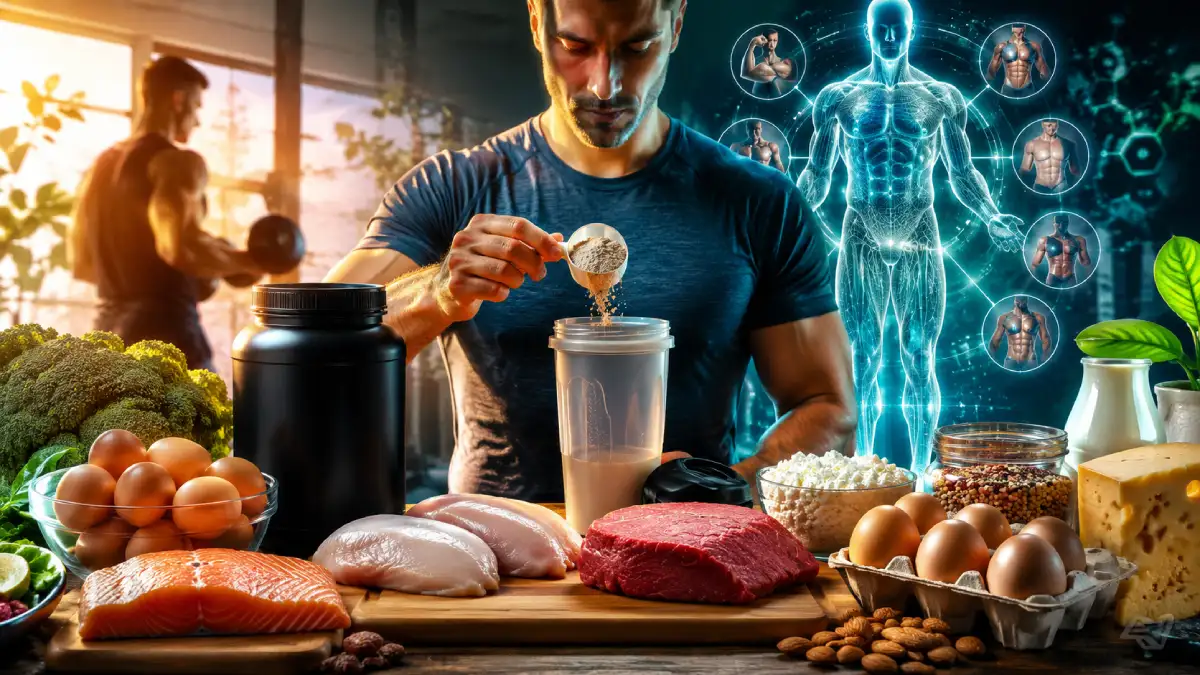
A protein supplement is useful if it fills a genuine gap, in a form you actually consume and tolerate. If your meals are enough, no supplement is necessary. If you are eating less, losing weight unintentionally or caring for someone vulnerable, the issue goes beyond choosing a powder.
The trap when searching for “protein dietary supplements” is this mix-up: sports whey, a bar and a medical nutrition drink are compared as three versions of the same product. Their packaging may look similar. Their purpose, not so much.
Here is how to choose a category, then calculate the cost of filling the gap. No brand rankings: the best purchase may still be buying nothing.
Sports powder and oral nutritional supplements: two different decisions
Dietary proteins are digested into amino acids, used among other things to renew tissues. This need exists without exercise. The EFSA reference intake for healthy adults is 0.83 g/kg/day, including food. It is neither an individual prescription nor a universal target for every sporting or medical context.
A powder concentrates a protein source, such as milk, soy or pea. It makes intake easier without turning it into a complete meal. A scoop does not replace the other functions of a varied diet.
An oral nutritional supplement, or ONS, can meet energy and protein needs in someone who is malnourished. Some products come as drinks, others as creams or preparations for fortifying food. The relevant regulatory category is foods for special medical purposes. EFSA specifies that they should be used under medical supervision.
The clinical rationale matters more than the shop aisle. A drink bought at a pharmacy is not automatically an ONS. A powder is not automatically a “food supplement” in the regulatory sense: read its exact designation.
In the management of malnutrition, Assurance Maladie describes fortifying meals and using ONS when necessary. So this is not simply about adding the most protein in the fewest calories. Someone who eats too little may also be short of energy.
The decision tree: food, powder or medical care?
Decision tree
Choose the right category before the product
Unintentional weight loss, declining appetite or difficulty eating: investigate the cause. A healthcare professional may recommend an ONS.
Keep your usual meals. There is no identified gap for a powder to fill.
Adjust a portion or snack. If the constraint persists, compare powders, sports drinks and bars.
Age alone does not determine the format. For an independent older person who eats well, a birthday does not automatically call for a medical nutrition drink. Conversely, a younger adult may need nutritional care.
If you are a carer, start with practical obstacles: shopping, preparation, dental pain, loneliness, nausea, difficulty swallowing. Another tub will not fix painful dentures.
Estimate the shortfall without doubling your entire intake
To determine a target suited to your profile, use the guide how much protein per day. Here, the decision starts after that estimate.
Over three representative days, including one with your usual constraints, record the portions you actually eat. This is a practical observation method, not a diagnostic test. Count protein from all foods, not just meat and eggs. Use labels and stick to the same convention for raw or cooked weights.
Estimated shortfall = chosen target − protein already consumed, with a minimum of zero.
Hypothetical example: a target of 90 g already tailored to the context, with meals providing around 75 g, leaves a gap of 15 g. There is no mathematical reason to automatically add a shake containing 30 g of protein. If adjusting your meals provides those 15 g, the remaining shortfall is zero.
Do not turn a few grams’ difference into a medical problem. Portions and estimates have a margin of error. Focus on whether the gap recurs regularly and whether changes to your eating routine can resolve it.
If your appetite declines or you lose weight unintentionally, do not spend several days perfecting this record before seeking advice. The calculation does not investigate illness, absorption problems or psychological causes.
Compare formats based on the problem to solve
A useful table compares constraints rather than promises of “performance”:
| Category | When it may help | What to check | Key limitation |
|---|---|---|---|
| Food and snacks | Adjusting meals without a supplement | Actual portion, preparation, storage, appetite | Sometimes less convenient on the go |
| Sports powder | Filling an isolated gap with an adjustable portion | Protein per serving, ingredients, tolerance, added liquid | Not a complete meal |
| Ready-to-drink sports drink | Travel, no shaker available | Protein per bottle, energy, price, storage | Less adjustable portion, extra packaging |
| Protein bar | Portable snack to chew | Protein per bar, energy, allergens, any polyols | The bar’s weight is not its protein weight |
| ONS | Identified medical nutritional need | Prescribed indication, energy, protein, texture and monitoring | Cannot be chosen on price per gram alone |
Yogurt, fromage blanc, eggs, tofu or pulses can help fill the gap. The portions needed depend on the specific food: compare the label, not its “high-protein” reputation.
For powder, first decide whether milk suits you, then whether you prefer a plant source and whether you like the texture. If you choose whey as the category, the whey comparison and buying guide then covers the products. You do not need to browse thirty brands before knowing whether a powder is useful to you.
Read the label in the right order
Start with the serving size. “80 g per 100 g” does not mean 80 g in the shaker. With this hypothetical composition, 25 g of powder provides 20 g of protein. Added milk also provides its own protein and calories: count it separately.
Then note this information:
- Protein per portion actually consumed, checking whether the values refer to the dry or prepared product.
- Energy per serving, to distinguish protein intake from energy fortification.
- Carbohydrates and sugars, without confusing total sugars with added sugars alone.
- Ingredients and allergens, including milk, soy or other ingredients indicated on the packaging.
- Pack size and storage after opening, which also affect waste.
If you have a milk allergy, “low-lactose” whey does not solve the problem: lactose and milk proteins are two different things. For an intolerance, look for explicit information about lactose rather than assuming an “isolate” label is enough.
A short list makes reading easier but does not, by itself, guarantee safety or quality. Conversely, for an ONS, a high energy content may be exactly what the care plan calls for. “Fewer calories = better product” is not a universal rule.
Finally, distinguish protein products from blends that add stimulants or substances marketed as anabolic. The alerts shared by the Ordre des pharmaciens based on ANSES nutrivigilance data concern a mixed range of products. They do not justify attributing the same risk to all plain powders.
Calculate the cost per 20 g, then the cost of filling the gap
The cost per 20 g is a comparison unit, not a recommended dose. It measures neither overall nutritional quality nor clinical benefit.
For a pack of powder or food, first calculate its total protein: net weight in grams × protein per 100 g ÷ 100. For a drink, use the volume in millilitres and the content per 100 ml. Do not mix grams and millilitres.
Cost per 20 g of protein = total price paid × 20 ÷ total protein in the pack. Include delivery if you want to compare the cost delivered to your home.
Here are entirely hypothetical teaching examples, unrelated to market prices:
| Hypothetical format | Price paid | Protein in the pack | Cost per 20 g | Theoretical cost for 15 g |
|---|---|---|---|---|
| Powder, 1,000 g at 80 g/100 g | €30 | 800 g | €0.75 | €0.56 |
| Sports drink, 1 bottle | €2.50 | 25 g | €2.00 | €1.50 |
| Bar, 1 unit | €2 | 20 g | €2.00 | €1.50 |
| Food, 500 g tub at 8 g/100 g | €2 | 40 g | €1.00 | €0.75 |
The theoretical cost assumes a perfectly adjustable portion and no waste. If you buy and drink a whole €2.50 bottle to fill a 15 g gap, your spending that day is €2.50, even if the proportional calculation shows €1.50. The rest is not automatically useless, but it exceeds the estimated shortfall.
This mismatch is the Toll, the hidden cost of a solution: here, the fixed portion, discarded product and storage constraints. A cheaper large pack becomes a bad buy if you do not finish it.
The template to copy into your spreadsheet
Copy only columns A and B, without the headers or the “Row” column, starting at cell A1 in Excel, LibreOffice or Google Sheets. The inputs are hypothetical and editable. The formulas use only operators to keep them easy to reproduce in different languages.
| Row | Column A: data | Column B: value or formula |
|---|---|---|
| 1 | Total price paid, euros | 30 |
| 2 | Net quantity, g or ml | 1000 |
| 3 | Protein per 100 units, g | 80 |
| 4 | Shortfall to fill, g | 15 |
| 5 | Total protein, g | =B2*B3/100 |
| 6 | Cost per 20 g, euros | =B1*20/B5 |
| 7 | Quantity to fill the gap, g or ml | =B4*100/B3 |
| 8 | Proportional cost of filling the gap, euros | =B1*B4/B5 |
Cells B2 and B3 must be strictly positive. B1 and B4 must be positive or zero. With these values, you get 800 g of protein in total, €0.75 per 20 g, a portion of 18.75 g of powder and an unrounded cost of €0.5625 to fill the gap. Format the cost cells to two decimal places.
To compare three options, copy the block into three sheets and replace the four inputs. Alongside it, add the quantity actually bought or consumed and its cost: this prevents confusion between a theoretical portion and actual spending. The template does not calculate an ONS prescription or reimbursement.
When to seek medical advice rather than buy
Unintentional weight loss, a persistent loss of appetite, unusual weakness or difficulty eating warrant a consultation. In someone close to you, clothes becoming too loose or regularly untouched plates are worth reporting, even without a precise calculation.
L’Assurance Maladie points out that care also involves investigating the cause of eating difficulties. ONS are generally used to supplement meals, according to the care plan, and should not displace them. If the prescribed product is not being consumed, tell the healthcare professional rather than replacing it yourself.
If you have kidney disease, a condition under medical care, are taking medication, are pregnant or breastfeeding, or if the supplement is for a minor, have the plan checked before substantially changing intake or introducing a supplement. Difficulty swallowing requires an assessment of the appropriate texture. An inability to drink or swallow, choking or difficulty breathing requires urgent help, by calling 15 or 112 in France.
For a healthy adult with no warning signs, first try a simple meal adjustment, then reassess after one week: does the gap persist, is the format tolerated, do meals remain complete? This timeframe is an organisational guide, not a clinical protocol. Stop the new product and seek advice if you experience unusual symptoms.
The same discipline applies to other supplements: define a question before adding a bottle. The guide to the benefits, limitations and risks of Alpha-GPC · FR lets you examine this other category separately, without confusing it with a solution to inadequate protein intake.