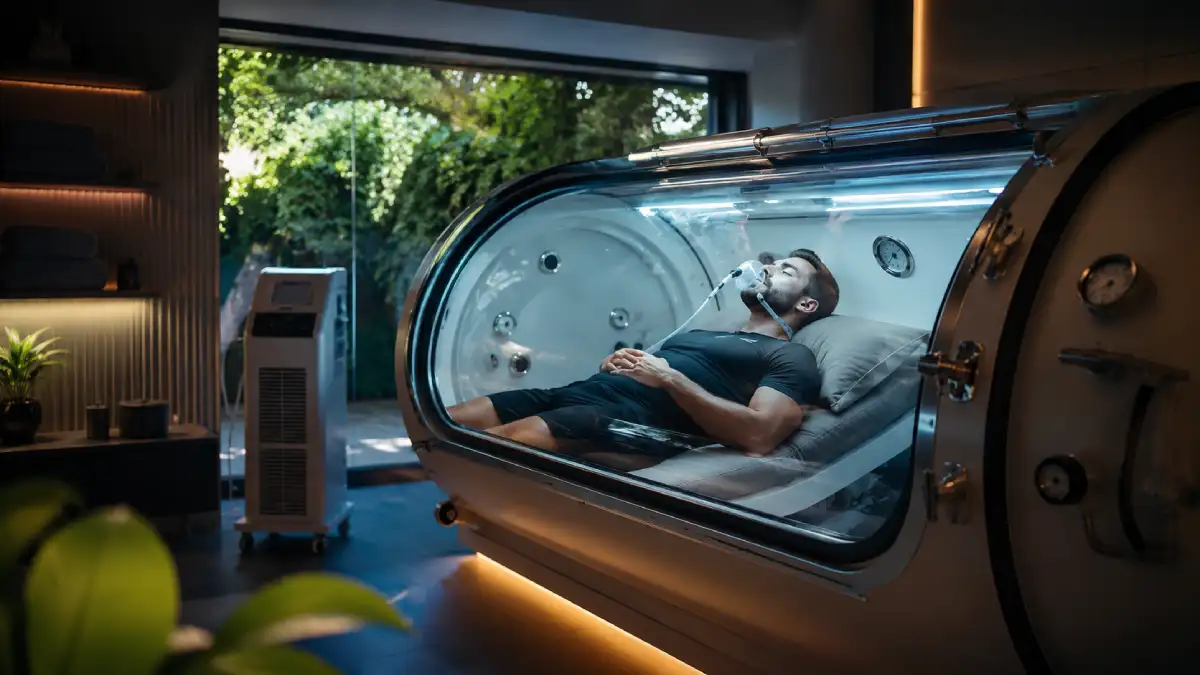
Hyperbaric chambers are not exactly new to France. Nice University Hospital has used them since 1967. What is new is their repositioning as a recovery, cognition and anti-aging service for healthy people.
That distinction changes the verdict. Hyperbaric oxygen therapy, or HBOT, is an established medical treatment for a few specific indications. For a healthy recreational athlete or biohacker, however, the evidence remains limited, difficult to apply elsewhere and often obtained using protocols very different from those sold at wellness centers.
My provisional verdict is therefore simple: a serious medical tool, a still-speculative bet for recovery, and no evidence of human longevity benefits. A short trial may be defensible for a specific athletic outcome, after medical advice. A package of 20 to 60 sessions sold to “rejuvenate your cells” is not defensible today.
Why hyperbaric chambers are entering biohacking
Three signals are fueling the trend. A center aimed at the general public opened in Bernay in January 2026. Similar services are already available at sports or cryotherapy centers. Meanwhile, Nice University Hospital’s new chamber received extensive media coverage.
But the Nice example mostly tells the opposite story to novelty. Installed in May 2025, the new equipment replaced an old chamber and is used for diving accidents, poisoning, embolism and complex wounds. Modernized hospital infrastructure does not validate a spa’s recovery promises. A few private openings signal an emerging offering, not yet documented widespread adoption.
The mechanism itself is real. Inside a pressurized chamber, the person breathes pure or highly concentrated oxygen. The pressure primarily increases the amount of oxygen dissolved in plasma, creating a gradient capable of reaching certain poorly oxygenated tissues. It also reduces the volume of gas bubbles, which explains its usefulness in diving medicine.
In a healthy person at sea level, however, more dissolved oxygen does not mean a muscle recovers faster or a brain works better. Changes in oxygen levels can activate pathways related to oxidative stress, angiogenesis or plasticity. These are biological hypotheses, not automatic clinical benefits.
What the studies really show in 2026
The first mistake is to lump every study into the same chamber. A session at 1.3 atmospheres absolute, or ATA, is not interchangeable with 90 minutes at 2 ATA. The population, gas breathed, number of sessions and comparator matter just as much as the word “hyperbaric.”
| Promise | Best relevant evidence | What it shows | Confidence level for a healthy person |
|---|---|---|---|
| Established medical indication | European consensus and French public health information | Benefit depends on the condition, alongside other care | High to variable depending on the indication |
| Sports recovery | 2026 meta-analysis, 10 trials and 299 participants | Improvement in pooled measures classified as muscle damage, but not overall muscle soreness | Low |
| Cognition and sleep | 2026 trial, 60 young men living at 4,300 m | Small improvement in self-reported sleep and working memory after five days | Low outside high altitude |
| Skin and anti-aging | 2025 systematic review, 15 publications | Possible biological signal, evidence too limited to justify the cost | Very low |
| Longevity | Small uncontrolled trial on blood cells | Altered telomeres, without measuring disease, independence or lifespan | Not demonstrated |
Sports recovery: a signal, not a faster return to play
The meta-analysis published in 2026 reports faster recovery on measures classified as muscle damage. It finds no overall benefit for muscle soreness. Ten small trials, different pressures and 299 participants do not justify promising fewer injuries or a faster return to sport.
A crossover trial in just 12 trained cyclists is more concrete. After fatiguing exercise, 75 minutes at 1.3 ATA with 97% oxygen preceded a five-minute maximal test. Mean power was 7 watts higher than after passive rest, or around 2.3%. That is an interesting acute signal, not proof of better adaptation over several months.
An older Cochrane review remains at odds with this. It found no improvement in strength, swelling or function after experimentally induced injuries, and even observed slightly more pain at 48 and 72 hours in some trials. Recent evidence is more favorable on markers, but not enough to declare the debate settled.
Cognition, sleep and fatigue: populations that are hard to generalize from
The trial from July 21, 2026 deserves attention, but its participants were 60 young men acclimatized to 4,300 meters. After five days, the adjusted difference in PSQI sleep score was 1.08 points, and working-memory accuracy was better. This result tells us nothing about a woman, an older adult or a worker living at sea level.
An earlier trial in 63 healthy adults over 64 reported better attention and processing-speed scores after 60 sessions at 2 ATA. The control group received no sham treatment, so participants knew whether they were entering the chamber. Several authors worked for an HBOT company, and one was a shareholder. The signal exists, but it needs independent replication with a credible sham.
The 2026 findings on ME/CFS do not fill this gap. They concern 30 patients who completed 40 sessions, without an untreated patient control group. Seven of the 37 people enrolled did not finish, including because of pressure-related pain or anxiety. This cohort justifies a controlled trial, not extrapolation to fatigue in a healthy athlete. Likewise, the new findings on BDNF and memory were obtained in rats. An animal hippocampal mechanism does not amount to a human nootropic.
Skin and longevity: biomarkers replace clinical outcomes too quickly
The frequently cited skin study involved 13 men aged around 68. After 60 sessions, some characteristics of skin biopsies had changed. However, the researchers did not assess the skin’s clinical appearance and had no separate placebo group.
The telomere study came from the same team. Thirty-five adults were enrolled, without a control group, and the analyses focused on subtypes of blood cells. Lengthening a measured telomere demonstrates neither fewer diseases nor more years of life. The 2025 aesthetic review itself concludes that the evidence is limited and does not yet justify the cost.
Prices, centers in France and session duration
Santé.fr lists around twenty hyperbaric centers, mainly in hospitals. A medical session typically lasts 90 minutes. Depending on the indication, a course may involve one or two sessions per day for 10 to 50 days. This is treatment chosen for a medical condition, not a recovery menu.
Here are the consumer services whose parameters or prices were public as of August 6, 2026:
| Example | Advertised parameters | Public price | Comparison limitation |
|---|---|---|---|
| Bernay | Around 1 h 15 including setup, pressure not published in the article reviewed | €60 | Impossible to link the price to a precise dose |
| Annecy | 45 min inside the chamber at 1.45 ATA, advertised oxygen concentration of 92 to 96% | €65 | Different from trials at 2 ATA for 90 min |
| Annecy, 10-session package | Same advertised protocol | €560 | A package does not create evidence of effectiveness |
| Annecy, 20-session package | Same advertised protocol | €960 | No validated “longevity” outcome |
I did not identify a national pricing benchmark that would support presenting €50 to €150 as a reliable French average. The two verifiable standard sessions cost €60 and €65. For a rough sense of scale, matching just the 60-session count of the anti-aging trials would cost at least €2,880 with the package observed, without matching the pressure or duration.
Medical or “wellness” HBOT: the real difference
The Undersea and Hyperbaric Medical Society reserves its clinical definition for the entire body being placed in a rigid chamber at a minimum of 2 ATA, breathing medical oxygen under prescription and supervision. Yet other publications call exposures starting at 1.2 or 1.3 ATA HBOT. Marketing terminology is therefore not enough.
Before a session, ask the center for the following information:
- exact pressure in ATA, not “gentle pressure”
- oxygen concentration actually breathed and delivery method
- time spent at the target pressure, excluding compression and decompression
- the device’s intended purpose and conformity documentation
- qualifications of the person performing medical screening
- monitoring throughout the session and evacuation procedure
- fire safety protocol, maintenance, prohibited clothing and objects
- a study supporting the specific goal using comparable parameters
CE marking indicates that a product meets the European rules applicable to placing it on the market. It does not prove that every recovery, skin or longevity claim advertised by a center has been demonstrated. A private service can be reputable, and a rigid chamber can still be misused. The decisive criterion is the pairing of protocol and indication, backed by competent supervision.
Risks and contraindications
The most common risk comes from pressure. The ears and sinuses need to equalize during compression. A meta-analysis of 24 trials and 1,497 participants reported at least one adverse effect in 30.1% of people receiving HBOT versus 10.4% of controls. Events mainly affected the ears or eyes, with highly heterogeneous protocols and patients.
Possible risks include the following:
- ear and sinus pain or barotrauma
- claustrophobia, anxiety or dizziness
- temporary changes in vision, particularly nearsightedness after repeated sessions
- oxygen toxicity, rarely progressing to a seizure
- pulmonary barotrauma in a susceptible person
- hypoglycemia in some people with diabetes
- fire in an oxygen-enriched environment
An untreated pneumothorax is the classic absolute contraindication. An ENT infection, difficulty equalizing the ears, lung disease with air trapping, a history of seizures, fever, recent eye surgery involving intraocular gas, an implant, heart disease, pregnancy or certain treatments require specific medical advice. Pregnancy is not a universal prohibition, because HBOT may be used in certain emergencies such as carbon monoxide poisoning.
In 2025, the FDA warned that fires involving hyperbaric devices had caused serious injuries and deaths. It emphasizes training, grounding, continuous monitoring and banning incompatible objects or textiles. The word “wellness” does not neutralize oxygen, pressure or static electricity.
Stop the session if you experience ear or sinus pain that does not ease, severe dizziness, visual disturbances, breathing discomfort, chest pain, confusion or muscle twitching. Respiratory distress, loss of consciousness or a seizure calls for emergency care by calling 15 or 112.
A reasonable trial protocol without buying a treatment package
For an illness, a persistent injury or unexplained fatigue, do not design a personal experiment. Seek a diagnosis and medical advice. The protocol below is only for a healthy adult who wants to assess acute sports recovery.
Proceed with a defined budget and stopping rule:
- Choose a single outcome, such as power on a familiar cycling test the day after a standardized workout
- Record two weeks of baseline measurements before paying for anything
- Have a doctor check for contraindications, and reject any center unable to provide pressure, oxygen, monitoring and emergency procedure details
- Buy one session to test tolerability, at the same time after exercise, without changing the center’s protocol yourself
- If it is well tolerated, complete just two additional pairs over three to six weeks, each comparing an HBOT day with a matched passive-rest day, after full recovery and in a prearranged order
- Keep training, sleep, carbohydrate intake, hydration, caffeine and test time constant
- Record performance as the primary outcome and muscle soreness as the secondary outcome
- Stop immediately at the first abnormal symptom, or after the two comparisons if there is no reproducible difference
At the verified rates, the three paid sessions cost around €180 to €195. This test will neither be blinded nor equivalent to a clinical trial, but it protects your budget better than a one-off feeling followed by a package purchase. Also compare any potential gain with cheaper options and their trade-offs, such as a cold plunge after strength training · FR.
Do not use this protocol to claim you are testing cognition, skin or longevity. Those goals would require long durations, complex measurements and evidence that research does not yet provide.
The Verdict
Hyperbaric chambers deserve their place in hospitals. They have not yet earned an automatic place in a healthy athlete’s routine.
I consider recovery HBOT a low-confidence early bet: a sound mechanism, a few human signals, but few robust functional outcomes and limited transferability to low-pressure services in France. For cognition, skin and longevity, I would not pay for a course.
If you test it, test a narrowly defined decision: measurable recovery, no more than three sessions, medical advice, a documented protocol and a capped budget. If the center sells 20 sessions first and explains the limitations afterward, the right experiment is to leave with your money.