The short answer
Brown noise has become a TikTok trend, promoted as “the sound that silences the ADHD brain.” The ADHD study everyone cites tested white noise in children, using tasks lasting a few minutes.
No noise color “forces” the brain to focus. However, a continuous sound can mask unpredictable changes, particularly speech, and make an environment more stable. The benefit depends on the task, background noise, hearing sensitivity and the individual.
The most frequently cited ADHD evidence involves white noise in children, with small samples and brief cognitive tasks. It does not support prescribing white noise, let alone brown noise. For sleep, the interesting pink-noise findings involve pulses synchronized with slow waves in a laboratory, not a continuous ten-hour soundtrack.
The most rational choice is therefore a personal low-volume test, compared with silence in an alternating order. If the sound helps, keep it as an environmental tool. If it gets in the way, noise-canceling headphones, moving elsewhere or reducing conversations remain more direct options.
What the three colors mean
Color describes how energy is distributed across frequencies. It does not correspond to a single frequency or predict a mental state.
The useful acoustic differences are as follows:
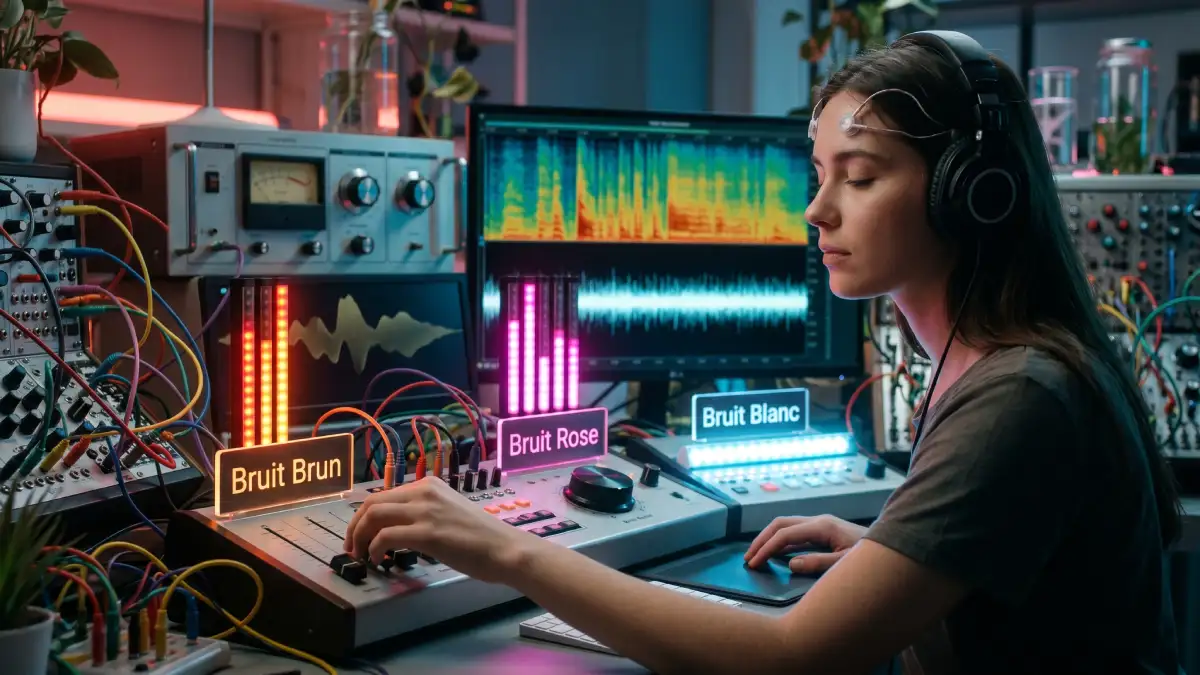
- white noise : similar power per hertz, with a treble-heavy sound
- pink noise : power that decreases as frequency increases, sounding more balanced to the ear
- brown noise : an even steeper slope toward low frequencies, with a deep rumble
Brown noise is named after Brownian motion, not a biological property. Rain or ocean sounds can approximate certain spectral slopes, but they are generally not pure pink or brown signals.
The main practical mechanism is masking. A conversation attracts attention because it changes and carries meaning. A steady background reduces the contrast between that conversation and the surroundings. This does not make the stimulus invisible or “block” the amygdala. It only reduces its salience under certain conditions.
Focus: what the ADHD study shows
The experiment by Söderlund and colleagues, published in 2007, compared memory tasks performed with or without white noise. Noise improved performance in the group of children with ADHD and worsened it in the control group on certain measures. This finding supports the idea that the optimal level of stimulation varies between individuals.
It does not demonstrate the following claims:
- all children or adults with ADHD benefit from noise
- the mechanism necessarily involves dopamine
- noise improves daily functioning or long-term symptoms
- brown noise is superior to white noise
- prolonged listening replaces established treatments
“Stochastic resonance” is an interesting mechanistic hypothesis: a certain level of noise can help some systems detect a weak signal. In humans, moving from this hypothesis to a clinical recommendation requires larger, replicated trials that more closely reflect real life.
If you have diagnosed ADHD, you might use sound as one accommodation among others. Do not change your treatment on this basis without discussing it with your doctor. If attention difficulties are new, severe or associated with anxiety, depression, sleep deprivation or substance use, a professional assessment is more useful than a playlist.
White, pink or brown, depending on the problem
To mask speech
White noise covers more high frequencies and may reduce consonant intelligibility more effectively. It is also more likely to sound hissy or tiring. Start low. If you constantly raise the volume to cover an open-plan office, active noise cancellation or moving to another space is preferable.
For a gentler background
Pink noise reduces high frequencies and is often better suited to listening at moderate levels. This preference is subjective. There is no strong evidence that it specifically induces alpha waves, improves computer programming or boosts memory while awake.
For low-frequency comfort
Brown noise can feel enveloping and less shrill. Reports of calm or reduced mental chatter are plausible as individual experiences, but specific clinical trials are insufficient. Low frequencies may also mask voices less effectively and travel more readily through building structures.
The right choice therefore depends on the obstacle: high-pitched noise, conversation, hypervigilance or simple preference. A color is not a medical indication.
The special case of sleep
The study by Papalambros and colleagues included thirteen adults aged 60 to 84. An algorithm detected the phase of slow oscillations during sleep, then delivered short pulses of pink noise at the chosen moment. During that experimental night, the intervention increased certain slow oscillations and improved one measure of memory compared with a sham night.
Three limitations change the decision: a small sample, a single population and a closed-loop system using EEG. A speaker playing continuous pink noise is not the same intervention. It may mask a neighbor or traffic, but it can also fragment sleep if the level varies or becomes bothersome.
For sleep, address the source of the noise first. If it cannot be reduced, test a steady background sound with a timer. A fire alarm, a baby or a safety signal must remain audible.
Binaural beats and colored noise are not equivalent
A binaural beat presents two slightly different tones, one in each ear. The brain perceives a fluctuation corresponding to the difference between them. Colored noise covers a broad frequency band. Layering the two does not create a proven “synergy.”
Tracks claiming to produce exactly 40 Hz, gamma, flow or dopamine turn a signal characteristic into a cognitive promise. A frequency measured on an EEG describes collective activity; it is not a single focus switch. Do not add multiple layers if your goal is simply to mask a voice.
A six-session personal protocol
To find out whether noise helps you, you need to compare the same task and avoid cherry-picking the best result afterward.
Set up this test:
- choose a repeatable 25-minute task, such as proofreading or similar exercises
- schedule two sessions in silence, two with pink noise and two with brown or white noise
- alternate the order over three days rather than grouping each color together
- keep the same headphones, the same low volume and a comparable time of day
- record work completed, errors, perceived distraction out of ten and auditory discomfort
- stop immediately if you experience pain, tinnitus, dizziness or a headache
Reassess after the six sessions. A tiny difference in how you feel without better work does not justify constant listening. Noise can also become a cue to start a task, but this conditioning does not require any particular color.
To structure your environment beyond audio, the comparison of time blocking and deep work · FR lets you test your work rhythm separately.
Hearing safety
Risk depends on sound level, duration and total daily exposure, not color. NIOSH uses 85 dBA over eight hours as its recommended occupational limit and halves the duration for every 3 dB increase. This is not a target for recreational listening. A lower level reduces risk and is generally enough for masking.
Follow these simple rules:
- set the lowest useful level
- prefer a speaker if it allows a lower volume and bothers no one
- take breaks and also count music, transport, tools and concerts
- do not try to cover loud noise with even louder noise
- seek medical advice if tinnitus, a blocked-ear sensation or reduced hearing persists
The Verdict
Colored noise is an inexpensive masking tool, not precise neuromodulation. White may cover certain sounds better, pink is often gentler and brown emphasizes low frequencies. Individual preference matters more than the neurochemical story.
I keep the sound that improves a measurable task at low volume. I reject promises of ADHD treatment, guaranteed brainwave synchronization or deep sleep from a simple audio loop. The best color is the one that reduces distraction without increasing the sound level or becoming another environmental crutch.