Griffonia risks: the main risk of 5-HTP is serotonin syndrome, especially with an SSRI antidepressant or another product that acts on serotonin. 100 mg is not a guaranteed safe dose: the 2008 Afssa opinion hosted by ANSES could not establish any intake that would guarantee its safety.
If you have already combined the products and have fever, confusion, rigidity or repeated muscle jerks, do not take any more and seek urgent help. In France, call 15 or 112 for severe symptoms or rapid deterioration. Do not stop a prescribed treatment on your own to replace it with a plant.
Which Griffonia side effects should you watch for?
“Natural” describes an origin. It says nothing about the strength of the biological signal or compatibility with your medicines.
You need to distinguish digestive problems reported in trials, possible behavioural effects and serotonin toxicity, which calls for a different response. Here is a useful breakdown, without inventing a frequency for all users:
| Symptom | What it may mean | General response |
|---|---|---|
| Nausea, digestive discomfort, vomiting or diarrhoea | Adverse effects reported with 5-HTP | Do not take any more if you have a reaction, and seek advice if it persists or causes significant discomfort |
| Fatigue, drowsiness | Reported effects that impair alert driving | Avoid driving and have the product and combinations checked |
| Unusual agitation, tremors, sweating, racing heart | Possible behavioural effect or cluster of serotonergic signs | Seek prompt medical advice, especially after combining products |
| Fever, marked confusion, rigidity, repeated jerks, rapid deterioration | Potentially severe toxicity | Urgent medical help, 15 or 112 in France |
This table helps you decide when to seek help. It does not allow self-diagnosis: nausea alone is not serotonin syndrome, and the absence of fever does not rule it out.
What a recent trial actually lets us quantify
In a 2026 randomised trial involving 112 adults, a single dose of 5-HTP did not improve the targeted measures of distractibility. 11 of the 56 exposed participants reported fatigue, nausea or vomiting: 19.6%. This was an acute experiment, not surveillance of all Griffonia products or an estimate of risk while taking antidepressants.
Small trials and published cases cannot provide a reliable incidence of serotonin syndrome, rare events or tolerability over several months. So do not turn either this 19.6% or a reassuring testimonial into your personal probability.
Interactions, contraindications and emergencies: who should avoid it?
This is the safety section to read before opening the bottle. 5-HTP is a serotonin precursor. SSRIs limit its reuptake, MAOIs slow its breakdown, and other medicines also act on this pathway. Combining these mechanisms can increase serotonergic activity. More serotonin does not automatically mean a better mood.
The official Health Canada monograph, dated 28 August 2024, contraindicates combining it with antidepressants. This Canadian document provides safety information, not French authorisation.
In particular, have a pharmacist check these categories:
- SSRIs, including sertraline, fluoxetine and escitalopram, SNRIs and MAOIs, as well as other relevant antidepressants
- painkillers with serotonergic activity, including tramadol and certain other opioids
- cough suppressants containing dextromethorphan, and certain migraine or nausea treatments
- St John’s wort, tryptophan, SAMe and mood-targeting blends
- carbidopa and other regular treatments whose compatibility has not been checked
This list is not exhaustive, and it does not mean every member of each class is equivalent. Bring the full list, including supplements and products you take occasionally. No generic interval between doses is enough to make a combination safe.
A 2017 case report describes severe serotonin toxicity in a man taking sertraline and several supplements, including 5-HTP, with intense exercise and other confounding factors. This is a clinical signal, not proof that 5-HTP alone always causes this event. The National Library of Medicine explains the signs and how the syndrome can potentially progress rapidly.
Pregnancy, breastfeeding, bipolar disorder and other higher-risk situations
Avoid self-medication during pregnancy or breastfeeding, under the age of 18, or if you have scleroderma, a chronic illness or take multiple medicines. Depression, persistent insomnia or a history of mania, hypomania or psychosis require assessment first.
Psychological distress or suicidal thoughts are not a reason to increase a precursor. If you are at risk of harming yourself or cannot stay safe, call 15 or 112 in France. For an ongoing sleep problem, the approach should be to look for its cause rather than keep switching products.
What should you do if symptoms appear?
Do not take any more, keep the packaging and note the time, the stated amounts and any other products taken. Seek medical or pharmaceutical advice. Persistent vomiting, unusual agitation or accumulating symptoms are reasons not to wait until the next dose. The severe signs described at the start of the article require urgent help. Do not drive or try to counter the reaction with another supplement. A healthcare professional decides what to do about prescribed medicines.
Can Griffonia have the opposite effect?
Yes, aiming for calm does not guarantee a calming response. The Afssa opinion describes behavioural effects, among others, and a case of mania after adding 5-HTP to an MAOI has been published. Combinations and individual factors prevent any frequency from being inferred.
Agitation, irritability or an unusually reduced need for sleep prove neither that a serotonin deficiency is being corrected nor that you are “detoxing”. Do not increase the amount to force the expected effect. Follow the guidance in the safety section.
You also need to distinguish an adverse effect from a lack of benefit. Sleeping just as badly does not mean the amount is too low. The L-theanine and ashwagandha comparison assesses other evidence, without validating stacking all three plants.
Is Griffonia banned in France? Status and ANSES/EFSA opinions
No, the word Griffonia does not refer to an ingredient that is uniformly banned. You need to distinguish the plant, its extracts and the isolated substance. When checked on 16 October 2026, the public Compl’Alim database displayed the following distinctions:
| Item | Information in the French database | What this does not prove |
|---|---|---|
| Griffonia simplicifolia | Listed as authorised, flagged as a risk ingredient | That every product sold is safe or compliant |
| Seeds and seed extracts | History of consumption before May 1997 for a maximum 5-HTP content of 30% | That 30% is a daily dose or a clinical safety limit |
| 5-HTP on its own | Classified as unauthorised and a novel food | A universal medical ban on any molecule bearing this name |
The Griffonia and 5-HTP entries provide administrative guidance with no legal force of their own. The plant entry calls for warnings concerning pregnancy, breastfeeding and antidepressant treatment. The status of the specific product depends on its composition and the applicable framework.
ANSES: do not invent a “safe dose of 100 mg”
The key document is the Afssa opinion of 8 September 2008, pages 50–51, hosted by ANSES. It mentions 100 mg per day as a DGCCRF proposal corresponding to a request from an operator. Its conclusion does not guarantee this dose: the evidence did not allow an intake ensuring safety to be proposed. Presenting it as a current ANSES recommendation reverses the document’s meaning.
This is an old opinion, not a new alert published in 2026. Consulting it now does not make it new. In the official-source search carried out for this revision, I did not identify a new ANSES dose guaranteeing the safety of 5-HTP.
EFSA: evidence of efficacy and safety are two separate questions
The 2009 EFSA opinion on mood and attention did not consider a cause-and-effect relationship established for these claims in the general population. It is neither an upper intake limit nor a product authorisation. Later trials must be examined separately, without attributing a recent reassessment to it.
5-HTP, Griffonia and serotonin: what is the actual mechanism?
5-HTP, or L-5-hydroxytryptophan, is an intermediate in the pathway tryptophan → 5-HTP → serotonin. Griffonia seeds are a source of it. A subsequent conversion contributes to melatonin production in certain cells.
The precursor can enter the brain and also be converted in peripheral tissues. This is why a more direct mechanism than tryptophan does not let you predict mood or read the outcome from blood serotonin levels. A biomarker number is not a wellbeing score.
Do the sleep and mood benefits justify the risks?
A 12-week sleep trial involving 30 older adults studied 100 mg per day. Some subjective components improved, especially in poor sleepers, but the control group did not receive an identical placebo capsule. A small group, an older population and an exploratory result: this does not validate taking it for every case of insomnia.
The mood analysis of the same cohort must not be counted as thirty new independent participants. The full text reports a non-significant group-by-time interaction for the depression score. A before-and-after improvement in one arm does not establish superiority over the control.
The guide to the evidence on nootropics helps maintain this distinction between a mechanism and a useful outcome. The N-of-1 method applied to supplements · FR can limit some attribution errors, but it does not make any interaction safe and is not a treatment for depression.
How do you read the label without turning it into a prescription?
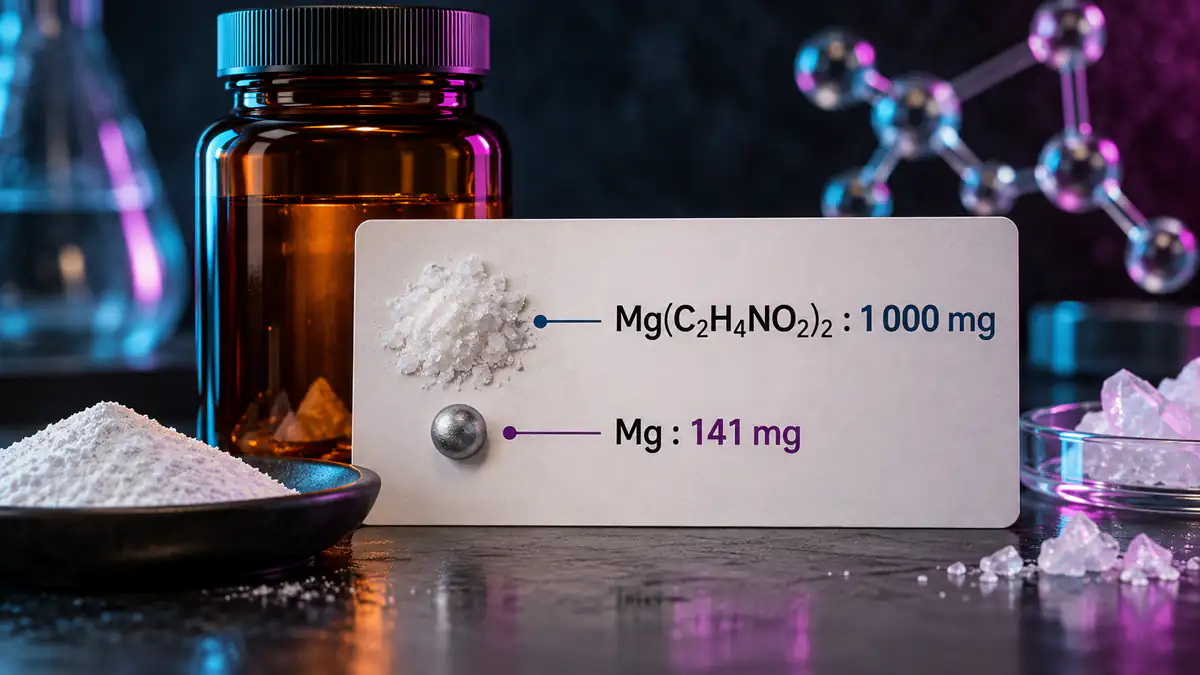
An amount of extract is not an amount of 5-HTP. For example, 400 mg of extract standardised to 20% would provide 80 mg of 5-HTP: that is label arithmetic, not a recommendation. A formula that specifies neither source nor standardisation leaves this information missing.
A manufacturer’s name, a pharmacy sale or a certificate do not validate use in your situation. Look for a clear composition, the operator and the batch, then have compatibility checked. No optimal timing, course length or personal dose is proposed here. The trap of the “natural” bottle is selling a simplicity that pharmacology never promised.