Introduction: Beyond the Myth, the Reality of the 2026 Data
In our comprehensive analysis of whether creatine is a real danger to the kidneys or just a myth · FR, we scientifically cleared the molecule of the most serious charge against it. No, creatine does not destroy your kidneys’ filters.
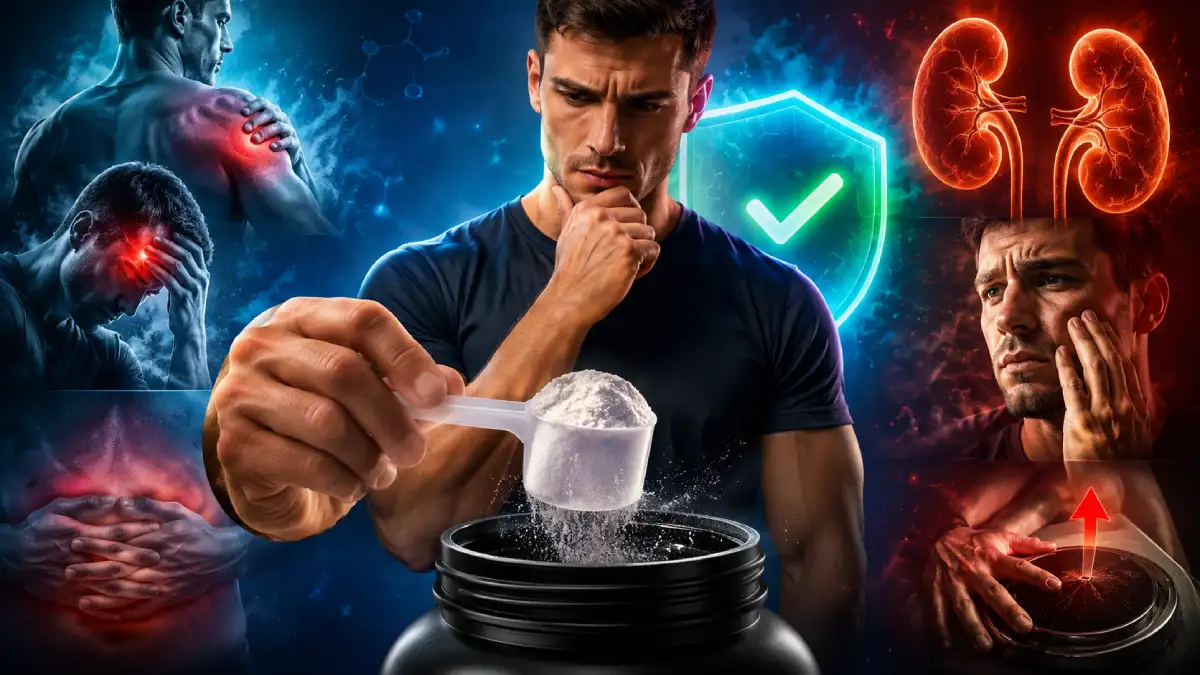
That said, claiming it causes absolutely no physiological changes would be a lie. When you saturate your cells with phosphocreatine to boost your ATP, your metabolism adapts. And if you go about it the wrong way, that adaptation can come with very real discomfort: intestinal problems, stomach aches, headaches, or sudden changes on the scale. For headaches, separately check the link between creatine and headaches before attributing them to the supplement.
As a biohacker, your goal is to get 100% of a molecule’s benefits (whether for muscle performance or cognitive creatine for the brain) while reducing its side effects to zero.
These problems are not inevitable consequences of the molecule, but the direct result of protocol errors, outdated dosing, or poor raw material choices. Here is the breakdown of creatine’s 5 real side effects and the tactical arsenal to avoid them completely.
1. Gastrointestinal Problems (Cramps and Diarrhea)
This is the side effect most frequently reported by users starting supplementation. It manifests as stomach discomfort, bloating, or, in the most extreme cases, acute diarrhea within an hour of taking it.
The Biological Mechanism
Creatine monohydrate has relatively low solubility in cold water. If you try to dissolve 5 grams of powder in a glass of ice-cold water, a large proportion of the crystals will remain suspended. Once ingested, these crystals accumulate in your stomach and then pass into your small intestine without being absorbed.
Undissolved creatine has a strong osmotic effect: it acts like a sponge, drawing water from surrounding tissues into the intestinal lumen. This sudden fluid buildup accelerates peristalsis and causes cramps and loose stools.
The Protocol to Avoid It
- Ditch the loading phase: Consuming 20 grams of creatine per day divided into 4 doses is the surest way to saturate your digestive system before saturating your muscles. Choose a steady dose of 3 to 5 grams per day instead. Saturation will take slightly longer (3 weeks instead of 5 days), but the intestinal risk drops to zero.
- The temperature hack: Dissolve your creatine in lukewarm or hot water (such as herbal tea or coffee). Creatine’s solubility increases exponentially with temperature. Stir until the liquid is perfectly clear: no crystals should remain at the bottom of the glass.
- Switch to Creatine HCL: If your digestive system remains hypersensitive despite using lukewarm water, replace monohydrate with creatine HCL. With 38 times greater solubility, it requires much less water and is absorbed instantly without drawing in water through osmosis, as we detailed in our comparison Creatine Monohydrate vs HCL · FR.
2. Rapid Weight Gain from Water Retention
A few days after starting your protocol, you step on the scale and notice a sudden increase of 1 to 2.5 kilos. For someone looking to optimize their power-to-weight ratio or slim down, this can trigger panic.
The Biological Mechanism
Creatine is an osmolyte. When it is transported into your myocytes (muscle cells) via CreaT1 transporters, it changes intracellular osmotic pressure. To restore balance, the cell must draw in water molecules.
This is intracellular water retention, not to be confused with subcutaneous water retention caused by poor circulation or excess processed salt. Your muscles do not become fat or soft; they fill with water, increasing their volume, firmness, and protein synthesis potential.
The Protocol to Avoid It
- Understand the signal: This side effect is not a problem; it is mathematical proof that the supplement is working. If you do not gain this small amount of intracellular water weight, you are probably one of the non-responders (often people who already consume huge quantities of red meat and whose stores are naturally saturated).
- Avoid the fast-carb trap: Many guides recommend taking creatine with fruit juice or dextrose to trigger an insulin spike. If you do this, it is not creatine that will cause peripheral water retention or fat storage, but the massive influx of fast-digesting sugars. Instead, pair it with a balanced meal or one of the 10 best low-GI snacks to stimulate insulin in a controlled way without storing fat.
3. Headaches and Peripheral Dehydration
Some users experience a mild tension headache (a band of pressure across the forehead or temples) after a few days of continuous supplementation, often accompanied by a dry mouth.
The Biological Mechanism
This phenomenon follows directly from the previous point. Since your muscles commandeer a significant amount of water to saturate their intracellular volume, that water is temporarily removed from general circulation.
If your daily fluid intake stays at your usual sedentary level, you enter a state of relative peripheral dehydration. Your plasma volume decreases slightly, reducing brain oxygenation and triggering compensatory headaches.
The Protocol to Avoid It
- Adjust your hydration equation: When taking creatine, your water requirements increase by approximately 500 ml to 750 ml per day. You should aim for a minimum of 35 to 40 ml of water per kilo of body weight.
- Replenish your electrolytes: Drinking large amounts of plain water can paradoxically worsen dehydration by diluting your minerals. Add a pinch of Himalayan or Atlantic salt to your water bottles, or use our assessment tool for electrolytes and sweating to calibrate your sodium, potassium, and magnesium intake.
4. Muscle Cramps at Rest
Paradoxically, although creatine is supposed to improve contractility and exercise tolerance, some athletes complain of fasciculations (small involuntary muscle twitches) or nighttime cramps in their calves or the arches of their feet.
The Biological Mechanism
Cramps are never caused directly by the creatine molecule itself. They result from a twofold induced imbalance: mild dehydration of peripheral muscle tissue combined with a disruption in the calcium/magnesium ion ratio inside the cell. When the cell fills with water, the relative concentration of intracellular minerals changes. If you are already on the verge of magnesium deficiency, nerve signaling becomes disrupted and the muscle can no longer relax.
The Protocol to Avoid It
- Pair creatine with magnesium: This is one of the most powerful combinations in biohacking. Magnesium acts as a natural muscle relaxant and an ATP cofactor.
- Choose the right form: Avoid cheap magnesium oxide forms that speed up bowel movements. Choose magnesium bisglycinate or malate, or use our guide to understand why magnesium L-threonate is superior for the nervous system. Taking your magnesium with dinner will eliminate 100% of creatine-related nighttime cramps.
5. The Risk of Impurities and Liver/Kidney Stress (Hidden Contaminants)
Although this is not an intrinsic side effect of creatine, consuming low-quality products can cause generalized metabolic fatigue, nausea, or an abnormal rise in liver enzymes.
The Biological Mechanism
Creatine is synthesized industrially from chemicals called cyanamide and sarcosinate. If the final purification process is rushed or carried out in factories with lax standards (often to slash online prices), the finished product contains toxic residues:
- dicyandiamide (which overloads the kidneys).
- dihydrotriazine (a pro-oxidant chemical derivative).
- Heavy metals (lead, arsenic).
When you ingest these molecules day after day, your liver and kidneys have to work to detoxify the body, negating creatine’s protective and cellular effects.
The Protocol to Avoid It
- Insist on the Creapure® label: Do not cut corners on this supplement. Creapure®, synthesized in Germany, guarantees 99.99% purity and undergoes rigorous testing to certify the complete absence of dicyandiamide and dihydrotriazine.
- Check third-party testing: If you buy a private-label brand, insist on seeing a certificate of analysis from an independent laboratory dated within the last 6 months, proving the absence of heavy metals.
Side Effect Management Summary
To summarize the action plan and eliminate these barriers for good, use this corrective matrix:
| Side Effect | Root Cause | Immediate Corrective Action |
|---|---|---|
| Stomach Cramps / Diarrhea | Undissolved crystals / Outdated loading phase | Take a maximum of 3 to 5 g/day, dissolved in lukewarm water, or switch to Creatine HCL. |
| Sudden Weight Gain | Healthy intracellular water retention | Accept the mechanism (beneficial for anabolism) and cut out fruit juices. |
| Headaches / Dry Mouth | Dehydration of peripheral tissues | Increase water intake to 40 ml/kg/day and add electrolytes. |
| Muscle Cramps | Mineral dilution / Magnesium deficiency | Consume quality sea salt and supplement with Magnesium Bisglycinate or Malate. |
| Nausea / Liver Fatigue | Presence of pollutants or heavy metals | Buy only Creapure®-certified creatine monohydrate. |
Conclusion: Master Your Protocol, Unlock Your Potential
Creatine is neither magic nor dangerous: it is a precision biological tool. The side effects attributed to it are simply warning signs of improper use.
By adopting a steady dosing approach, ensuring your Creapure powder is fully dissolved in lukewarm water, and adjusting your water and magnesium intake, you eliminate all risks. You then allow your body to fully harness this molecule for what it does best: optimize your mitochondria, strengthen your muscular structure, and protect your brain against cognitive decline.