The creatine monohydrate dosage commonly studied in adults is 3–5 g per day. The loading phase is optional. A loading regimen often uses around 20 g per day, split into several doses for 5–7 days, followed by a daily maintenance dose. Without loading, muscle stores increase more gradually, over about four weeks. If you experience a headache after a dose, also see what to do if you get a headache while taking creatine.
These are research regimens, not a prescription tailored to your weight, medication or kidneys. The choice is not about finding the biggest dose: it is about understanding the total daily amount, measuring it correctly and checking whether supplementation makes sense for you.
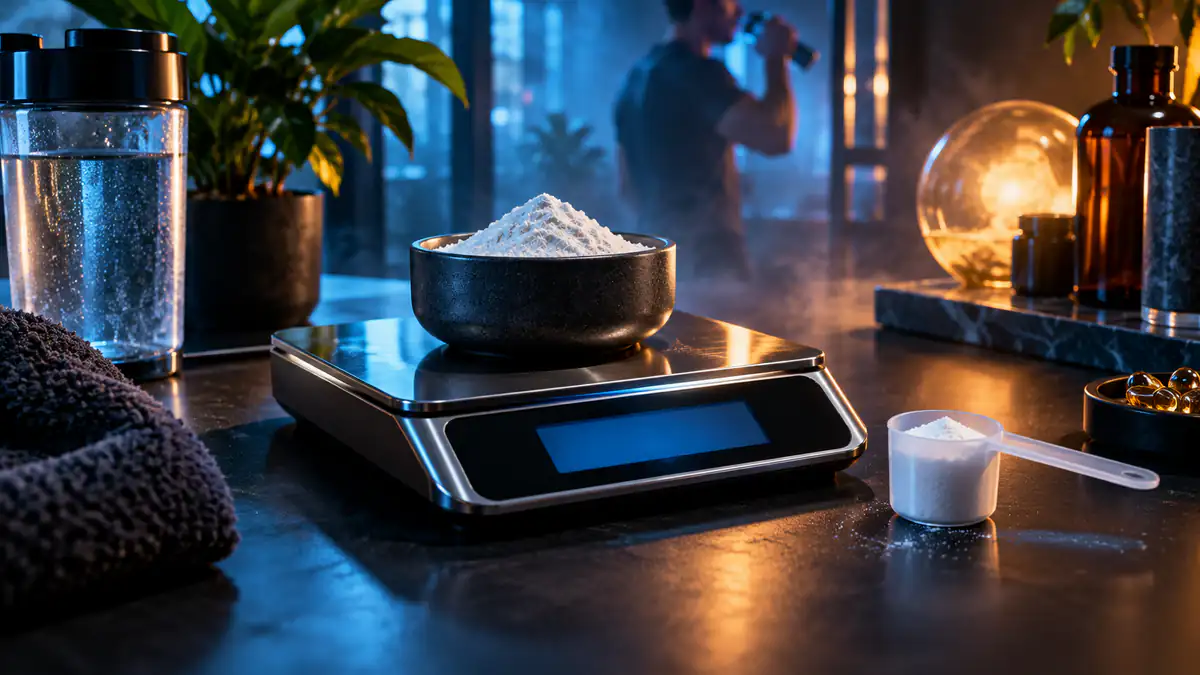
The opening image is a generated illustration of a scale and powder. It does not document an actual weighing or a dose to copy.
What daily dosage has been studied in adults?
The International Society of Sports Nutrition position stand, published in 2017, generally describes 3–5 g per day to maintain high muscle stores. The 2021 review addressing common questions about creatine notes that this same range can also be used without loading, with a slower buildup.
The form concerned is creatine monohydrate, the most extensively studied. These figures do not automatically validate an equivalent amount of gummies, a pre-workout blend or another chemical form. To compare products, see the guide creatine monohydrate or HCL · FR rather than transferring doses at random.
You also need to distinguish three things:
- the daily dose : the total consumed over a day.
- the dose per serving : the amount taken at one time.
- the duration of the regimen : a few days of loading or regular intake over several weeks.
A label stating a 5 g serving does not mean four servings per day. Conversely, “20 g per day split into four doses” does not mean 20 g at each dose. This confusion multiplies the amount by four, with no established benefit for your goal.
Table of studied regimens
| Regimen | Daily amount described | Duration or next step | What it means |
|---|---|---|---|
| Without loading, reference point from reviews | 3–5 g of monohydrate per day | Regular intake; about four weeks for a gradual increase in stores | No initial high-dose phase |
| Historical comparison by Hultman, 1996 | 3 g per day | 28 days | Increase in muscle stores comparable to that of the rapid regimen studied |
| Common loading regimen described in reviews | Around 20 g per day, often in four doses of 5 g | 5–7 days, then generally 3–5 g per day | Speeds up the buildup; is not mandatory |
| Loading calculated by body weight | Around 0.3 g/kg of body weight per day in total, split into doses | 5–7 days, then maintenance | Protocol formula, not the amount for each dose |
| Maintenance calculated by body weight in some studies | Around 0.03 g/kg per day | After loading in some protocols | Not strictly equivalent to 3–5 g at every body weight |
This table summarizes Hultman and the 2017 and 2021 reviews. It is not an invitation to freely choose the highest-dose regimen. Product directions and instructions from a healthcare professional still need to be followed; an experimental protocol does not authorize exceeding the label directions.
With or without loading: what really changes?
Creatine increases muscle stores of creatine and phosphocreatine, which are useful for repeated short, intense efforts. It does not work like a stimulant whose effect would depend on taking a large dose just before training.
The difference between the two approaches is mainly a difference in the rate of accumulation, not a physiological need to start with a high dose.
What the reference study shows
In 1996, Hultman and colleagues studied different intakes in 31 men. Taking 20 g per day for six days increased total muscle creatine concentration by around 20%. A similar but gradual increase was observed with 3 g per day for 28 days.
The study also tested 2 g per day to maintain the increase after loading. It would therefore be inaccurate to attribute all the details of the modern “loading followed by 3–5 g” regimen directly to it. That maintenance range is described in broader reviews.
This result concerns a concentration measured in muscle. It does not promise an identical gain in strength or muscle mass for everyone. Training, initial stores, diet and individual response influence what happens next.
Why not always load?
Loading involves more doses and increases the daily amount for a few days. It can also make initial water-related weight changes more noticeable, which matters in sports with weight classes. This increase is neither a measure of muscle gained nor a necessary step to prove effectiveness.
Without an imminent sporting deadline, skipping loading is a simple, documented option. This is a practical judgment in this guide, not proof that properly conducted loading is always dangerous. Conversely, wanting to reach saturation faster does not justify a single large dose or prolonged loading.
The timeframes remain approximate: “about four weeks” does not mean that a noticeable change must occur exactly on the twenty-eighth day. Muscle saturation and training progress are not the same outcome.
Dosage per kilogram: how should you read the formulas?
Weight-based doses are used to standardize participants’ exposure in some studies. On their own, they do not provide a personalized calculation of the best dose.
Arithmetic example, not an individual recommendation: for a body weight of 70 kg, loading at 0.3 g/kg/day corresponds to 21 g over the whole day. A maintenance formula of 0.03 g/kg/day corresponds to 2.1 g per day. The zero after the decimal point therefore changes the dose by a factor of ten.
Before copying a figure found in a study, check:
- whether it concerns loading or maintenance.
- whether it is expressed per day or per dose.
- whether the denominator is body weight or lean mass.
- which population was studied and for how long.
Some research uses other values, including 0.1 g/kg/day. The 2017 position stand also mentions higher intakes in larger athletes. This does not make those doses necessary for everyone who trains: an amount studied in one context is not a universally optimal dose.
Per-kilogram formulas should not be mechanically extrapolated in cases of obesity or illness, or from a review focused on adolescents. Weight alone is no substitute for a health assessment. Nor is there a rule requiring a different dose for every woman solely because of her sex.
Grams, scoop and scale: avoiding measurement errors
A scoop holds a volume. A scale measures mass. The volume of a spoon does not tell you the grams without information about the product and how it is filled.
A level, heaped or tightly packed scoop does not necessarily provide the same amount. Changing the brand, powder or spoon can change the conversion. Even a visually similar white powder does not necessarily weigh the same for a given volume.
Checking the amount without inventing precision
To check a portion of powder:
- put the scale on a stable surface.
- place a dry container on it.
- use the tare function to reset the display to zero with the container in place.
- gradually add the powder and read the mass in g.
- compare it with the serving information on the label.
A scale with a display that changes in tenths of a gram is better suited to a small portion than one that rounds to the nearest gram. But resolution and accuracy are not the same thing : displaying a decimal place does not guarantee an accurate weighing. Also follow the manufacturer’s minimum weighing mass and instructions.
Do not turn this check into a hunt for hundredths of a gram. The aim is to avoid a portion twice as large as intended, a forgotten tare or a supposedly universal spoon—not to manufacture clinical precision at home.
Total powder and declared creatine are not always the same
With a powder consisting only of monohydrate, the mass of powder provides a simple reference point. With a flavored product or blend, 5 g of powder does not necessarily mean 5 g of creatine monohydrate : flavorings and other ingredients also contribute to the mass.
Read the amount of creatine listed per serving, as well as the number of servings. A label may distinguish between “creatine” and “creatine monohydrate”: do not improvise a conversion between the two. If the presentation is ambiguous, ask the manufacturer or a pharmacist for clarification.
Finally, add up the amounts from your different products. Adding powder to a pre-workout that already contains creatine can increase the total without you realizing it. An ingredient list without precise amounts does not let you calculate this combined intake correctly.
Rest days, duration and consistency
The daily regimens presented here include days without training. Their aim is to build up and then maintain stores, not to kick-start that day’s workout. Taking a weekly amount all at once is not equivalent to the daily protocol.
A single missed dose does not suddenly empty your stores. The 2017 position stand describes a gradual return toward initial values over several weeks after stopping. In practice, resume your usual routine without compensating with a double dose. This precautionary rule is not a catch-up protocol tested in a trial.
Choose a time that is easy to stick to. The guide creatine before or after exercise · FR addresses timing separately; it does not change the distinction between daily amount and loading.
There is no established need to routinely schedule cycles with breaks for every healthy adult. That does not mean everyone should take it indefinitely. Reassess its usefulness, tolerability and your health circumstances rather than renewing a subscription out of habit.
To assess its value for sport, keep your training sessions comparable and track your performance over several weeks. Weight alone cannot distinguish water, muscle and dietary changes. Not feeling an immediate effect does not mean you need to increase the dose.
Digestive tolerability and health precautions
Large single doses may be less well tolerated
A 2008 trial in 59 male soccer players compared 10 g in a single dose, two doses of 5 g and a placebo over 28 days. Diarrhea was more common with the single 10 g dose than with the two 5 g doses. This supports splitting doses when a high daily amount is used.
The sample size was limited, symptoms were reported by participants and the total studied was not the usual 3–5 g per day regimen. It therefore cannot predict your individual risk or establish that splitting doses eliminates all digestive problems.
If you experience discomfort, do not continue loading just to “finish the protocol.” Reducing exposure or stopping intake is more prudent than adding other supplements. If symptoms persist, seek advice. Creatine does not justify a forced hyperhydration protocol either.
Precautions before starting
This guide is for adults who exercise, not minors. Seek medical or pharmaceutical advice if you have kidney disease, abnormal kidney test results, a chronic illness or take regular medication, especially medication that may affect the kidneys. Pregnancy and breastfeeding also require advice: sports data in healthy adults are not enough to establish safety in these situations. During an acute illness with dehydration, do not start loading. Disclose your supplementation if a blood test is planned.
Persistent vomiting, a marked reduction in urine output, unusual swelling or dark urine with severe muscle pain require prompt assessment, not a scoop adjustment.
The 2025 renal meta-analysis found no statistically significant difference in glomerular filtration, while reporting a small increase in creatinine. This result does not guarantee universal safety. The guide creatine, kidneys and interpreting creatinine · FR explores this point without automatically treating an abnormality as a harmless effect of the supplement.
Sources, limitations and practical decision-making
Confidence is high that regimens without loading can increase muscle stores. It is lower when it comes to determining each person’s optimal minimum dose or comparing all regimens for long-term sports performance gains.
The historical study involved men; the reviews bring together different populations and protocols. The 2017 and 2021 articles also disclose ties between several authors and the supplement industry. They remain useful for describing doses, but they are not an independent public health recommendation.
The key reference point: a measured daily amount, loading only as an option, no automatic calculation based on weight. Before choosing a regimen, check the product, combined intakes and precautions. If a health situation makes the choice uncertain, the next step is not a more sophisticated formula: it is professional advice.
The references below were checked on October 5, 2026. No publication dated December 2026 is used as already available evidence, and no findings in adolescents are extrapolated here to adults.