5-Amino-1MQ is an experimental small molecule, not a peptide or a validated weight-loss treatment in humans. Cell and mouse experiments justify research. They do not justify taking the capsules or using the vials offered online.
Documentary check: 15 October 2026. No human weight-loss clinical trial or corresponding medicine was identified within the scope described below. This dated search does not guarantee the absence of unpublished work or work registered under another code.
5-Amino-1MQ: a small molecule targeting NNMT
Its full name is 5-amino-1-methylquinolinium, also abbreviated as 5A1MQ. It refers to a small chemical structure, not a chain of amino acids connected by peptide bonds. The word “amino” in its name does not make it a peptide. A shop category is not a pharmacological classification.
The target being studied is nicotinamide N-methyltransferase, or NNMT. This enzyme converts nicotinamide into 1-methylnicotinamide, using a methyl-group donor called SAM. Nicotinamide also participates in the NAD+ salvage pathway, with NAD+ acting as a cofactor in cellular metabolism. Inhibiting NNMT could alter these balances. That does not mean every instance of inhibition improves health.
The work by Neelakantan and colleagues specifically tests this mechanism and metabolic effects. However, the target is not a switch located exclusively in fat: the work by Babula and colleagues also examines the liver and the molecule’s distribution across several tissues.
The marketing sleight of hand is to replace “metabolic pathway under study” with “human fat eliminated”. I call Mitochondria Marketing the use of a real biological mechanism to sell a benefit that remains unproven. Here, NAD+ readily becomes a shortcut from a cell culture to a weight-loss promise.
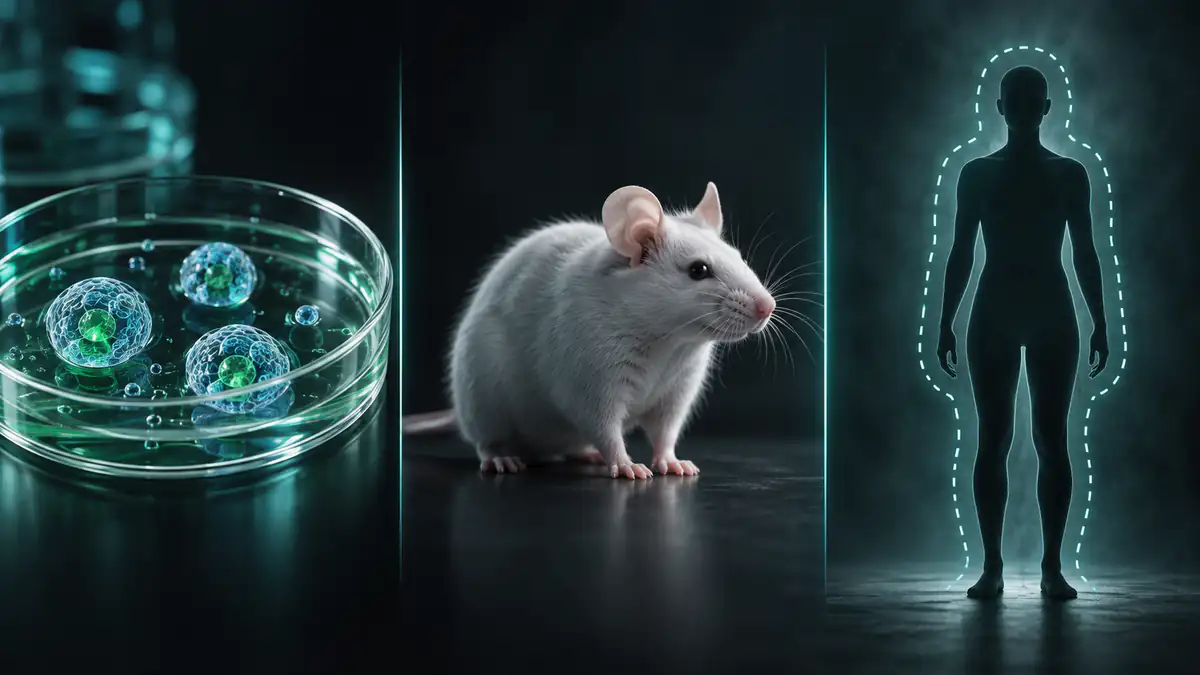
NNMT: three levels of evidence
A mechanism alone cannot bridge the gap to humans
- CellsNNMT inhibition and changes in metabolites in experimental systems.
- AnimalsEffects measured in mouse models, under their specific conditions.
- HumansNo clinical weight-loss benefit established by the trials identified.
What the key preclinical study shows
The key paper, published in the 2018 volume of Biochemical Pharmacology, was reviewed in full. It examines, among other things, cultured mouse adipocytes and 18 male mice with diet-induced obesity, divided into two groups of nine. The experimental treatment, administered subcutaneously, is compared with the vehicle over 11 days.
At the end, the treated group shows an average weight decrease of approximately 5.1% from baseline, while controls gain approximately 1.4%. These are percentages of the mice’s starting weight, not an estimate of what an adult would lose. The authors also report a lower mass of a specific fat depot, epididymal white adipose tissue. This depot is not the entirety of body fat.
The absence of a significant difference in food intake does not prove an effect with no influence whatsoever on human appetite. It describes what was measured in this short experiment. Similarly, the absence of obvious adverse signs does not constitute a clinical safety study.
Later findings are still from animals
A 2021 study combines NNMT inhibition with a dietary change in obese mice. It reports greater weight and fat loss than with the dietary change alone. This tests neither a commercial capsule in humans nor a replacement for nutritional care.
In 2024, Babula and colleagues study three groups of eight obese mice over approximately one month. At the highest exposure level, they mainly observe a reduction in weight and fat gain, along with improvements in certain metabolic parameters. Reducing weight gain is not the same as losing weight. Several authors disclose ties to Ridgeline Therapeutics, including its founder and current or former employees.
These findings suggest an avenue for drug development. Their repetition in similar models does not replace independent evidence in humans.
Matrix: claim, experimental evidence and human unknowns
Here are the distinctions that change how you read the promises:
| Claim | What was actually studied | What is missing in humans |
|---|---|---|
| “Inhibits NNMT” | Enzymatic and cellular activity, with reduced 1-methylnicotinamide in experimental systems | Relevant exposure, selectivity and clinical effects after administration |
| “Causes fat loss” | Weight and fat tissues in certain mouse models, with defined interventions | Controlled trials showing meaningful, sustained fat loss |
| “Increases NAD+” | Measurements in mouse adipocytes, with results depending on analyses and concentrations | A reproducible effect in human tissues and an associated health benefit |
| “Works without suppressing appetite” | No significant difference in food intake in certain animal experiments | Effects on people’s hunger, intake and eating behaviour |
| “Preserves muscle” | Animal body-composition measurements in some studies | Strength, function and muscle mass monitored in human trials |
| “Is safe because it is selective” | A limited panel of targets in early research, followed by off-target activity reported in 2024 | Clinical tolerability, interactions, toxicity and safety margin |
| “A capsule is equivalent to another formulation” | Permeability studies and animal pharmacokinetics | Human bioavailability and equivalence of the formulations sold |
Experimental sources for this matrix: Neelakantan 2018, Sampson 2021 and Babula 2024.
One detail deserves attention: in the first study, the overall analysis of cellular NAD+ does not reach the conventional statistical threshold, whereas a comparison at one concentration does. Summing this up as “increases NAD+” without qualification overinterprets a small experiment.
Human data: what the search actually finds
The exact queries “5-amino-1mq”, “5-amino-1-methylquinolinium” and “5A1MQ” were tested in the ClinicalTrials.gov and CTIS registries. No matching record was returned on 15 October 2026. The broader query “NNMT” in ClinicalTrials.gov returns two studies, but their interventions are not 5-Amino-1MQ. A result for an enzyme’s name does not prove that its inhibitor has been tested.
The bibliographic search using these same names, via Europe PMC, identified no published clinical trial demonstrating weight loss after administration of this molecule. Tissues or cells collected from humans are not a treatment trial in humans. Nor does a study of NNMT expression tell us about the tolerability of a swallowed or injected product.
Online testimonials cannot isolate its effect: diet, activity, other products, selective reporting and the actual identity of the contents can all affect interpretation. The unknown is therefore not just “how many kilos”. It also concerns what is absorbed, which tissues are exposed, adverse effects and their frequency.
Capsules and vials: presentation proves no equivalence
During the commercial review, capsule listings combined research terminology with familiar supplement-style presentation. Some also used the “peptide” category. This observation documents marketing, not efficacy or safety. No purchase link or commercial protocol is reproduced here.
Putting a substance in a capsule does not turn it into an evaluated food supplement, and offering it in a vial does not turn it into an injectable medicine. The form, chemical salt, excipients and manufacturing controls matter. Animal absorption studies do not validate retail products.
A purity certificate can provide information about a sample and an analytical test. It proves neither human benefit nor, on its own, the correct content, sterility or absence of endotoxins in an injectable product. The FDA’s technical documentation on endotoxins describes why controlling them is a distinct issue. This principle concerns injectable products in general, not a contamination rate measured here for 5-Amino-1MQ.
The guide to certificates of analysis, sterility and the risks of online products · FR details these distinctions. They remain relevant to a small molecule sold through the same channels, even if it is not a peptide.
Online doses and risks: none of this establishes a dosing regimen
There is no established human dosing regimen in the trials identified. Copying a community-sourced dose, converting milligrams per kilogram from mice or adjusting for your own weight does not fill this gap. A conversion method can contribute to drug development as part of a complete dossier. On its own, it does not provide a safe dose for self-medication.
The 2024 study reports MAO-A inhibition in a laboratory test. This enzyme participates in monoamine metabolism. This finding proves neither an effect of the same magnitude in a person nor a specific clinical interaction. It is, however, enough to rule out claims of absolute selectivity or harmless combinations. The authors themselves mention optimising this off-target activity.
The major unknowns remain the effects of repeated exposure, interactions, liver and kidney effects, and reproductive safety. This does not mean that a specific toxicity has been demonstrated for each: the lack of data prevents them from being ruled out and prevents a safety margin from being defined.
Pregnancy, breastfeeding, being underage, chronic illness or regular medication are not situations where a “cautious” dose invented online solves the problem. The practical verdict is not to expose yourself outside an authorised clinical research setting.
Status in France: registries checked on 15 October 2026
The audit result is stated with its scope: no corresponding medicinal product found in the French and European data consulted. This is not an official certificate issued by ANSM, nor an opinion on every importation or possession scenario.
The following sources were checked:
| Official source or registry | Check performed | Result and limitation |
|---|---|---|
| Public medicines database, operated by ANSM with its partners | Medicinal product and composition files, abbreviated and full names | No match. The database covers medicines currently marketed or marketed within the past three years |
| ANSM website | Internal search for “5-amino-1mq” | No result. This document search engine is not, on its own, a marketing authorisation registry |
| EMA | Downloadable catalogue of medicines and substances, updated on the day of the check | No match. Covers the centralised procedure, not all national authorisations |
| ClinicalTrials.gov | Three names for the molecule, then “NNMT” | No trial under the three names. The two NNMT results do not test this molecule |
| CTIS, European public portal | Three names for the molecule and “NNMT” | No result. Finding limited to public information and the terms tested |
| Former European registry EU CTR | Same names and “NNMT” | No result. This historical registry does not replace CTIS and has publication limitations |
Access to sources: French medicines data, ANSM search, EMA data, ClinicalTrials.gov, CTIS and EU CTR.
Trial authorisation, a scientific publication and marketing authorisation are three distinct things. The EMA describes this pathway: the centralised European decision rests with the European Commission, following scientific assessment. The label “research use only” replaces none of these steps.
Nor do these checks establish that the product is an authorised supplement. An offer accessible from France is not proof of French regulatory compliance. The EMA warns against medicines from unregistered sources, with risks involving identity, quantity and quality. This general warning is not an analysis of every seller.
Useful questions to ask a healthcare professional
The goal is to examine your metabolic problem or your wish to lose weight, not to get a dose found on a forum approved. Prepare these questions for your doctor or pharmacist:
- What health problem or goal actually warrants care in my situation?
- Which options have human evidence, and what are their benefits, risks and monitoring requirements?
- Do my medications and medical history change the options available to me?
- If I have already used 5-Amino-1MQ, what information should I share and what assessment is needed?
If exposure has already occurred, keep the product name, packaging, batch number, date and stated quantities for the healthcare professional or poison control centre. Do not take the product again to “check” a symptom. Difficulty breathing, loss of consciousness or feeling severely unwell warrant a call to 15 or 112 in France.