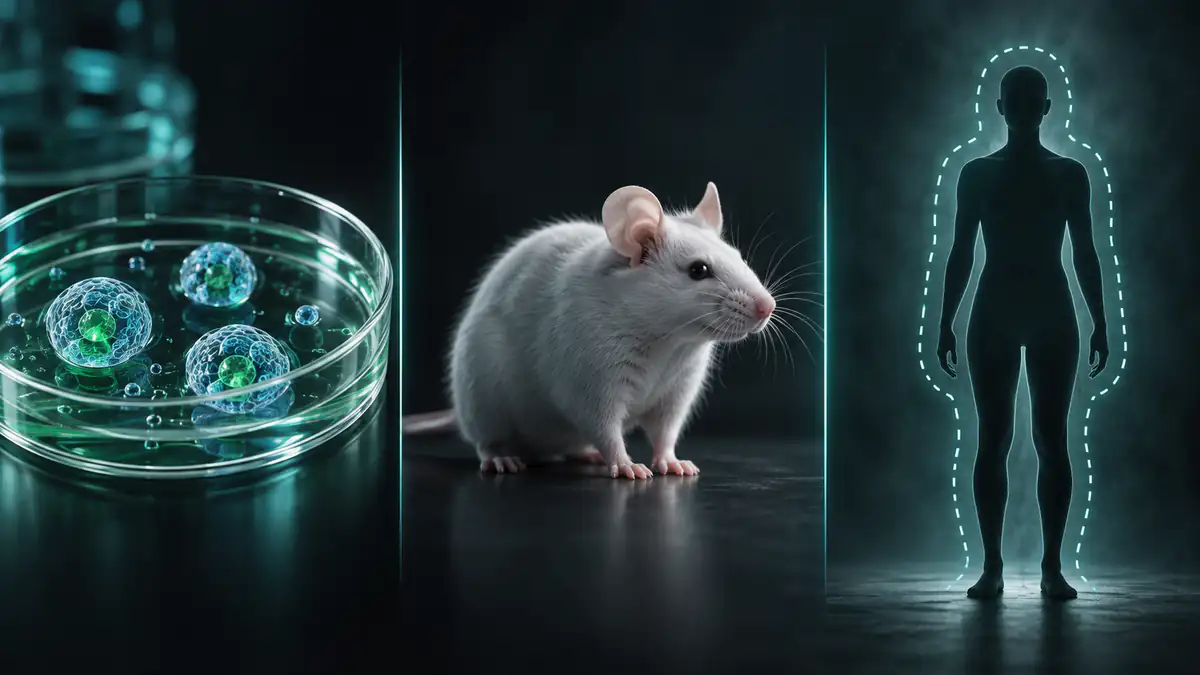
FOXO4-DRI is an experimental senolytic peptide, not a validated anti-aging treatment for humans. Cellular and animal findings support a genuine biological avenue. They demonstrate neither rejuvenation in humans, nor an extension of human life, nor safety of use.
The sales pitch often takes three steps: a senescent cell disappears, a marker improves, a vial promises longevity. Step three is nowhere in the experimental findings.
This evidence review was checked on October 16, 2026. It compares the models studied, favorable findings and an adverse animal signal. It provides no injections, doses or places to buy. The guide to senolytics and so-called zombie cells · FR provides the general context. Here, the analysis focuses specifically on this synthetic peptide.
FOXO4-p53 interaction: hypothesis and mechanism
Eliminating a cell is not rejuvenating it
A senescent cell is characterized in particular by a lasting halt in cell division. Depending on its context, it may also produce inflammatory factors and alter its environment. Yet it is not interchangeable with any old, damaged or simply inactive cell.
A senolytic aims to eliminate some of these cells. This strategy differs from cellular repair: after apoptosis, the cell is dead. Any potential benefit then depends on what its removal contributes to the tissue as a whole, and what it takes away.
In the landmark study by Baar and colleagues, published in Cell in 2017, FOXO4 contributes to the survival of senescent cells by interacting with p53. The FOXO4-DRI peptide disrupts this interaction, promotes the movement of p53 out of the nucleus and triggers apoptosis in the models examined.
FOXO4 is a protein found in the body. FOXO4-DRI is a synthetic construct. DRI refers to a D-retro-inverso design, using D-configuration amino acids and a sequence reversed relative to the reference segment. The name is neither a safety label nor certification of perfect targeting.
A better-described mechanism, still preclinical
A 2025 structural study describes the binding of FOXO4-DRI to the TAD2 domain of p53 using nuclear magnetic resonance and other biophysical methods. It clarifies molecular interactions without measuring an anti-aging benefit in people.
p53 is involved in several cellular decisions, including the damage response and apoptosis. Altering an interaction involving this protein does not, on its own, allow an overall favorable or unfavorable effect on cancer to be predicted.
This publication declares partial funding from Cleara Biotech, along with equity holdings and patents for some authors. That does not invalidate the measurements. It does matter when assessing the independence of the conclusions and the need for external confirmation.
Animal and cellular models: mapping the evidence
The table distinguishes the origin of the material from the level at which the treatment is tested. A human cell in a dish is still a preclinical experiment.
| Study | Model and comparison | Outcomes examined | What this does not demonstrate |
|---|---|---|---|
| Baar et al., 2017 | Senescent cells, mouse models of chemotherapy toxicity, accelerated and natural aging | Apoptosis, doxorubicin-related effects, physical fitness, coat condition and renal function depending on the model | Rejuvenation or lifespan extension in humans |
| Zhang et al., 2020 | Mouse Leydig cells induced to become senescent and aged male mice, with controls | Apoptosis, testicular environment and circulating testosterone | Treatment of hypogonadism in men |
| Born et al., 2023 | Several animal models of pulmonary hypertension and senolytic strategies | Hemodynamics, remodeling and pulmonary endothelial cells | Universal benefit of senolysis; an adverse signal is present |
| Kong et al., 2025 | Fibroblasts and human keloid fragments in culture, compared with controls | Senescence, cell cycle, apoptosis and localization of phosphorylated p53 | Regression or prevention of keloid recurrence in patients |
| Hu et al., published online in 2026 | Endothelial cells and mouse models, with controls | Senescence markers, inflammation and vascular properties | Prevention of cardiovascular events in humans |
The corresponding publications are available for 2017, 2020, 2023, keloids in 2025 and the endothelial study published online on January 15, 2026. The latter carries a 2025 date in its reference and DOI: it is not a second independent study.
For 2017, the results presented here are those in the indexed abstract, without a full audit of the protocol. The 2020 study, the keloid study and the endothelial study were reviewed in full text. This is a targeted search, not a systematic review of all applications of the peptide.
A marker is not a measure of longevity
Reductions in p16, p21 or senescence-associated staining can support a biological interpretation. They do not directly measure preserved independence, disease prevention or years of life gained.
The recent endothelial study reports improvements in vascular parameters in mice. Some analyses rely on small sample sizes, which vary by outcome. The findings remain specific to these models and their experimental conditions.
Studying more tissues broadens the hypotheses. It does not automatically turn multiple animal experiments into human clinical evidence.
Testosterone and keloids: findings that are not interchangeable
The testosterone findings here concern old mice
The 2020 study combines observations in human testicular tissue, experiments in a mouse cell line and treatment of old mice. The human component examines, among other things, the location of FOXO4. It does not administer the peptide to men.
In male mice aged 20 to 24 months, circulating testosterone increases in the treated group, assessed 30 days after treatment. The corresponding figure indicates a sample size of six animals for this measurement. This finding does not demonstrate improved libido, strength or symptoms of hypogonadism in men.
A 2024 study on spermatogenesis, whose abstract was checked, also reports favorable findings in cells and old mice. It provides no evidence of improved fertility in human couples.
The keloid findings concern human tissue outside the body
The study by Kong and colleagues uses surgical specimens, fibroblasts and cultures of keloid fragments. Among other things, the authors examine culture conditions that promote a senescent phenotype.
FOXO4-DRI promotes apoptosis in these models. Effects also involve senescent fibroblasts from normal skin: “senolytic” therefore does not mean “exclusively targeting pathological scar tissue.”
No finding in this paper supports promises of reduced keloid size in a treated patient, better wound healing or fewer recurrences after surgery. Removed tissue does not provide the same information as an organism with blood circulation, immunity and clearance of the product.
A hormone increase in a mouse and apoptosis in a skin fragment address two different questions. Adding them together to announce “whole-body rejuvenation” creates a conclusion that neither experiment tests.
Human trials: what registries let us verify
A dated check, with limitations
On October 16, 2026, the official ClinicalTrials.gov API was queried using the terms FOXO4-DRI, FOXO4 DRI and Proxofim. Each search returns zero studies.
The broader search for “FOXO4” returns one record, NCT07494565, concerning lymphoma treatment with celecoxib and R-CHOP. This is not a FOXO4-DRI trial. A protein name mentioned in a record is not enough to identify the intervention.
The targeted literature search, using PubMed and Europe PMC records, did not identify any publication in which FOXO4-DRI was administered to people. Studies using human material must be distinguished from trials in participants receiving the peptide.
This finding does not prove that no human exposure has ever occurred. It does not comprehensively cover all registries worldwide, unregistered studies or unpublished data. It means that no usable human clinical evidence was identified within the scope checked.
What would change the verdict
A credible result should allow several elements to be verified:
- the exact identity of the peptide and formulation studied
- a registry number, a protocol and a defined population
- an assessment of tolerability and what happens to the product in the body
- complete results, with a comparator, adverse events and appropriate follow-up
- a relevant clinical outcome, rather than a single laboratory marker
Registration would be a documentation milestone, not evidence of efficacy. A study of another senolytic or a peptide derivative would not automatically validate FOXO4-DRI.
Unknown risks and regulatory status
The adverse lung signal matters
The study by Born and colleagues, published in Circulation in 2023, rules out summing up the evidence as “promising but still understudied.”
In a mouse model that spontaneously develops pulmonary hypertension, FOXO4-DRI worsens several parameters, including right ventricular systolic pressure, hypertrophy and muscularization of pulmonary vessels. The authors also investigate other strategies for eliminating senescent cells in several models.
This is not a complication rate in humans. It is an experimental signal of harm. It shows that the tissue, the disease and the cells eliminated can change the direction of the outcome. An improvement in the aorta in another model does not cancel it out.
Human data are lacking to quantify adverse effects, drug interactions, immunogenicity or the consequences of repeated exposure. The long-term risks to tissue repair, organ function and carcinogenesis have not been established. Guaranteeing their absence would be just as incorrect as claiming that cancer causation has been demonstrated.
Analytical purity: an answer to a limited question
A certificate showing high purity does not validate human use. Depending on the method used, it is not enough to establish all the properties of the finished product: full identity, actual quantity, impurities, stability, sterility and endotoxins.
Even a product chemically matching the peptide studied would retain the molecule’s unknowns. Batch quality and clinical safety are two separate assessments. The DGCCRF highlights the risks associated with medicines offered online outside authorized channels. No contamination rate specific to FOXO4-DRI products is estimated here.
A mouse dose does not resolve these unknowns. A mathematical conversion, even adjusted for body surface area, determines neither human organ exposure nor a clinical safety margin.
France and the European Union: scope of the check
Searches for the terms FOXO4, FOXO4-DRI and Proxofim found no matches in the French medicinal product and composition files from the BDPM, listed as of September 29, 2026. The same check in the EMA medicines table, exported on October 16, 2026, found no matches.
No corresponding marketing authorization was therefore identified in these sources. The EMA catalogue does not cover all national authorizations. This check does not resolve every exceptional access pathway or the legal questions surrounding possession or importation. It does not constitute authorization as a food supplement.
If you have already used a product presented as FOXO4-DRI, tell a doctor or pharmacist about the exposure and any other substances taken, and keep the packaging. Difficulty breathing, chest pain or feeling severely unwell warrants urgent help, including calling 15 or 112 in France. These are general warning signs, not quantified human effects of this peptide.