

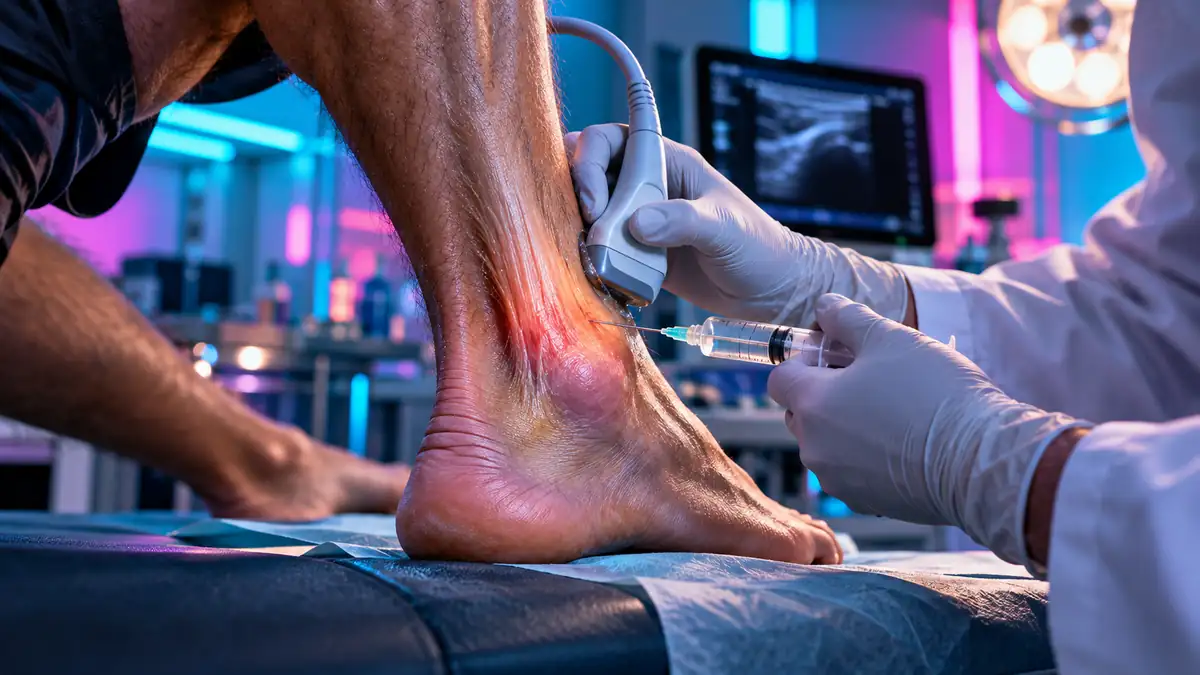
Three groups, the same exercise program
This single-center trial compared a sham injection in 64 participants, a high-volume injection without a corticosteroid in 63 participants, and a high-volume injection with hydrocortisone in 65 participants. Participants and assessors were unaware of group allocation.
The sham injection contained a small volume of local anesthetic. The other two used saline and a local anesthetic, with or without hydrocortisone. The comparator was therefore not an absence of treatment.
All participants received the same exercise program, information about their condition, and advice on modifying activity. The trial therefore assessed what the injection added to this care, not its effectiveness in isolation.
No clear difference in the primary outcome
The primary clinical outcome was the VISA-A score, used to assess Achilles tendon-related pain and disability, at 52 weeks. Researchers had these data for 181 participants, or 94% of the original sample.
At one year, no clear difference was observed between the sham injection and either high-volume injection. The confidence intervals remained compatible with effects in either direction: this result therefore does not demonstrate perfect equivalence between the options, but it does not show any lasting additional benefit.
With a corticosteroid, a favorable signal only in the short term
At six weeks, the high-volume injection with a corticosteroid produced a better VISA-A score than the sham injection. But at 26 weeks, its results were worse than those of the high-volume injection without a corticosteroid. These comparisons involve different time points and comparators: they do not support describing the corticosteroid as providing lasting benefit.
The economic analysis suggested lower costs with the corticosteroid than with the sham injection, with similar effectiveness measured in quality-adjusted life years. This economic finding does not override the lack of clear clinical benefit at one year.
What this trial changes
The authors conclude that the clinical results do not support routine use of high-volume injections with a corticosteroid for this tendinopathy. The trial also shows no clear advantage at one year for the version without a corticosteroid.
No serious trial-related adverse events were recorded. This is not enough to rule out rare complications. These results concern the midportion of the Achilles tendon and cannot automatically be extended to other tendon conditions.
Limitations to keep in mind
Only the PubMed abstract was consulted, not the full text. The trial was conducted at a single center, and the estimates remain uncertain. Funding, conflicts of interest, and details of adverse events have not been verified. The results do not apply to all forms of Achilles tendinopathy.
What we can take away
In this trial, adding a high-volume injection to an exercise program provides no clear benefit for pain and disability at one year. The early favorable signal for the corticosteroid does not justify promising lasting improvement.
Sources and provenance
- Efficacy and cost effectiveness of high volume injections with and without corticosteroid compared with sham for midportion Achilles tendinopathy (Inject trial): randomised controlled trial.
Source date: 2026-10-28.
Journal Article, Randomized Controlled Trial · Résumé PubMed uniquement, texte intégral non consulté