

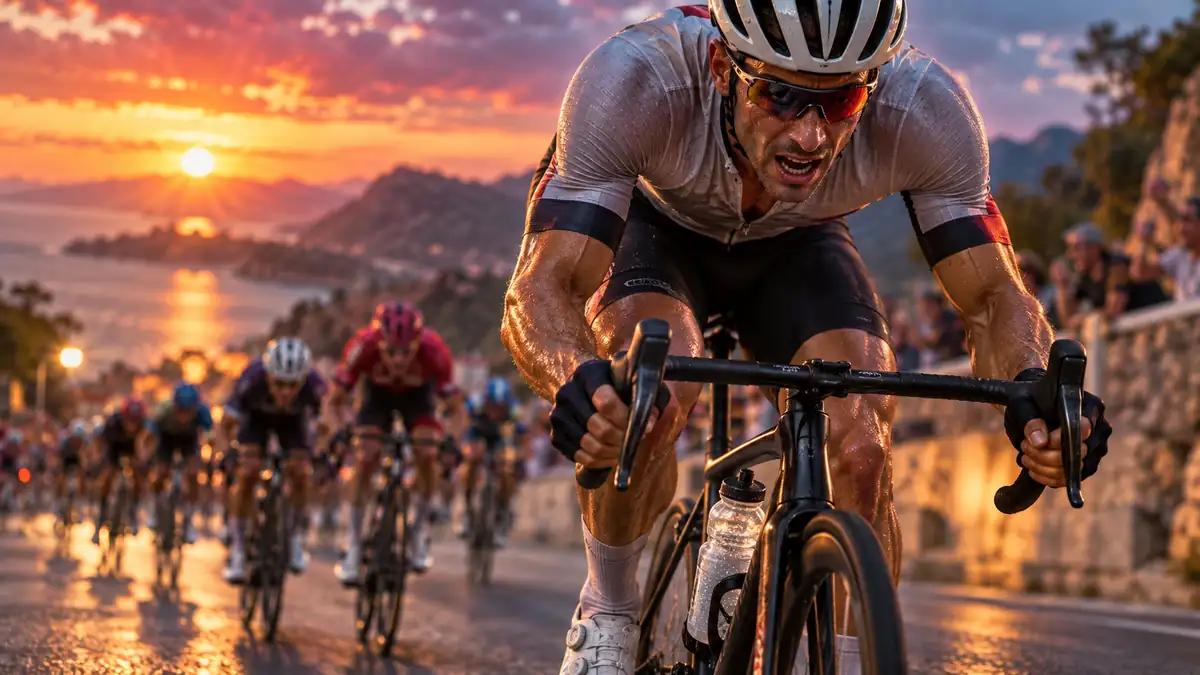
A trial in which each cyclist tests both conditions
The study includes 24 participants: 15 men and 9 women. After a familiarization session, each completes two experimental sessions: one after ingesting sodium bicarbonate, the other after a similar-looking placebo.
The order is randomized, and the trial is double-blind. This crossover design allows researchers to compare the same person's performance under both conditions, rather than comparing two separate groups.
Each session includes a submaximal test, five five-minute blocks of high-intensity interval training, then four 30-second Wingate sprints. The results therefore apply to this specific sequence of tests in already trained athletes.
More power, but a variable response
During the high-intensity blocks, power is an average of 8.1 watts higher with bicarbonate, or about 2%. Time spent above 90% of maximal oxygen uptake, or VO2 max, increases by an average of 23.7 seconds.
During the Wingate sprints, the average difference reaches 11.6 watts, again around 2%. The abstract reports statistically significant differences, but also substantial variation in those differences: these averages do not guarantee an individual benefit.
By contrast, the study detects no improvement in cycling economy or in the fraction of VO2 max used during the submaximal test. The observed benefit therefore does not extend to every measure.
An acute effect, not evidence of lasting progress
Blood bicarbonate concentrations, pH and lactate are higher in the bicarbonate condition. These physiological changes accompany the increase in power, without demonstrating better training adaptation on their own.
Spending more time above 90% of VO2 max could be useful for training. But the researchers note that any potential long-term improvement in VO2 max or sprint performance remains to be studied. This trial also does not establish a benefit in competition.
Tolerability remains a blind spot in the dossier
The dossier contains only the Europe PMC abstract, not a reviewed full text. This excerpt does not detail adverse effects, medical exclusions, funding or conflicts of interest. Their absence from the abstract does not mean they are absent from the study.
This missing information prevents the result from being turned into a recommendation for use. When making a purchasing decision, the observed average benefit should remain separate from tolerability and suitability for your own sporting context.
Limitations to keep in mind
Sample of 24 well-trained cyclists, comparison across two experimental sessions and substantial variation in results. Full text not reviewed. Tolerability, funding and conflicts of interest not verified in the dossier.
What we can take away
This trial supports a small, immediate increase in power in trained cyclists. It demonstrates neither lasting progress nor a benefit for all athletes.
Sources and provenance
- Sodium Bicarbonate Supplementation Enhances Repeated High-Intensity Interval Training Performance and Time Above 90% of V ˙ O 2 max in Well-Trained Cyclists.
Source date: 2026-10-01.
research-article, Randomized Controlled Trial, Journal Article · Résumé Europe PMC uniquement, texte intégral non consulté