

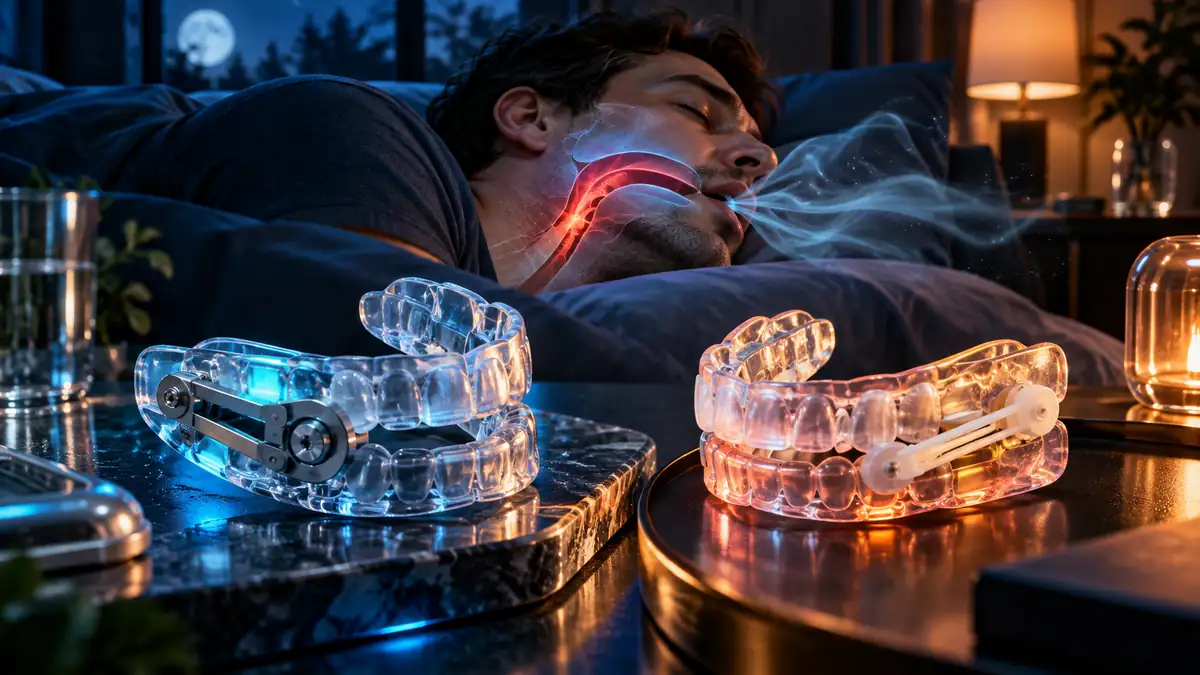
Each participant wore both appliances
This randomized trial, conducted at a single center in Genk, Belgium, compared the SomnoDentFlex and OrthoApnea NOA devices. Participants wore each appliance for three months, in a randomly assigned order, with a two-week break between periods.
All 16 adults had moderate obstructive sleep apnea. Participants and clinicians knew which device was being used, but those scoring the examination results did not. The trial was registered before enrollment began.
Less frequent respiratory events with both devices
The apnea-hypopnea index, or AHI, measures the number of apneas and hypopneas per hour. Its median value fell from 17.6 events per hour before treatment to 3.1 with SomnoDentFlex and 2.3 with NOA. These reductions were statistically significant compared with baseline.
In a post hoc analysis, an AHI below 5 events per hour was observed in 12 out of 16 participants with SomnoDentFlex and 10 out of 16 with NOA. These results describe this small group and do not guarantee an individual response.
The estimated difference between the devices was 0.16 events per hour, with a 95% confidence interval ranging from −2.56 to +2.87. No statistically significant difference was detected. This does not demonstrate that the appliances are identical or interchangeable.
A comparison weakened by the measurements
The main comparative analysis between the appliances was not initially planned. More importantly, the assessment method changed between periods, from home respiratory polygraphy to laboratory polysomnography. The authors report a period effect that cannot be separated from this change in method.
Information on actual appliance use and adjustments was also insufficient. No participant discontinued because of an adverse event, but these events were not collected systematically: the absence of discontinuations is therefore not enough to establish good tolerability.
The useful finding remains limited: both appliances were associated with a reduction in AHI in this trial, with no established comparative advantage. These data are not enough to choose one over the other.
Limitations to keep in mind
Single-center trial with 16 participants, a main comparison that was not prespecified, and a change in measurement method confounded with the study period. Data on adherence, adjustments, and adverse events are insufficient. Only the PubMed abstract was consulted. Funding and conflicts of interest were not verified.
What we can take away
Both appliances were associated with a reduction in respiratory events, but this trial demonstrates neither the superiority of either appliance nor their equivalence.
Sources and provenance
- A randomised controlled crossover trial comparing two mandibular repositioning appliances for treatment of moderate obstructive sleep apnoea.
Source date: 2026-10-28.
Journal Article, Randomized Controlled Trial, Comparative Study · Résumé PubMed uniquement, texte intégral non consulté