Short answer
TMG has become the mandatory accessory in the longevity stack: “a methyl donor to offset your NMN.” The mechanism exists. The 1:1 ratio you see everywhere, however, has never been tested in humans.
TMG, also called anhydrous betaine, has a real biochemical effect: it can provide a methyl group to convert homocysteine into methionine through the BHMT pathway. Human trials and a meta-analysis show a reduction in homocysteine, particularly when it is elevated. This does not mean it “optimizes” the epigenome, increases dopamine, fixes fatigue or should accompany every NAD+ precursor.
Homocysteine is a marker, not a toxin that needs to be arbitrarily pushed below some “biohacker” target. Before supplementing, you need to find out why it is elevated. Folate or vitamin B12 deficiency, renal impairment, hypothyroidism, certain medications and rare genetic diseases are not managed in the same way.
My verdict: TMG makes sense for specific medical indications, particularly certain forms of homocystinuria, and can lower a lab value in other adults. For a healthy person with no abnormal test result, the clinical benefit remains uncertain and does not justify an automatic “methylation stack.”
TMG, anhydrous betaine and betaine HCl: do not confuse them
Trimethylglycine is a molecule naturally found in beets, spinach, whole grains and other foods. Here, the term betaine refers to anhydrous betaine, used as an osmolyte and methyl donor.
Betaine hydrochloride, or betaine HCl, is a different product marketed to acidify stomach contents. It should not be used as a dose-for-dose substitute for TMG. Its purposes and risks differ. Our guide to betaine HCl and reflux covers this issue separately.
This distinction matters on the label. A product stating “betaine HCl 650 mg” does not simply provide 650 mg of TMG suitable for homocysteine protocols.
The useful mechanism: the BHMT pathway
Homocysteine sits at a crossroads in methionine metabolism. It can be remethylated into methionine or directed toward transsulfuration. Two remethylation systems are particularly relevant.
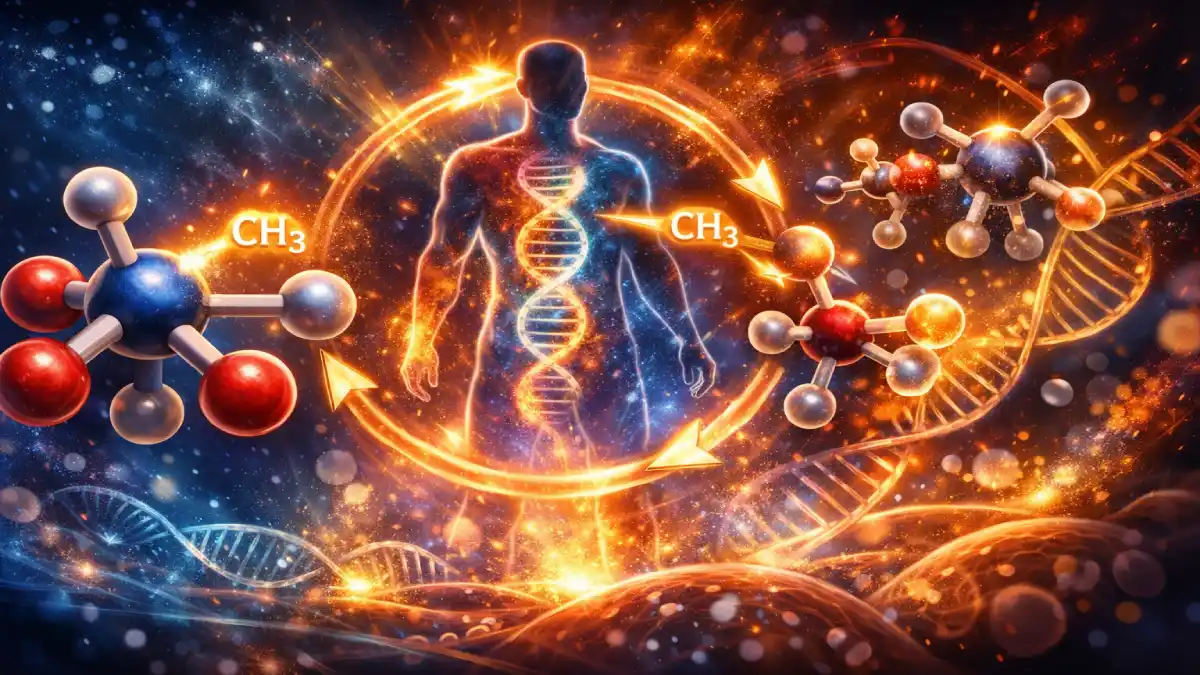
The folate- and vitamin B12-dependent pathway operates in many tissues. The BHMT pathway uses betaine and is concentrated mainly in the liver and kidney. TMG donates a methyl group to homocysteine, producing methionine and dimethylglycine.
This mechanism explains the possible reduction in homocysteine. It does not prove several widespread claims:
- that fatigue reveals a general shortage of methyl groups
- that TMG increases dopamine or adrenaline in a beneficial way
- that a supplement changes gene expression in an overall beneficial direction
- that a below-normal level improves health further
Methylation is not a single gauge you can top up. Different reactions take place depending on the tissues, substrates and enzymes involved. The categories “undermethylator” and “overmethylator,” inferred from irritability, insomnia or personality, have no clinical diagnostic validation.
What homocysteine trials show
A 2013 meta-analysis pooled trials of betaine supplementation in healthy adults. It concluded that plasma homocysteine decreased. However, an average effect on a biomarker does not tell us whether heart attacks, strokes, cognition or mortality improve.
A 2023 randomized trial in 100 Chinese adults with hyperhomocysteinemia tested a combination of 1 g of betaine, 400 µg of folic acid, 8 mg of vitamin B6 and 6.4 µg of vitamin B12 for twelve weeks. The active-treatment group reduced homocysteine more than the placebo group. Because four nutrients were combined, this trial does not measure the isolated effect of 1 g of TMG.
The situation is different in homocystinurias. These are rare metabolic diseases involving sometimes very high concentrations and a substantial risk of thrombosis. Betaine may be prescribed as a medicine in these conditions, with doses, targets and monitoring that must not be copied for self-supplementation.
If your test shows an elevated value, read the guide to homocysteine: causes and what to do · FR before buying a methyl donor.
MTHFR: a variant is not a diagnosis
The MTHFR variants C677T and A1298C are common. They can alter the activity of an enzyme in the folate cycle, but their presence does not mean a person is ill, deficient or unable to methylate properly.
TMG takes a different pathway, which provides a rational hypothesis when homocysteine remains elevated. But “bypassing MTHFR” is not enough to decide on treatment. Taking TMG has no demonstrated benefit for someone with a variant and normal homocysteine. Conversely, elevated homocysteine without a variant may require investigation.
The following factors need to be assessed together:
- homocysteine level and blood sampling conditions
- vitamin B12, with methylmalonic acid if the context warrants it
- folate status and dietary habits
- creatinine and kidney function
- thyroid function, depending on symptoms
- medications, alcohol and smoking
- history of thrombosis or suspected rare metabolic disease
Buying a direct-to-consumer genetic test and then adding methylfolate, B12, B6 and TMG risks treating a genotype rather than a clinical problem. High-dose vitamin B6 can notably cause neuropathy, a risk detailed in our article on the neurotoxic dose of vitamin B6 · FR.
TMG and NAD+ precursors: the 1:1 ratio is made up
The story is appealing: nicotinamide produced during NAD+ metabolism is methylated for elimination, so NR or NMN would deplete methyl reserves, and TMG would restore them. A metabolic pathway exists, but the commercial protocol has not been validated.
The 2018 crossover trial in middle-aged and older adults studied nicotinamide riboside for six weeks. It confirmed an increase in NAD+ metabolism and good short-term tolerability. It did not establish a clinical methyl deficiency requiring a milligram-for-milligram ratio with TMG.
No nutritional requirement can be inferred simply from the weight of another supplement. NR, NMN and TMG have different molar masses, absorption and pathways. A 1:1 rule in milligrams lacks a sufficient physiological basis.
If someone takes an NAD+ precursor in a supervised trial, homocysteine can be measured before and after if the clinician considers it relevant. Adding several methyl donors preventively makes the trial impossible to interpret and introduces risks of its own.
Athletic performance: mixed results
Betaine acts as an osmolyte, which has prompted trials on strength, power, body composition and endurance. Results are inconsistent. A 2025 systematic review on endurance found only five studies, all judged to be at high risk of bias. Some physiological or power outcomes were favorable; others were not.
A six-week CrossFit trial published in 2020 showed no improvement in hypertrophy or strength. Other small trials report positive signals for specific performance measures. This heterogeneity does not support promises of muscle gain or recommending 2.5 g per day as a universal standard.
If strength is the goal, progressive loading, protein intake, energy availability and creatine monohydrate have a stronger evidence base. TMG should come only after these variables, in a trial with a standardized exercise and outcome measure.
Risks, interactions and lipid profile
Reported adverse effects are mainly digestive, including nausea, diarrhea or discomfort. Body odor may change in some people. Pregnancy and breastfeeding data do not justify self-directed use without a medical indication.
A meta-analysis published in 2021 concluded that supplementation modestly increased total cholesterol. This effect matters when TMG is proposed as cardiovascular protection solely on the basis of lower homocysteine. Improving one marker while potentially worsening another requires looking at the overall picture.
Medical advice is necessary in the following situations:
- markedly elevated homocysteine or a history of thrombosis
- kidney or liver disease
- a known lipid disorder
- pregnancy, breastfeeding or age under 18
- taking multiple B vitamins or methionine
- suspected homocystinuria
Do not stop a treatment or replace folate or vitamin B12 with TMG without identifying the cause. B12 deficiency can cause neurological damage even if homocysteine falls through another pathway.
A cautious decision-making protocol
For an adult without a rare disease, the protocol starts with a measurement, not a bottle.
Follow this order:
- confirm the abnormality and clinical context with a healthcare professional
- investigate common causes and address the deficiency or causative medication where possible
- decide whether TMG adds a plausible benefit to treatment of the underlying cause
- choose a dose from an applicable trial, without copying the high doses used for rare diseases
- recheck homocysteine, tolerability and lipid profile after a defined period
- stop if the marker does not respond or the overall assessment worsens
For simple curiosity about “methylation,” no symptom is specific enough to justify this protocol. Fatigue, brain fog and disrupted sleep call for a broader assessment.
Lowering homocysteine does not automatically mean preventing a heart attack
Elevated homocysteine is associated with cardiovascular risk in observational studies and becomes very dangerous in certain severe genetic diseases. But an association does not establish that every reduction achieved through supplementation proportionally reduces risk.
Large B-vitamin trials have taught a general lesson: changing an intermediate biomarker does not always deliver the expected cardiovascular benefit. The cause of the elevation, the population and the treatment matter. Someone deficient in B12 needs to correct that deficiency. Someone with renal impairment does not resolve their overall risk merely by masking homocysteine. Homocystinuria requires a specialist center.
Nor is there a universal “optimal” threshold below 7 µmol/L to pursue with supplements. Reference intervals depend on the laboratory and context. Chasing the lowest number can increase doses without evidence of clinical benefit.
Reassessment must therefore distinguish three outcomes:
- has the original cause been identified and treated
- has homocysteine decreased by the expected proportion
- has the overall profile, particularly lipids, symptoms and tolerability, improved
This framework avoids labeling TMG an artery protector based solely on a change in one marker.
Product quality and dietary sources
Dietary betaine is not equivalent to a concentrated dose. Beets, spinach and whole grains provide a range of nutrients without guaranteeing the amount used in a trial. For a supplement, look for “anhydrous betaine” or “trimethylglycine,” the amount per serving and independent testing. Avoid blends that confuse TMG, betaine HCl and high-dose B vitamins.
The Verdict
TMG is a genuine methyl donor and a useful therapeutic tool in certain metabolic disorders. It can lower homocysteine. Those are the two solid claims.
It has not been shown to optimize a healthy adult’s epigenome, to be mandatory with NMN or NR, to automatically correct the consequences of an MTHFR variant or to reliably improve performance. Its best use is therefore not a preventive stack. It is a conditional decision based on an assessment, an underlying cause and reassessment.