Elderberry and flu: the short answer
Elderberry syrup has not been shown to shorten the flu or a cold. Small favourable trials exist, but almost all come from manufacturers, and the only large independent trial found no difference from placebo. That is the most honest conclusion the evidence allows as of November 2026.
Elderberry does have an intriguing evidence base. Its berries contain compounds that inhibit flu viruses in the laboratory, and early clinical trials reported spectacular recoveries. The problem lies elsewhere: those trials were tiny, and the large trial launched to confirm them contradicted their findings.
For a healthy adult, elderberry syrup is therefore not a priority purchase. One use, however, is definitely worth avoiding: homemade juice prepared with raw berries, leaves or stems.
Berries, flowers, syrup: what are we talking about?
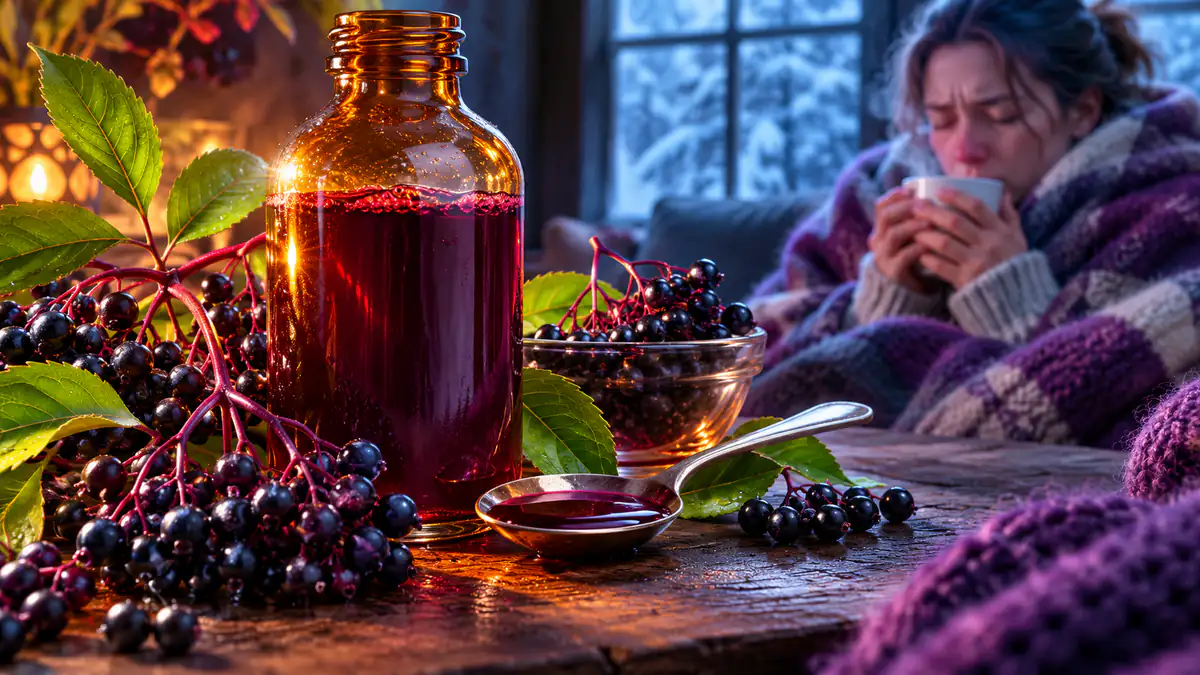
Black elder, Sambucus nigra, provides two very different products. The dark purple berries are used in syrups, gummies and capsules sold for flu. The white flowers are mainly used in teas.
The European Medicines Agency recognises the traditional use of the flowers to relieve early cold symptoms in adults and adolescents over 12. “Traditional” has a precise meaning here: the use is considered plausible and safe after at least 30 years of use, but the committee itself notes the absence of clinical trials involving the flowers. If symptoms worsen or last longer than a week, it advises seeking medical advice.
For the berries used in syrups, the same committee reviewed the evidence without adopting a European monograph: it issued only a public statement. In other words, the product most widely sold for flu has not even obtained the traditional-use status granted to elderflower tea.
The mechanism, and its limits
Elderberries are rich in anthocyanins and other polyphenols. As early as 1995, an Israeli team showed that a standardised extract inhibited the replication of several strains of influenza A and B viruses in cell cultures. In 2011, another standardised extract inhibited streptococci and a respiratory bacterium in culture, as well as flu viruses.
These findings provide a biological hypothesis, not proof that a syrup shortens your flu. Between a Petri dish and your airways, the compounds need to be absorbed and reach the right tissues at the right concentration and at the right time. This is the territory of Mitochondria Marketing: using a genuine biological mechanism to sell a product whose benefit has not been demonstrated.
The trials that started the craze
Before 2020, three placebo-controlled trials examined flu treatment. The 2021 systematic review by Wieland and colleagues analysed them using Cochrane methods: 151 participants in total.
The first, published in 1995 by Zakay-Rones and colleagues, took place in a kibbutz during an influenza B outbreak. Clear improvement, including fever, occurred within two days in 93.3% of patients taking Sambucol, compared with six days in 91.7% of patients taking placebo. The authors reported complete recovery within two to three days in nearly 90% of treated patients.
The figures look impressive until you check the trial size: 27 participants analysed according to Wieland, aged 5 to 56. The review found that the randomisation method was not described and that the risk of bias was high because participant follow-up was incomplete.
The second, published in 2004 by the same Jerusalem virology team, included 60 adults aged 18 to 54 who had been ill for no more than 48 hours, during the winter of 1999–2000 in Norway. They took 15 ml of syrup four times a day for five days. Symptoms resolved an average of four days earlier than with placebo. According to Wieland, the trial was funded by the Jerusalem-based company Razei Bar, and the product tested was Sambucol.
The third, conducted in China in 2009, tested lozenges containing 175 mg of extract in 64 patients, four times a day for two days. It was funded by HerbalScience Singapore. Wieland could not extract usable data on duration.
What the review concludes
Wieland’s verdict is cautious: elderberry might reduce flu duration, but the evidence is “uncertain”. Duration estimates vary enormously between trials, with 94% heterogeneity, meaning the trials do not tell the same story. None had a protocol or registration published in advance.
A 2019 meta-analysis, involving 180 participants, instead concluded that elderberry had a “large effect”. Wieland criticised its use of a quality assessment tool that rated these same trials as having a low risk of bias. With almost identical data, the rigour of the assessment changes the conclusion.
An overview of 18 reviews published in 2026 on plants for respiratory infections places elderberry among those showing “some benefits”. Yet it considers the evidence insufficient for a strong clinical recommendation because of methodological flaws in the trials.
The 2020 trial that stopped the momentum
Between 2017 and 2018, following a severe flu winter, elderberry sales in the United States more than doubled, exceeding 100 million dollars. Against this backdrop, a Cleveland Clinic team launched the most rigorous trial in this evidence base, published in 2020 by Macknin and colleagues.
The trial was investigator-initiated, double-blind and placebo-controlled, and conducted in three emergency departments. It included 87 patients aged 5 and older, with PCR-confirmed flu and symptoms lasting less than 48 hours. Those over 12 took 15 ml of extract, equivalent to 5.7 g, four times a day for five days, while those aged 5 to 12 took it twice a day.
The result: it took an average of 5.3 days with elderberry for all symptoms to become mild or absent, versus 4.9 days with placebo. Complete recovery occurred after 8.6 days with elderberry and 8.7 days with placebo. No difference, even though the trial had more than 90% statistical power to detect a two-day benefit.
An unplanned secondary analysis even suggested that patients taking elderberry alone, without an antiviral, took two days longer to feel better than those taking placebo alone. This finding remains tentative and does not prove that elderberry makes flu worse. The main result is enough: the four-day benefit reported by the early trials did not reappear when an independent team repeated the experiment.
The authors themselves note a limitation: the sample remains small. But it is the largest flu treatment trial using elderberry alone, and the only one registered in advance.
Prevention: fewer colds, or shorter colds?
Only one trial has tested elderberry for preventing colds. In 2016, Tiralongo and colleagues followed 312 passengers on long-haul flights departing from Australia, with an average age of 51. They took 600 mg of extract daily for the ten days before departure, then 900 mg daily until four or five days after arrival.
The difference in the number of colds was not significant: 12 travellers taking elderberry versus 17 taking placebo. However, colds in the placebo group lasted longer, with 117 cumulative days of cold symptoms versus 57, and more severe symptoms.
Two caveats weigh on this finding. The study was funded by Iprona, the extract manufacturer, which supplied the capsules and partly contributed to the trial design. Also, the primary outcome declared in the trial registry was not the one highlighted in the publication, which Wieland rated as a high risk of selective reporting.
For prevention, the conclusion is therefore simple: nothing shows that elderberry reduces the risk of catching a cold, and its effect on duration rests on a single manufacturer-linked trial.
Table: what the trials show
| Study | Population | Product and dose | Main result |
|---|---|---|---|
| Zakay-Rones 1995 | 27 flu patients, aged 5 to 56 | Sambucol syrup | Improvement in 2 days versus 6, randomisation not described |
| Zakay-Rones 2004 | 60 adults with flu | Sambucol, 15 ml 4 times daily, 5 days | 4 fewer days, trial funded by Razei Bar |
| Kong 2009 | 64 adults with flu | 175 mg lozenges, 4 daily, 2 days | Duration results unusable according to Wieland |
| Tiralongo 2016 | 312 healthy travellers | Capsules, 600 then 900 mg daily | 12 colds versus 17, not significant, shorter colds |
| Macknin 2020 | 87 patients, PCR-confirmed flu | Extract, 15 ml up to 4 times daily, 5 days | No difference in duration or severity |
This table does not compare products against each other. Above all, it shows a pattern in this evidence base: the smaller the trial and the closer its ties to the manufacturer, the larger the reported effect.
Cytokine storm: a concern without evidence
During the Covid-19 pandemic, a concern circulated: by stimulating immunity, elderberry might trigger a “cytokine storm”, the excessive inflammatory reaction seen in severe cases. Wieland’s review specifically investigated this risk.
It found no study linking elderberry to inflammatory complications in humans, and no evidence that it overstimulates the immune system. The three studies that measured inflammatory markers after elderberry intake found an effect on some markers that appeared to diminish with continued use, without known clinical consequences.
The opposite has not been demonstrated either: there is no proof that elderberry protects against Covid-19. The US agency NCCIH notes that the Food and Drug Administration and the Federal Trade Commission took action against companies selling it as a Covid-19 remedy without evidence.
Safety: the real danger is in the kitchen
In the trials, elderberry was well tolerated over courses lasting two to sixteen days, with no serious adverse effects reported. However, Wieland stresses that the trials monitored adverse effects poorly, leaving their true frequency uncertain. The 2026 overview reached the same conclusion for all the plants studied: adverse effects were probably underreported.
The documented risk comes from elsewhere. According to the NCCIH, raw or unripe berries, as well as leaves and stems, contain substances that release cyanide. They can cause nausea, vomiting and severe diarrhoea. Cooking eliminates these compounds.
A case of group poisoning was reported by the Centers for Disease Control and Prevention in 1984. In August 1983, in California, juice made from wild berries pressed with their leaves and branches was served to a group of 25 people. Eleven developed nausea and vomiting within fifteen minutes, and eight were airlifted to hospital. Symptom severity tracked the amount of juice consumed, while those who drank only tea remained well.
Who should avoid it or seek advice
The following situations warrant advice from a doctor or pharmacist before using any elderberry product:
- Pregnancy and breastfeeding, because almost nothing is known about elderberry’s safety in these situations.
- Regular medication use, since the NCCIH recommends speaking to a healthcare professional before taking an herbal product, given the lack of robust interaction data. The guide to supplement interactions helps you sort things out if you take several products.
- Use in a child, because paediatric data are limited to a few participants in two trials, and European recognition of the flowers’ use starts only at age 12.
- Immunosuppressant treatment or an autoimmune disease: no safety signal has been demonstrated, but these people were excluded from the traveller trial, for example.
If you still want to try it
The evidence does not justify recommending elderberry. If you are set on trying it, here is the approach most consistent with what has been studied:
- Choose a product containing only Sambucus nigra berries that states the amount of extract per dose, rather than a ten-ingredient winter blend.
- Start within the first 48 hours of symptoms, as in the trials, and stop after five days.
- Record your symptoms daily without expecting anything spectacular: the large 2020 trial found no days saved.
- Never make homemade juice with raw or unripe berries, or berries pressed with leaves and stems.
The Toll of this product—its hidden cost in time, money and attention—is not negligible. The trials required up to four doses a day, and a syrup may contain added sugar: check the label. For a benefit that does not hold up in the most rigorous trial, that is a steep bill.
The rest of the winter-remedy aisle does little better. Trials of echinacea show no effect on cold duration, and the evidence for zinc lozenges for colds remains shaky. Vitamin C taken regularly modestly shortens colds, without reducing their number in the general population.
Warning signs that take priority over syrup
According to the NHS, flu often clears up on its own with rest, water and a painkiller for fever. However, it can become serious in some people. Seek medical advice promptly if you are over 65, pregnant, have a chronic condition or a weakened immune system, feel very unwell or short of breath, or if symptoms do not improve after seven days.
Sudden chest pain, severe difficulty breathing or coughing up blood mean you need to call emergency services. And a useful reminder in November: cold weather does not cause a cold · FR—viruses do.