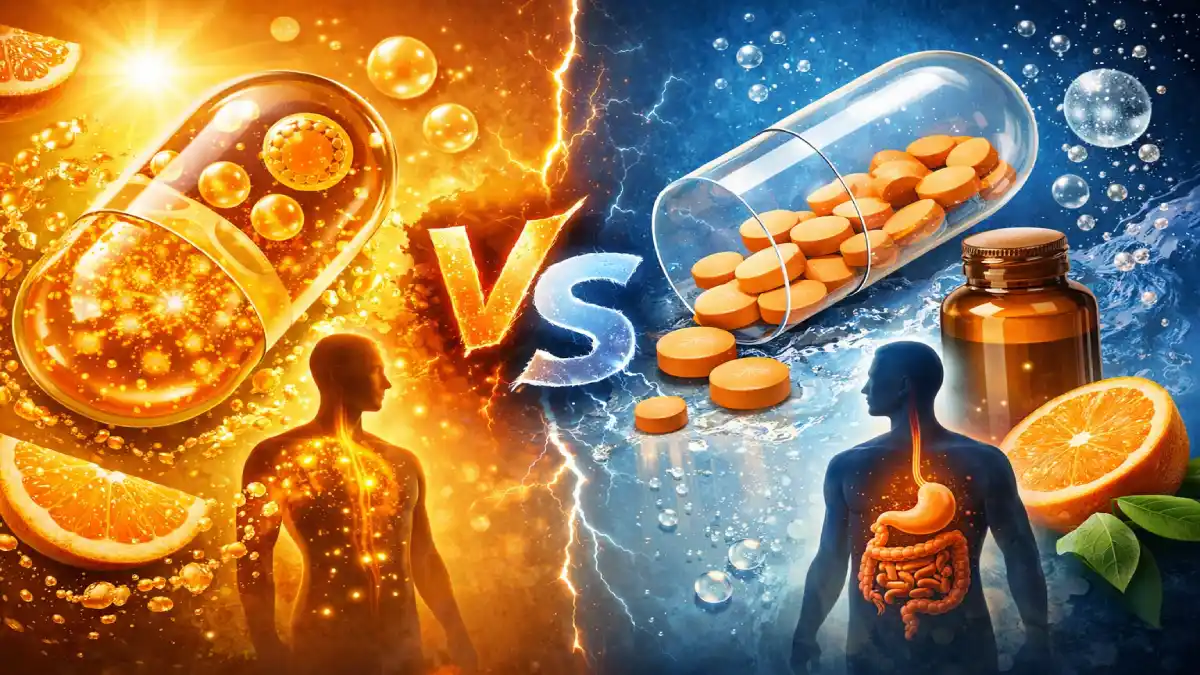
Liposomal vitamin C costs significantly more than regular vitamin C, with the promise of spectacular absorption. It does raise blood vitamin C levels a little more. What’s missing is proof that this makes any difference to your health.
Liposomal vitamin C can increase blood concentrations more than regular vitamin C, but no solid evidence shows that it offers better protection against infections, boosts energy more or produces a better clinical outcome in healthy adults.
The regular form is already very well absorbed at nutritional doses. As doses rise, liposomal vitamin C mainly becomes a question of cost, tolerability and formulation—not a necessity for meeting your needs.
How regular vitamin C is absorbed
Ascorbic acid is an essential water-soluble vitamin. The intestine absorbs it partly through specific transporters, and the kidneys then tightly regulate its blood concentration.
A depletion–repletion study hospitalized seven volunteers for several months and tested intakes ranging from 30 to 2,500 mg per day. It observed the following:
- the steepest part of the plasma response was between 30 and 100 mg per day
- the immune cells measured were saturated at around 100 mg per day
- a single 200 mg oral dose had complete bioavailability
- from 500 mg per dose upward, the fraction absorbed decreased
- at high doses, an increasing proportion was eliminated in the urine
This regulation produces diminishing returns. It does not mean that a regular tablet is “blocked” or useless. It means that a dose five times higher does not produce a concentration five times higher.
ANSES sets the French dietary reference intake at 110 mg per day for adult men and women. Blackcurrants, citrus fruit, kiwifruit, peppers, parsley, broccoli and other fruit and vegetables can provide this intake.
How a liposomal formulation works
A liposome is a structure made of phospholipids that surrounds some of the ascorbic acid. The aim is to protect the contents and alter their passage through the digestive tract.
The mechanism described in marketing often involves direct fusion with cells and mitochondria. The reality is more complex. Liposomes may be digested, remodeled, absorbed or release their contents before reaching the circulation. Size, composition, charge, stability and encapsulation rate influence the result.
The word “liposomal” therefore does not guarantee a formulation identical to one used in a trial. An ingredient list containing ascorbic acid and lecithin alone tells you nothing about the proportion actually encapsulated.
What comparative trials show
4 g trial: more in the blood, no better functional outcome
In 2016, eleven adults received a placebo, 4 g of regular oral vitamin C, 4 g of liposomal vitamin C or intravenous vitamin C across four visits.
The liposomal form produced higher circulating concentrations than the regular oral form, but lower concentrations than the intravenous form. In the experimental ischemia–reperfusion model used, all three forms of vitamin C provided similar protection. Better oral exposure therefore did not translate into a superior functional outcome in this test.
The study was funded by Empirical Labs. One author owned a company selling liposomal vitamin C and had financial interests related to its manufacture.
500 mg trial: a measurable but moderate absorption advantage
A 2024 crossover trial compared a placebo, 500 mg of regular vitamin C and 500 mg of liposomal vitamin C in 27 adults. Compared with the regular form, the liposomal product increased:
- peak plasma levels by 27%
- plasma exposure over 24 hours by 21%
- peak levels in leukocytes by 20%
- exposure in leukocytes over 24 hours by 8%
The result confirms better absorption for this specific product. The study did not measure infections, fatigue, performance or chronic disease. It was funded by the company marketing the formulation tested.
An increase of 8–27% is interesting in pharmacokinetic terms. It does not justify phrases such as “total absorption,” “unmatched intracellular penetration” or “multiplied effectiveness.”
Liposomal vs regular vitamin C: comparison
| Criterion | Regular vitamin C | Liposomal vitamin C |
|---|---|---|
| Absorption at nutritional doses | Already high | No necessary advantage demonstrated |
| Exposure at 500 mg | Reference | Higher with the product tested |
| Evidence of superior clinical benefit | Not applicable | Not demonstrated |
| Digestive tolerability | May decrease at high doses | Possibly better depending on formulation, with no guarantee |
| Ease of verifying quality | Ascorbic acid dose identifiable | Encapsulation and stability difficult to verify |
| Cost | Low | Significantly higher |
To meet your needs, the regular form or food is generally enough. For a specific medical indication, the choice should be based on trials for that indication, not just an area under the curve.
Immunity and colds: what vitamin C can actually do
A Cochrane review analyzed 29 comparisons involving more than 11,000 participants for cold prevention. In the general population, regular supplementation did not significantly reduce the risk of catching a cold.
Episodes were shortened by an average of around 8% in adults and 14% in children when vitamin C was taken regularly. A subgroup exposed to brief, intense physical exertion in harsh conditions appeared to benefit more in terms of prevention.
Starting vitamin C after symptoms appeared did not produce consistent results. Above all, these trials do not demonstrate that the liposomal form works better than the regular form.
A small reduction in duration does not mean “massively boosting immunity.” A persistent high fever, shortness of breath, chest pain, confusion or rapid deterioration requires medical assessment, not a higher dose.
Does vitamin C improve mitochondrial energy production?
Vitamin C contributes to antioxidant defenses and the synthesis of carnitine, catecholamines and collagen. Deficiency can cause fatigue and, at an advanced stage, scurvy.
In someone with adequate intake and vitamin C status, increasing plasma concentrations does not guarantee more ATP or better recovery. Oxidative stress is not waste to be eliminated completely. Some reactive species also contribute to signaling and adaptation to exercise.
The comparison with NAC and liposomal glutathione · FR leads to the same verdict: changing a redox biomarker does not prove an overall clinical improvement.
Should you pay more for the liposomal form?
The decision can follow three scenarios:
A varied diet and no particular needs
The liposomal form offers no demonstrated advantage. Regularly meeting the dietary reference intake through fruit and vegetables is enough.
Low intake or a preference for a simple supplement
A small dose of regular vitamin C is already well absorbed. Spreading food intake throughout the day makes more sense than an occasional megadose. A pharmacist can help you choose a dose if your diet does not meet your needs.
A medical condition or malabsorption
The clinician needs to identify the cause, the dose and sometimes the route of administration. A commercially available liposomal product does not replace treatment for severe deficiency or intravenous administration when medically indicated.
How to assess a liposomal product
No visual test can confirm encapsulation. A powder is not automatically fake, and a thick liquid is not automatically genuine.
Look instead for verifiable information:
- actual amount of vitamin C per dose
- phospholipid composition
- characterization method and particle size
- stability through the expiration date
- independent batch analysis
- no claims of equivalence to intravenous administration
A brand citing a study must have tested the same formulation, not just another product using the word liposomal.
Risks of high doses
Unabsorbed vitamin C can draw water into the intestine and cause diarrhea, cramps or nausea. Increasing the dose to the limit of digestive tolerance is not a medical dosing method.
An analysis of three large cohorts found that supplemental intake of at least 1,000 mg per day was associated with more kidney stones in men, but not in women. This is an observational association, not proof that every man will develop a stone.
Seek medical advice before taking high doses in the following situations:
- kidney disease or a history of stones
- hemochromatosis or another form of iron overload
- chemotherapy or treatment with a potential interaction
- pregnancy, breastfeeding or being under 18
- symptoms suggesting a significant deficiency
Vitamin C increases the absorption of non-heme iron. This effect is useful in some contexts and undesirable in cases of iron overload.
The Verdict
Yes, some liposomal products increase vitamin C concentrations more than the regular form. No, that does not demonstrate better immunity, better recovery or superior mitochondrial benefits.
To meet the adult reference intake of 110 mg per day, prioritize food or a simple regular form if needed. Save the extra cost of liposomal vitamin C for situations where there is a concrete tolerability advantage or a documented indication, not just the promise of spectacular absorption.