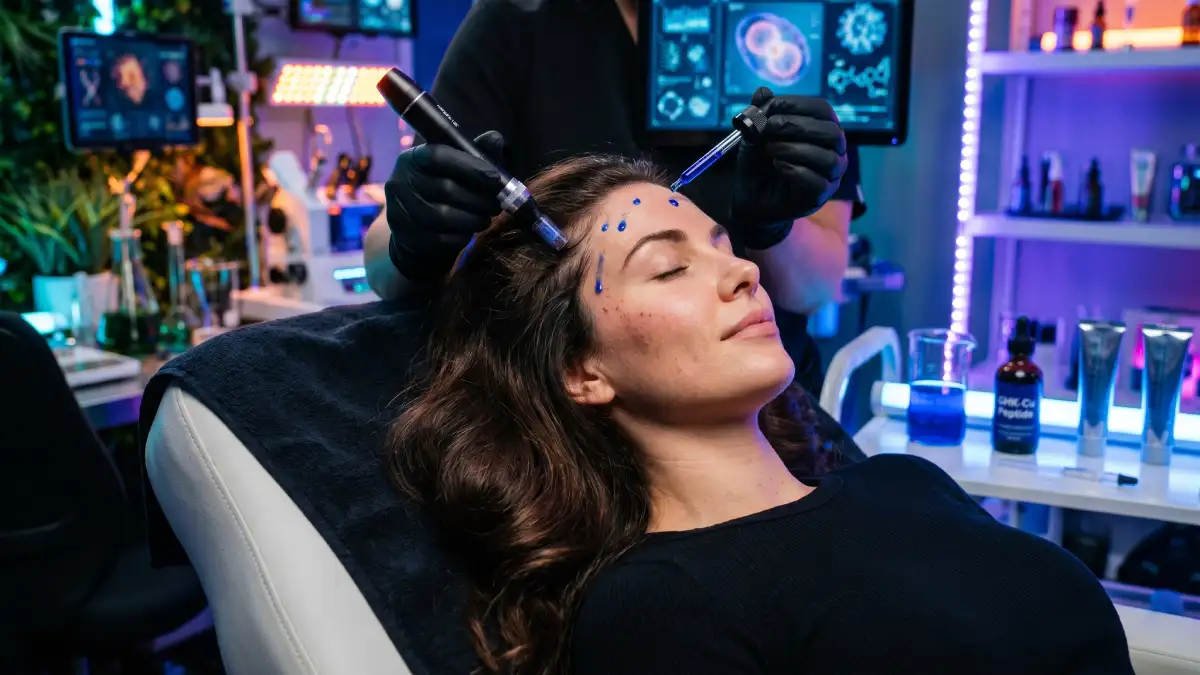
The verdict in one sentence: microneedling has limited but genuine clinical evidence for certain scars and as an adjunct to minoxidil in androgenetic alopecia, while the microneedling + GHK-Cu stack remains unvalidated in humans.
This distinction changes the decision. A plausible skin-repair mechanism is not enough to prove that a copper peptide serum applied to punctured skin rejuvenates the face or regrows hair.
Microneedling and GHK-Cu: two different interventions
The practice of microneedling creates multiple tiny punctures in the skin using a needle device. The procedure triggers a wound-healing response and can alter the penetration of applied products.
The peptide GHK-Cu, also called copper tripeptide-1 in some cosmetics, is a copper-bound tripeptide. Cell and animal experiments suggest effects on fibroblasts, the extracellular matrix and wound healing.
The levels of evidence are not equivalent:
| Question | Current level of evidence | Cautious conclusion |
|---|---|---|
| Microneedling for acne scars | Clinical trials and reviews, variable quality | May improve the appearance of certain scars |
| Microneedling + minoxidil for androgenetic alopecia | Several small randomized trials and heterogeneous meta-analyses | Promising adjunct under dermatological supervision |
| Topical GHK-Cu for wrinkles | Limited mechanistic and cosmetic data | Uncertain clinical benefit |
| GHK-Cu for hair regrowth | Very little directly applicable human data | Not a replacement for a validated treatment |
| Microneedling + GHK-Cu | Transdermal delivery studies, no robust clinical trial on cosmetic outcomes | Experimental stack |
What microneedling can do for skin
A systematic review of 33 publications on acne scars reported improvement in the included studies. It also highlighted inconsistent comparisons with combination treatments or lasers.
This supports a targeted indication, not the following promises:
- “reversing” skin aging
- erasing every scar
- rebuilding youthful skin in one session
- increasing collagen by a universal percentage
The effect depends on scar type, skin phototype, technique, number of sessions and practitioner skill. Ice pick scars, for example, do not necessarily respond like rolling scars.
A dermatologist can also identify a pigmented or inflammatory lesion that would be risky to puncture. That is a major difference between a home device and a medical indication established after an examination.
What studies show for hair
The strongest evidence concerns microneedling added to minoxidil, not GHK-Cu.
A meta-analysis published in 2025 included 12 randomized trials and 631 people with androgenetic alopecia. The combination improved hair count and diameter compared with minoxidil alone. However, heterogeneity was very high for hair count, and adverse effects were more frequent with the combination, although they were generally mild or transient.
The analyses did not show that any specific depth, duration or device type clearly explained the outcome. Turning this literature into a universal protocol precise to the millimeter would therefore be misleading.
The practical limitations matter:
- trials are often small and short
- counting methods and treated areas vary
- microneedling is generally studied alongside an established active treatment
- the data do not prove that the procedure outperforms minoxidil alone for every patient
- they do not demonstrate that GHK-Cu blocks DHT in humans
Diffuse, sudden or patchy hair loss may result from a deficiency, thyroid disease, autoimmune alopecia or effluvium. Needling the area without a diagnosis delays appropriate care.
GHK-Cu: an interesting mechanism, no established human benefit
Reviews of GHK-Cu describe modulation of collagen, elastin and glycosaminoglycan synthesis, as well as repair-related pathways. Much of this literature comes from cells, animal models or formulation research.
A transdermal delivery study showed that polymeric microneedles increased GHK-Cu passage in ex vivo human skin and porcine skin models. It measured penetration, not wrinkle reduction, hair regrowth or long-term safety in users.
So here is the shortcut to avoid:
more peptide crossing the skin ≠ a better clinical outcome
Increased penetration may also increase exposure to an excipient or contaminant. The skin barrier is not just a cosmetic obstacle. It is protection.
Claims of “reprogramming thousands of genes” come from expression analyses and mechanistic reviews. They do not demonstrate that a commercial serum restores human skin to a youthful state, let alone after microneedling.
Why applying a serum immediately is a problem
After needling, a cosmetic product designed for intact skin does not automatically become suitable for intradermal administration.
Possible risks include:
- bacterial, viral or fungal infection
- irritant or allergic dermatitis
- post-inflammatory hyperpigmentation
- a herpes flare
- hypertrophic scarring or keloids
- granuloma caused by particles introduced into the dermis
- increased exposure to preservatives, fragrances or contaminants
A case series published in JAMA Dermatology described three facial granulomatous reactions after microneedling with the application of topical products. A case series does not quantify how often the risk occurs, but it shows that “cosmetic” and “natural” do not mean “safe to inject into the dermis.”
A certificate of analysis stating chemical purity does not prove sterility, the absence of endotoxins or a product’s compatibility with punctured skin. The guide to peptides bought online · FR explains these differences.
Skin and scalp: do not copy the same protocol
Facial skin and the scalp involve different goals. On the face, the target may be a specific scar or texture. On the scalp, the type of alopecia must first be established, taking follicles, existing hair and accompanying treatments into account.
Decisions also differ in several areas:
| Variable | Face | Scalp |
|---|---|---|
| Prior diagnosis | Scar type, inflammation, pigmentation | Alopecia type, progression, associated causes |
| Measurable outcome | Standardized photos, skin surface contours, scar score | Density, diameter, standardized hair-part photos |
| Common risk | Irritation, post-inflammatory pigmentation | Irritation, folliculitis, worsening of a skin condition |
| Standard treatment | Depends on the scar and skin phototype | Minoxidil or other options based on medical diagnosis |
| Role of GHK-Cu | Not established after microneedling | Not established for regrowth |
Who should not improvise this procedure?
An assessment with a dermatologist is particularly important in the following situations:
- skin infection, herpes or warts in the area
- active inflammatory acne
- an eczema, psoriasis or rosacea flare
- a history of keloids or poor wound healing
- immunosuppression or poorly controlled diabetes
- a bleeding disorder or anticoagulant treatment
- pregnancy or breastfeeding with plans to use unassessed active ingredients
- recent isotretinoin use or another treatment that alters wound healing, depending on the dermatologist’s advice
Never share a cartridge or reuse single-use equipment. Home disinfection does not turn a blunt needle into a sterile device.
How to decide without buying the stack first
The best approach starts with the clinical problem, not the product.
For skin, follow this path:
- Have the scar or lesion type identified
- Ask which options have evidence for your skin phototype
- Compare the expected benefit, number of sessions, cost and pigmentation risk
- Check what will be applied before, during and after the procedure
- Insist on traceability for the device and consumables
- Standardize photos and reassess after the stated timeframe
For hair, follow this path:
- Confirm androgenetic alopecia before starting any treatment
- Investigate a secondary cause if hair loss is diffuse, rapid or patchy
- Discuss validated treatments and their contraindications first
- Consider microneedling only as a potential adjunct
- Do not replace the studied treatment with GHK-Cu on the assumption that they are equivalent
The stop rule is clear: significant pain, oozing, pustules, increasing swelling, fever, a spreading reaction or marked pigmentation require medical assessment.
The verdict
Microneedling is neither a complete scam nor a tissue-engineering tool to take lightly. It can help certain acne scars and may enhance minoxidil’s effect in androgenetic alopecia. Protocol quality remains variable.
GHK-Cu has interesting biological properties, but the effectiveness and safety of applying it immediately after microneedling have not been established by robust clinical trials. As things stand, this stack warrants neither a promise of “rejuvenation” nor an aggressive home protocol.