Short answer
Neither lumbrokinase nor nattokinase “thins the blood” like an anticoagulant drug. They break down fibrin in the laboratory. In humans, evidence of a net clinical benefit remains limited, heterogeneous and not transferable to a bottle bought online.
Nattokinase has a few randomized trials, mainly on blood pressure, showing a small effect. A three-year trial did not slow subclinical atherosclerosis at 2,000 fibrinolytic units per day. Lumbrokinase has mainly been studied in China as an add-on to stroke treatment in an open-label trial. Neither is equivalent to aspirin, apixaban, rivaroxaban or warfarin.
The deciding factor is safety: combination with an anticoagulant or antiplatelet drug, replacement of prescribed treatment, surgery, bleeding disorders. This comparison is not a fibrinolytic protocol.
Lumbrokinase and nattokinase: what are they?
Nattokinase is a single serine protease produced by Bacillus subtilis var. natto during soybean fermentation. Natto food is not the supplement: the food also contains plenty of vitamin K2, whereas some commercial extracts have had it removed.
Lumbrokinase is not a single molecule. It is a mixture of fibrinolytic enzymes extracted from earthworms, often Lumbricus rubellus. In China, enteric-coated capsules are available as a medicine in certain cerebrovascular settings. In France and the European Union, products sold online are supplements, without marketing authorization to prevent a clot or stroke.
So two bottles promising to “dissolve fibrin” are not two doses of the same active ingredient, nor two versions of an anticoagulant.
Are their proposed mechanisms comparable?
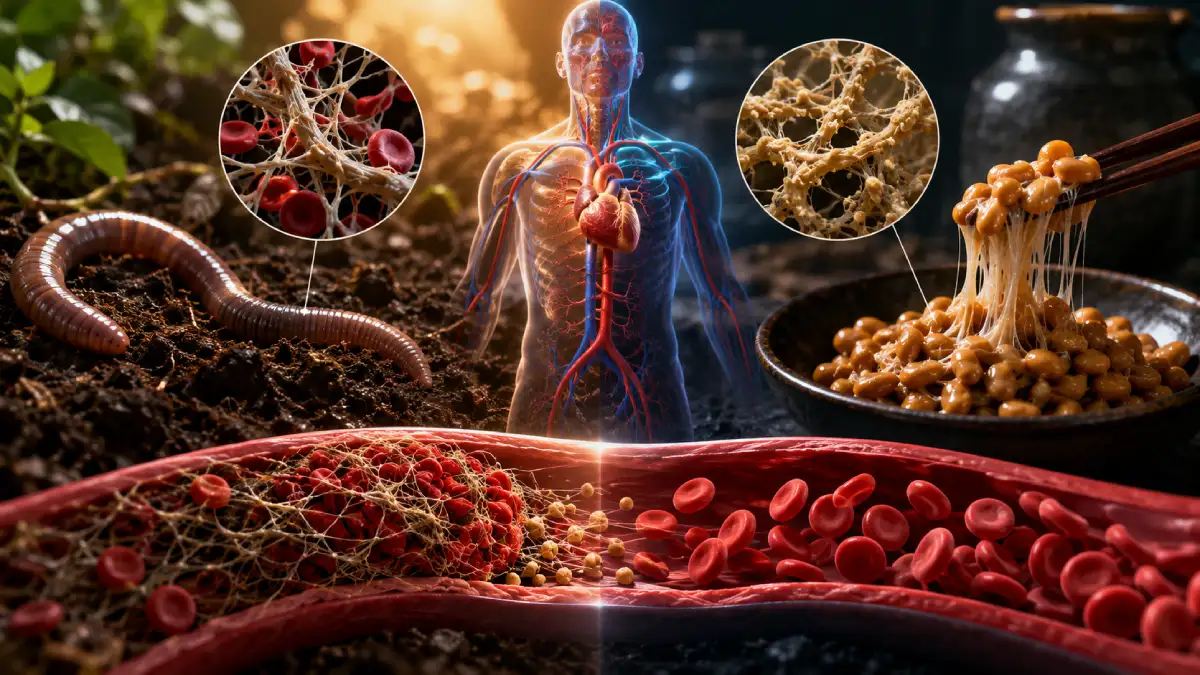
Fibrin forms the mesh of a clot. In vitro, nattokinase can cleave this mesh and inactivate PAI-1, an inhibitor of tissue plasminogen activator. According to enzymatic studies, lumbrokinase can also break down fibrin and facilitate plasminogen activation. These pathways make a fibrinolytic action plausible. They do not prove that an oral capsule reproduces the effect of a hospital thrombolytic such as alteplase.
Three gaps separate the test tube from the patient:
- the stomach destroys a large proportion of proteins. Enteric-coated formulations aim to limit this loss, without guaranteeing systemic exposure comparable to an infusion
- a biomarker (D-dimer, fibrinogen) is not a heart attack prevented
- an enzyme that cuts fibrin could, in theory, increase bleeding or, if a clot fragments, dislodge an embolus. This second risk is mainly theoretical, but it is enough to rule out self-medication after venous thrombosis
Comparing the two enzymes using a “potency” slogan makes no sense when the units, matrices and populations studied differ.
What do human studies show?
Nattokinase
A randomized, double-blind trial gave 2,000 fibrinolytic units per day for eight weeks to adults with mildly elevated blood pressure. Compared with placebo, the net reduction was about 5.6 mmHg systolic and 2.8 mmHg diastolic among 73 people who completed the protocol. That is a blood pressure signal, not evidence of an antithrombotic effect.
A meta-analysis of six trials and 546 participants found a pooled reduction of about 3.5 / 2.3 mmHg. At lower doses, total cholesterol and LDL did not improve, and glucose increased slightly. The authors reported no notable adverse events in these trials, which does not measure the risk in someone taking apixaban.
In 12 young men, a single dose of 2,000 units raised D-dimer and fibrin degradation products, and slightly prolonged aPTT. All values remained within normal ranges. A laboratory shift in a healthy volunteer does not justify calling it therapeutic thrombolysis.
The NAPS trial followed 265 people without clinical cardiovascular disease, with a median age of 65, for three years, using 2,000 units per day or a placebo. Carotid intima-media thickness and arterial stiffness did not differ between groups. Neither did blood pressure or coagulation biomarkers. It is the best long-term trial available, and its findings on subclinical atherosclerosis are negative.
A retrospective Chinese study of 1,062 people taking 10,800 units per day reported reductions in plaque and lipids. It was not a randomized placebo-controlled trial. Some authors had ties to the manufacturer. It cannot take precedence over NAPS to establish that a “high dose” becomes a treatment.
Lumbrokinase
The most frequently cited trial randomized 310 patients hospitalized for ischemic stroke: 192 received standard treatment plus enteric-coated lumbrokinase capsules (600,000 units three times a day before meals) for one year, while 118 received standard treatment alone. The enzyme group showed lower fibrinogen, more favorable intima-media thickness and fewer vascular events (2.08% versus 6.78%). The trial was not double-blind. Group sizes were unbalanced. The product was added to stroke care, not used preventively in healthy adults.
A small review included only two trials for fibrinogen. Broader Chinese reviews on cerebral infarction remain heterogeneous and of uneven quality. They do not validate a Western supplement or establish equivalence with an anticoagulant.
Scars, biofilms and atherosclerosis: where are the extrapolations?
Fibrin plays a role in wound healing. Concluding that an oral enzyme “dissolves an internal scar” or a bacterial biofilm leaps from biochemistry to a clinical indication. No robust human trial establishes this effect. A Reddit thread about lumbrokinase and scar tissue is not evidence.
Long COVID has brought the idea of microclots into circulation. A pilot trial of lumbrokinase (NCT06511050) is evaluating 300,000 functional units twice a day for six weeks in adults with long COVID, post-Lyme syndrome or ME/CFS. It is recruiting. Without published results, this is not a treatment.
For atherosclerosis, the clearest message comes from NAPS: 2,000 units of nattokinase for three years did not slow subclinical progression in low-risk people. Plaque images from open-label or retrospective studies are not enough to sell the “dissolution” of atheroma.
A useful comparison
| Criterion | Lumbrokinase | Nattokinase |
|---|---|---|
| Origin | Mixture of earthworm enzymes | A protease from natto |
| In vitro mechanism | Fibrin degradation, plasminogen pathways | Fibrin degradation, PAI-1 inactivation |
| Best human evidence | Chinese open-label trial, add-on after stroke | Modest blood pressure reduction; negative long-term trial on atherosclerosis |
| Common units | Manufacturer’s “units” or FU, not standardized across products | FU (tyrosine release from fibrin) |
| Interactions | Theoretical bleeding risk with antithrombotic drugs | Case of bleeding with aspirin; failure when substituted for warfarin |
| Status | Medicine for certain uses in China, supplement elsewhere | Supplement, not an authorized anticoagulant |
Bleeding risks and interactions
Memorial Sloan Kettering summarizes the cautious position: avoid nattokinase if you have a coagulation disorder or take anticoagulant, antiplatelet or fibrinolytic treatment. The same logic applies to lumbrokinase, even though published cases mostly concern nattokinase.
The clearest clinical evidence comes from case reports, not interaction trials:
- a woman taking aspirin for secondary stroke prevention developed a cerebellar hemorrhage after seven days of nattokinase at 400 mg per day, with microbleeds on MRI
- a patient replaced warfarin with nattokinase after mechanical heart valve replacement: valve thrombosis and repeat surgery
These observations do not quantify population-level risk. They are enough to rule out improvised combinations and substitution.
Aspirin inhibits platelets. Apixaban and rivaroxaban inhibit factor Xa. Warfarin antagonizes vitamin K. No food-derived enzyme has demonstrated the same net benefit for strokes or embolisms. Combining them adds a poorly quantified bleeding risk. The guide to supplement–drug interactions reminds you that the real danger is often a supplement plus medication, not two capsules interacting with each other.
Natto food poses a separate problem with vitamin K antagonists: vitamin K2 can reduce warfarin’s effect. A “K2-free” extract does not eliminate the fibrinolytic risk. Do not abruptly change your vitamin K2 · FR intake if you take fluindione, acenocoumarol or warfarin.
Never stop a prescribed anticoagulant to “go natural.” The mechanical valve case shows the cost of that substitution.
Why commercial doses are hard to compare
Nattokinase fibrinolytic units (FU) measure the tyrosine released from fibrin in a typical Japanese assay. This is not an international unit of urokinase, a milligram of protein or the unit used for a lumbrokinase mixture. A bottle labeled 2,000 FU and another labeled 300,000 “FU” of lumbrokinase are not five or one hundred and fifty times stronger than each other. They use different scales, sometimes proprietary ones.
The doses studied, for descriptive purposes only, are as follows:
- nattokinase: often 2,000 FU per day in Western randomized trials, sometimes more in Asian open-label studies
- lumbrokinase: 600,000 units three times a day in the Chinese stroke trial, 300,000 units twice a day in the ongoing long COVID trial
None of these doses is a validated dosing regimen for a supplement in France. Actual activity depends on the strain, purification, enteric coating and stated potency, which is rarely verified by an independent laboratory.
When should you seek medical advice?
Do not start these products, and stop them ahead of a procedure, if any of these situations apply to you:
- oral anticoagulant (warfarin, fluindione, apixaban, rivaroxaban, dabigatran) or antiplatelet drug (aspirin, clopidogrel)
- bleeding disorder, ulcer, frequent bleeding, very heavy periods
- stroke, venous thrombosis, embolism, fibrillation, mechanical valve, recent stent
- planned surgery, tooth extraction, biopsy or childbirth
- pregnancy, breastfeeding
- allergy to soy, natto or earthworms
- older age, poorly controlled hypertension, known microbleeds
Signs requiring urgent help: sudden headache, weakness on one side, double vision, black stools, vomiting blood, extensive bruising, sudden shortness of breath, chest pain. Tell your doctor or pharmacist the exact product name, the number of units on the label and when you started taking it.
If your concern is cardiovascular health, the levers backed by trials measuring clinical events remain smoking, blood pressure, LDL, physical activity and, when indicated, evaluated treatments, including certain medical-dose omega-3s · FR. A fibrinolytic enzyme is no shortcut.
Le Biohacker verdict
I would choose neither to “thin the blood.” Nattokinase has slightly more randomized data, mainly on blood pressure, and a negative long-term trial on atherosclerosis. Lumbrokinase has a signal from an open-label Chinese hospital trial that cannot be transferred to a supplement. Both share a poorly quantified risk of interaction with antithrombotic drugs and incomparable units.
If you already take an anticoagulant or aspirin, the decision is not which bottle is stronger. It is not to add one. If you do not take either, the lack of robust clinical evidence does not justify a personal experiment for a scar, biofilm or long COVID.