

A review of several traditional practices
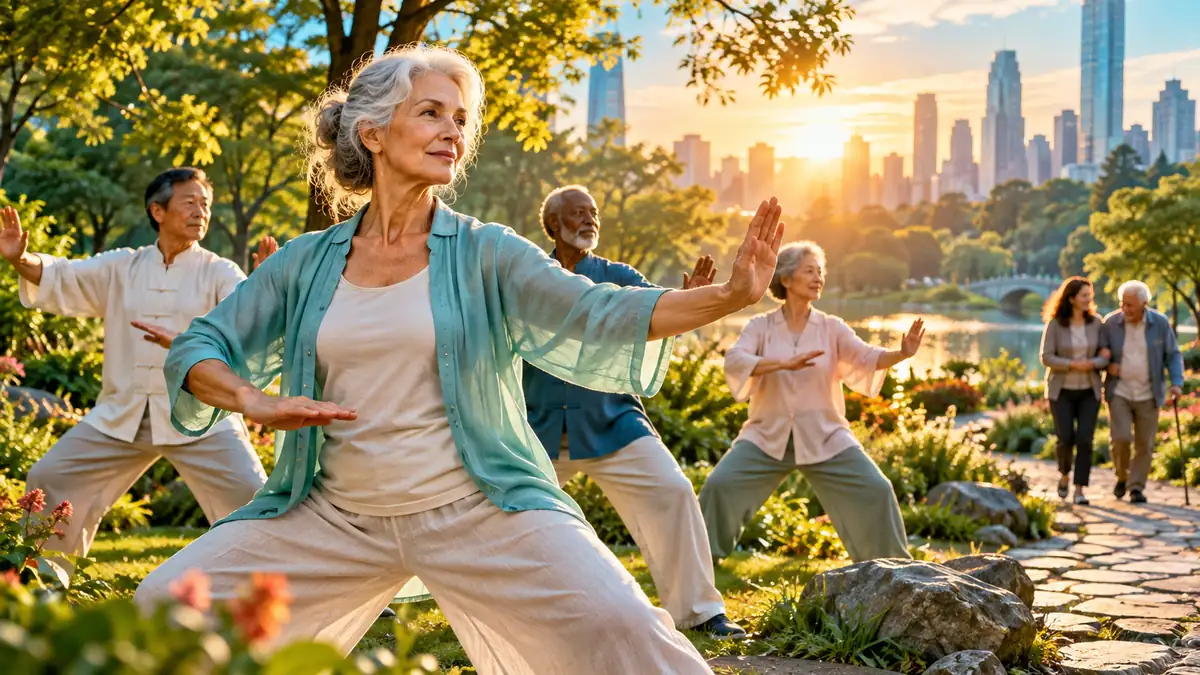
The researchers pooled randomized trials examining the effects of traditional mind-body exercises in older adults. Their literature search covers several scientific databases through December 10, 2025. The practices analyzed include tai chi, Baduanjin and Wuqinxi.
The findings concern scores on tests assessing fall risk and on the Berg Balance Scale. The available abstract does not provide enough detail about the activities offered to control groups, participant characteristics or the duration of all the trials to determine whom the findings apply to best.
A favorable signal, but substantial variability
In the pooled analysis, groups practicing these exercises have better fall-risk test scores than control groups. Analyses by practice suggest a benefit for tai chi and Baduanjin.
On the Berg scale, the mean difference between groups is 2.60 points in favor of the exercises, with a 95% confidence interval ranging from 1.47 to 3.72 points. The abstract does not establish whether this difference represents a meaningful improvement in daily life.
Results on this scale vary considerably across trials: heterogeneity reaches 95.6%. This average therefore does not describe a uniform benefit. Wuqinxi also shows a favorable signal for balance, without demonstrating a reduction in falls.
What these findings tell us
This review supports the potential value of these practices for balance in older adults, not a promise of fall prevention. A risk score remains an indirect measure: improving it is not enough to establish that participants fall less often.
The authors rate the evidence as low-certainty. Differences between trials and the limited information in the abstract also prevent identifying any one practice as superior to the others or deriving a training program from the findings.
Limitations to keep in mind
Only the PubMed abstract was consulted, not the full text. The evidence is low-certainty, and heterogeneity is very high for the Berg scale. Adverse effects, funding and conflicts of interest cannot be verified from the excerpt provided.
What we can take away
Tai chi and Baduanjin could improve some balance test scores in older adults. This review does not establish a reduction in actual falls.
Sources and provenance
- Effectiveness of traditional mind-body exercises on fall risk test scores and balance in older adults: A systematic review and meta-analysis.
Source date: 2026-10-16.
Journal Article, Systematic Review, Meta-Analysis · Résumé PubMed uniquement, texte intégral non consulté