

A study primarily designed to assess tolerability
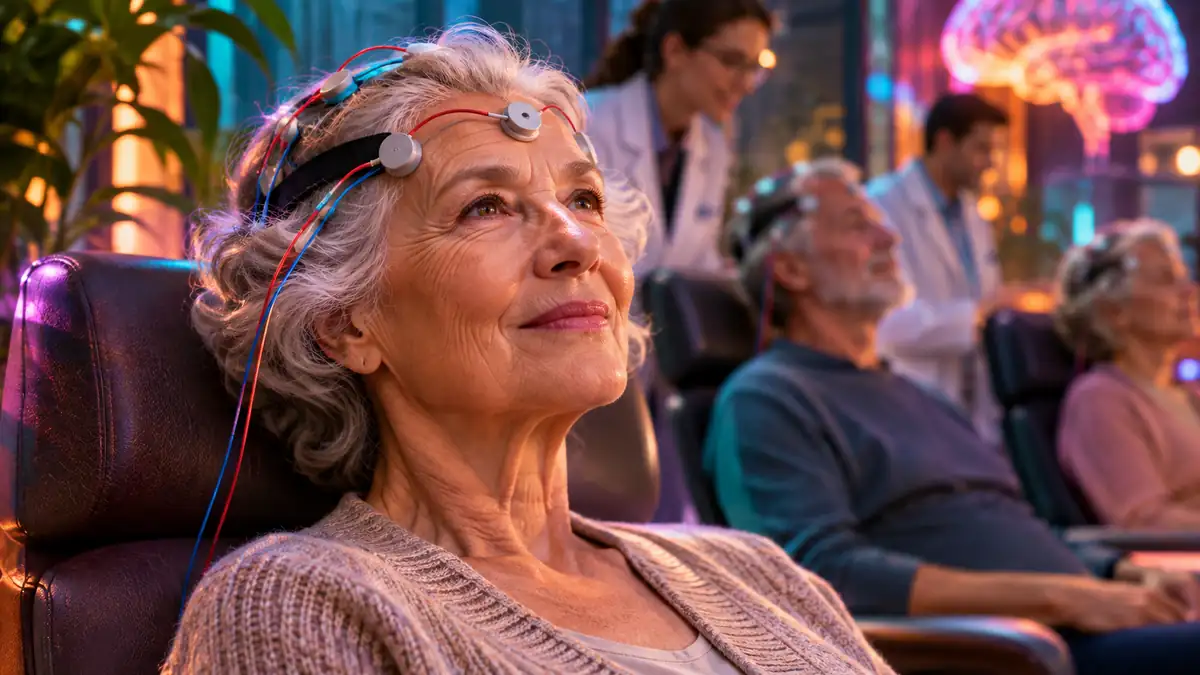
The researchers studied transcranial alternating current stimulation, or tACS, applied over the left dorsolateral prefrontal cortex during digital cognitive training. This technique uses an alternating electrical current. The hypothesis examined here is that it could enhance the effects of training, but this proposed mechanism is not evidence of efficacy.
Ten older adults with mild cognitive impairment received five daily sessions at a frequency of 6 Hz and an intensity of 3.2 mA. Changes in their outcomes were compared with those of ten participants from the placebo group of a randomized trial, who completed the same training with sham stimulation. The abstract does not provide further details on how participants were allocated for this comparison.
All participants completed the treatment. Mild and moderate adverse effects were reported during the active sessions, with no severe events observed. This finding concerns a small sample and a short series of sessions, not the safety of prolonged or unsupervised use.
A favorable result on one test, not across all cognitive functions
The clearest signal concerns errors on the antisaccade test, which is used to assess inhibitory control: the ability to suppress an automatic response. Changes differed between the groups in favor of active stimulation. However, no stimulation-specific effect was observed on reaction time.
Verbal and visual memory performance changed over time, but the abstract reports no difference that would allow those changes to be attributed to stimulation. For visuoconstructive abilities, the result is described as a trend, not an established effect.
The abstract does not provide the absolute magnitude of the benefit in inhibitory control. It is therefore impossible to assess its practical significance, particularly for independence or everyday cognitive difficulties.
What this study tells us
These results primarily support the feasibility of conducting this type of intervention in a research setting. They demonstrate neither a general improvement in memory nor a slowing of cognitive decline.
The authors describe the efficacy analyses as exploratory and call for confirmation in the ongoing randomized trial. Funding and conflicts of interest cannot be verified from the material provided.
Limitations to keep in mind
Only the PubMed abstract was consulted. The comparison involves twenty participants and five sessions. The exact allocation procedures, absolute effect sizes and persistence of the effects are not specified in the abstract. No benefit in everyday life is reported.
What we can take away
Combining electrical stimulation with cognitive training warrants further study. This small study is not enough to justify its use to improve memory.
Sources and provenance
- Feasibility and tolerability of combining 6 Hz transcranial alternating current stimulation (tACS) at 3.2 mA and digital cognitive training in older adults with mild cognitive impairment.
Source date: 2026-11-05.
Journal Article, Randomized Controlled Trial · Résumé PubMed uniquement, texte intégral non consulté