

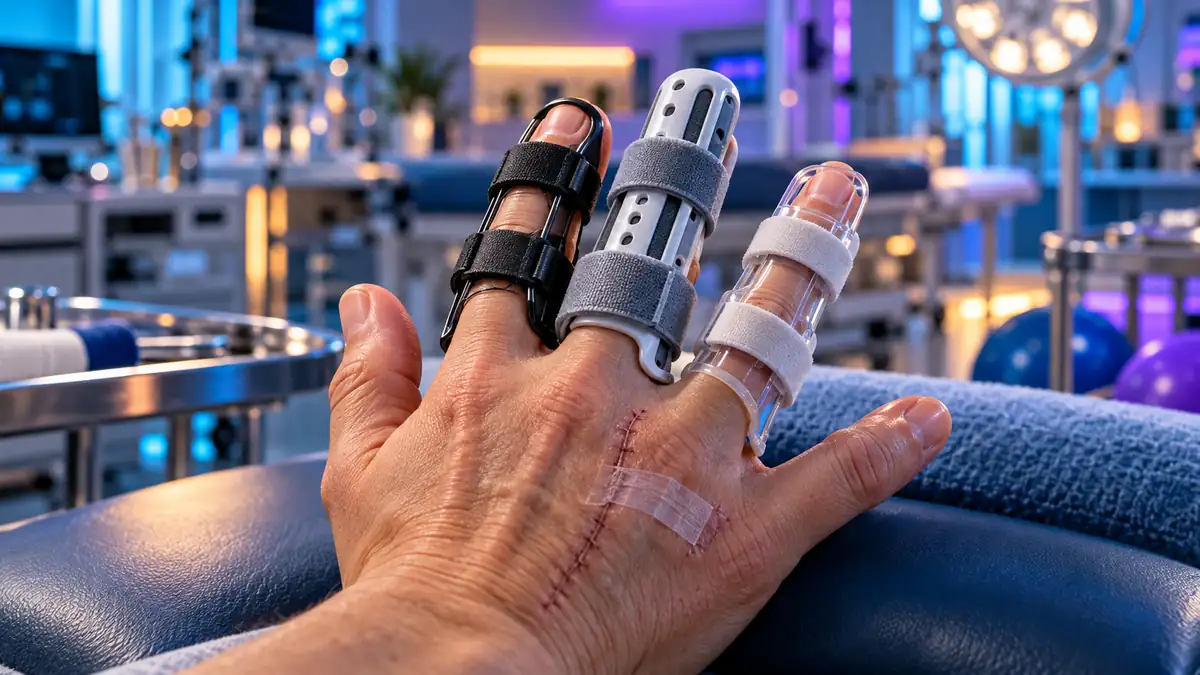
Three splints compared across 26 hospitals
The FIRST trial randomly assigned 430 people aged at least 16 years to a long forearm-based splint, a short Manchester splint or a mini relative motion flexion splint. Participants had undergone primary flexor tendon repair in zone 1 or 2, in one or two fingers.
In this trial, the splints were worn continuously for five weeks, then intermittently for one additional week, at night and in situations considered vulnerable. This describes the protocol studied, not rehabilitation instructions to follow without supervision.
The primary outcome was the PRWHE score, a patient-completed questionnaire on wrist and hand pain and function. The analysis used the average of measurements taken at 6, 12, 26 and 52 weeks, rather than the one-year result alone.
No design showed superiority
Mean scores were 24.5 with the long splint, 23.5 with the short splint and 22.4 with the mini splint. None of the adjusted comparisons between groups was statistically significant. Secondary outcomes were also comparable, apart from a few small differences according to the abstract.
Serious adverse events affected 10% of participants in the long-splint group and 11% in each of the other two groups. The abstract does not specify their nature or any potential link to the devices. These rates alone therefore do not establish equivalent safety.
No difference does not mean proven equivalence
The study sought to demonstrate the superiority of one splint. Failing to detect superiority does not prove that the three options are interchangeable for every patient. The confidence intervals remain compatible with differences in either direction.
Participants knew which splint they were wearing, which may influence a self-reported outcome. In addition, 403 of the 430 randomised participants were included in the analysis described as intention-to-treat. The abstract does not explain this difference in participant numbers.
Limitations to keep in mind
Only the PubMed abstract was consulted, not the full text. The conclusions apply to the primary repairs in zones 1 and 2 studied. Funding, conflicts of interest, details of serious adverse events and reasons for missing data could not be verified.
What we can take away
For the tendon repairs studied, FIRST provides no evidence demonstrating the clinical superiority of any of the three designs. It does not justify changing your prescribed splint on your own.
Sources and provenance
- Comparative effectiveness of three splints for rehabilitation after finger flexor tendon repair (FIRST): randomised controlled trial.
Source date: 2026-10-27.
Journal Article, Comparative Study, Multicenter Study, Equivalence Trial, Pragmatic Clinical Trial, Randomized Controlled Trial · Résumé PubMed uniquement, texte intégral non consulté