

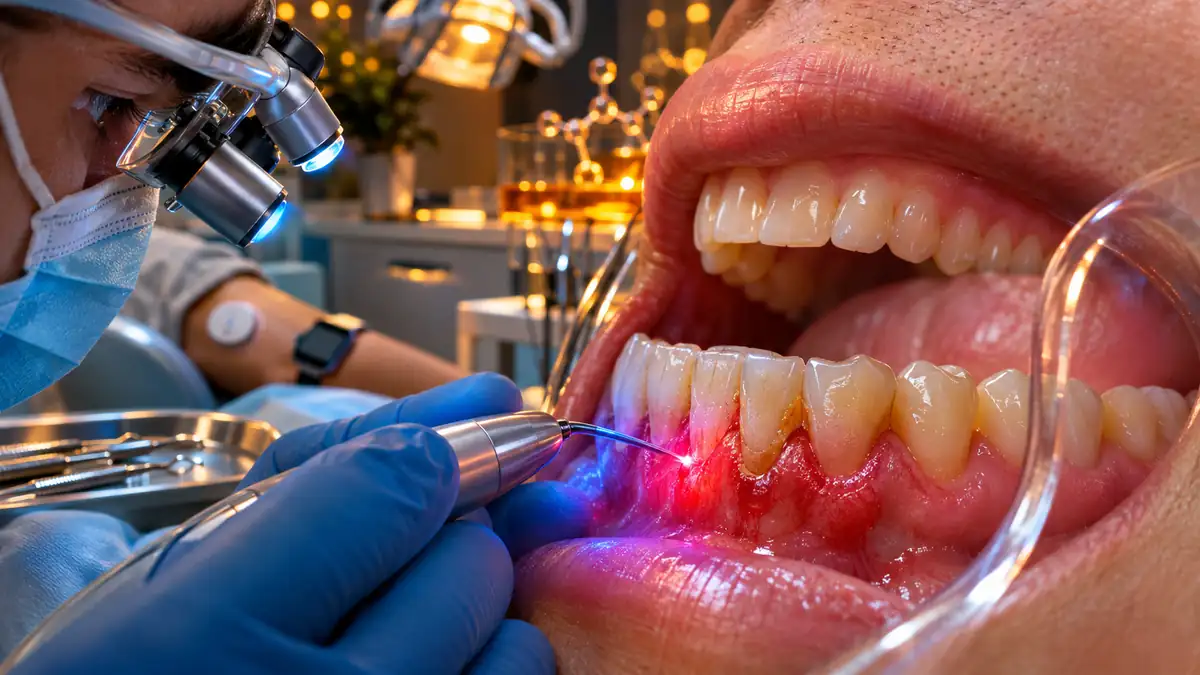
A laser added to care, not used instead of it
The researchers assigned participants to two groups of 60. Everyone received nonsurgical periodontal treatment comprising scaling, root planing and standardized oral hygiene instructions, with reinforcement of those instructions. Only one group also received Nd:YAG laser treatment.
The primary outcome was mean periodontal probing depth at six months, compared between groups after adjustment for its baseline value. The trial therefore assesses the value of adding the laser to this care, not its effectiveness when used alone.
A measured difference in periodontal outcomes
At six months, adjusted mean probing depth was 0.70 mm lower in the laser group. The 95% confidence interval ranged from 0.56 to 0.84 mm in favor of the laser. This between-group difference does not represent a guaranteed improvement for every patient.
Secondary outcomes also pointed to a benefit: the adjusted difference in clinical attachment level was −0.67 mm, and the proportion of sites bleeding on probing was 11.3 percentage points lower in the laser group.
However, these improvements came with a less favorable finding: gingival recession was slightly greater with the laser, with an adjusted difference of +0.09 mm. No serious treatment-related adverse events were recorded, which does not rule out rare or later effects.
A glycemic signal not to overinterpret
The adjusted difference in glycated hemoglobin favored the laser group by 0.26 percentage points. For fasting blood glucose, it was −0.62 mmol/L. These results concern secondary outcomes, not the trial’s primary objective.
Follow-up limited to six months cannot establish whether these differences persist. The abstract also reports no results on diabetes complications or long-term tooth retention.
What the abstract tells us
This trial supports an additional benefit of the Nd:YAG laser for the periodontal measures studied in this specific population. It does not allow the findings to be extended to all lasers or to people without diabetes.
Only the PubMed abstract was consulted. Detailed laser settings, blinding procedures and any changes to diabetes medications are not specified in the excerpt. Funding and conflicts of interest were not checked.
Limitations to keep in mind
A single trial of 120 participants, limited to six months and known only through its PubMed abstract. Glycemic outcomes are secondary. Protocol details, funding and conflicts of interest were not checked.
What we can take away
Adding an Nd:YAG laser to standard care improves periodontal measures at six months in this trial. Its lasting value and the clinical significance of the glycemic signal remain to be established.
Sources and provenance
- Adjunctive neodymium-doped yttrium aluminum garnet laser therapy for periodontitis in type 2 diabetes: A randomized controlled trial.
Source date: 2026-11-02.
Journal Article, Randomized Controlled Trial · Résumé PubMed uniquement, texte intégral non consulté