

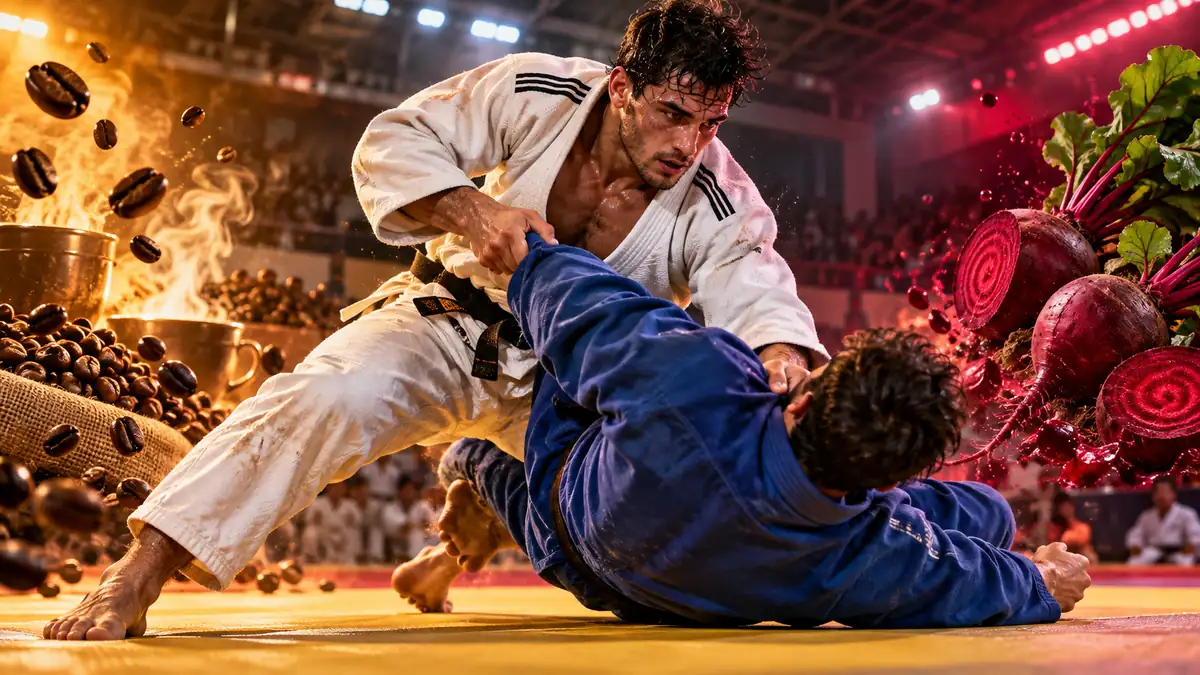
Four conditions compared in the same judokas
The researchers studied 35 competitive judokas, with an average age of 23. Each participant completed four sessions corresponding to four conditions: beetroot juice, caffeine, a combination of the two, and placebo.
The trial was randomized, double-blind and crossover: each athlete went through all conditions. This design allows interventions to be compared within the same person, rather than relying solely on differences between groups.
The sessions simulated a competition day with five randori bouts and the Special Judo Fitness Test, or SJFT. Neuromuscular and cognitive assessments rounded out the measurements.
Benefits at different times
Compared with placebo, caffeine improved SJFT results, neuromuscular function and cognitive performance during bouts one to three. This benefit was not observed in the fifth bout. By contrast, beetroot juice improved these same measures in the fifth bout.
The combination improved SJFT results during bouts one to three and five, cognitive function during bouts one, two and four, and neuromuscular performance during all bouts.
In the fifth bout, beetroot juice alone and the combination produced better results than caffeine alone in all three areas assessed. However, this does not demonstrate that the combination is consistently superior to each ingredient taken separately.
A signal about timing, not a validated strategy
The interesting finding concerns how the effects were distributed throughout the day. In this simulation, the benefits of caffeine observed early on did not persist through to the final bout, whereas those of beetroot juice appeared later.
The abstract reports statistically significant differences but does not provide their magnitude. It is therefore impossible to know whether the differences represent a meaningful sporting advantage. Doses, intake timing and adverse effects are not specified in the document consulted: this trial alone is not enough to propose a supplementation strategy.
Limitations to keep in mind
Only the Europe PMC abstract was consulted, not the full text. The sample consists of 35 judokas, and the effects are acute, in a simulated competition. The magnitude of the differences, doses, intake timing and tolerability data are not available in the excerpt. Funding and conflicts of interest could not be verified.
What we can take away
This study suggests that the timing of exertion matters when assessing supplementation. It demonstrates neither a benefit in real competition nor consistent superiority of the caffeine–beetroot combination.
Sources and provenance
- The Effect of Acute Beetroot Juice and Caffeine Supplementation on Specific Judo Performance During a Simulated Competition Day in Judo Athletes.
Source date: 2026-11-01.
research-article, Randomized Controlled Trial, Journal Article · Résumé Europe PMC uniquement, texte intégral non consulté