

A controlled trial, but a small EEG analysis
The trial involved two 12-week treatment periods, one with an oral cannabidiol oil, or CBD, and the other with a placebo. Their order was randomized, and the study was double-blind. An eight-week period without intervention separated the two treatments.
Twenty-nine autistic children aged 5 to 12 completed both periods. However, the analysis presented covers a subgroup of 18 children, including eight girls, who underwent resting-state EEG recordings.
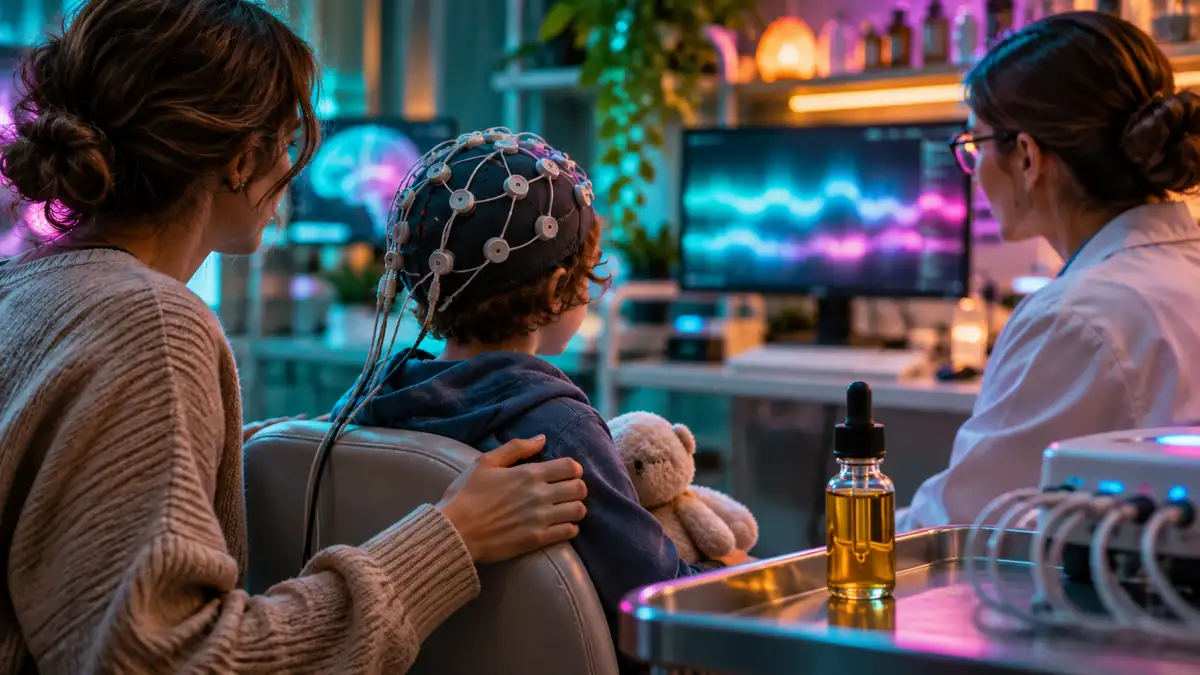
Before and after each period, the researchers recorded five minutes of brain activity with eyes open. They then calculated functional connectivity between 16 electrode pairs across five frequency bands. This measure describes relationships between electrical signals, not directly a social skill or clinical improvement.
A finding that holds up after statistical correction
After the CBD period, the researchers observed increased connectivity in the beta band between the right frontal and right inferior parietal electrodes, designated F4-P8. This finding remains statistically significant after correction for multiple comparisons, an important precaution when examining several connections and frequencies.
An increase also appears in the alpha band, but it does not remain significant after this correction. The abstract reports no significant change after placebo.
This last observation calls for a distinction: a significant change with CBD and a nonsignificant change with placebo are not enough, on their own, to demonstrate a difference between treatments. The abstract provided does not explicitly present the result of a direct comparison of their effects.
A biological lead, not a recommendation
The authors present these findings as preliminary evidence of an association between CBD and right frontoparietal connectivity. They call for replication in larger samples to confirm their generalizability and clinical relevance.
The abstract specifies neither the magnitude of the EEG change nor its possible relationship with clinical change. Nor does it provide the tolerability data needed to inform a decision about use in children. This analysis therefore opens up a research question, without justifying a recommendation for CBD in autism.
Limitations to keep in mind
Exploratory analysis limited to 18 children. The abstract does not detail the direct CBD–placebo comparison, the magnitude of the change, its links to clinical outcomes, or tolerability. Full text not consulted. Funding and conflicts of interest not verified.
What we can take away
The EEG finding warrants replication. It does not establish that CBD improves symptoms or everyday life for autistic children.
Sources and provenance
- Cannabidiol and fronto-parietal EEG connectivity in autistic children.
Source date: 2026-11-04.
Journal Article, Randomized Controlled Trial · Résumé PubMed uniquement, texte intégral non consulté