

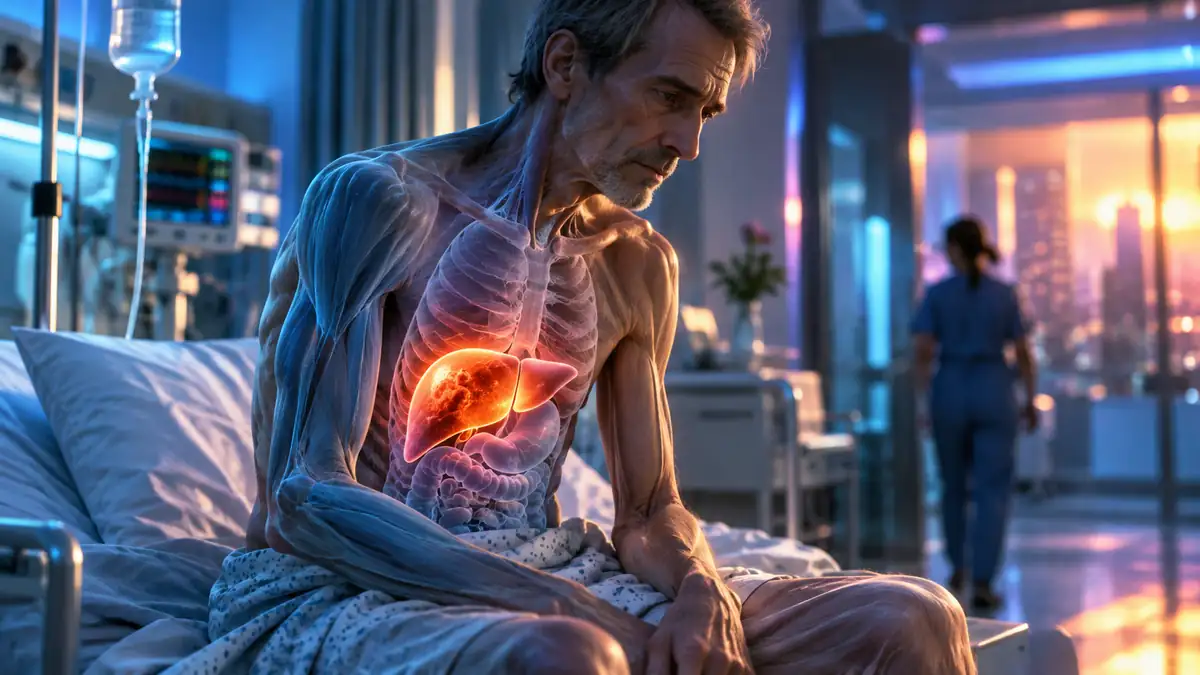
A review covering several treatment types
The researchers examined studies published between January 2015 and March 2025 on body composition and clinical outcomes in hepatocellular carcinoma. Measurements came from CT scans, MRI or bioelectrical impedance analysis.
The review includes 92 studies covering treatments with curative intent, locoregional treatments or systemic treatments. Across studies, the proportion of patients with sarcopenia ranged from 6.4% to 62.8%. This range highlights that the populations and measurement criteria are not interchangeable.
An association with mortality, not proof of causation
In the meta-analysis pooling 44 studies, sarcopenia was associated with a hazard ratio for death of 1.85, with a 95% confidence interval of 1.75 to 1.94. The association was in the same direction across the different treatment categories.
This figure means neither an 85% probability of death nor a specific reduction in life expectancy. The abstract does not provide the absolute risks or follow-up durations needed to translate this result into an individual prognosis.
After treatment with curative intent, sarcopenia was also associated with more recurrences in an analysis of 14 studies. These results identify a prognostic marker, without establishing that sarcopenia directly causes these events.
Body fat does not tell a single story
During systemic treatment, fatty infiltration of muscle, known as myosteatosis, was associated with higher mortality. By contrast, visceral fat was associated with lower mortality in this setting, whereas it appeared unfavorable after curative treatment.
This divergence rules out a simplistic reading in which all fat is either harmful or protective. It does not justify trying to gain fat and cannot be extrapolated to people without cancer.
Limitations to keep in mind
Only the PubMed abstract was consulted. The total sample size, follow-up durations, details of adjustments and study quality are not specified in the excerpt. Measurement standardization remains necessary. Funding and conflicts of interest were not checked.
What we can take away
Body composition could add to the prognostic assessment of liver cancer. However, this review does not provide a basis for prescribing a nutrition or training strategy to improve survival.
Sources and provenance
- Impact of body composition on clinical outcomes in patients with hepatocellular carcinoma: A systematic review and meta-analysis.
Source date: 2026-10-14.
Journal Article, Systematic Review, Meta-Analysis · Résumé PubMed uniquement, texte intégral non consulté