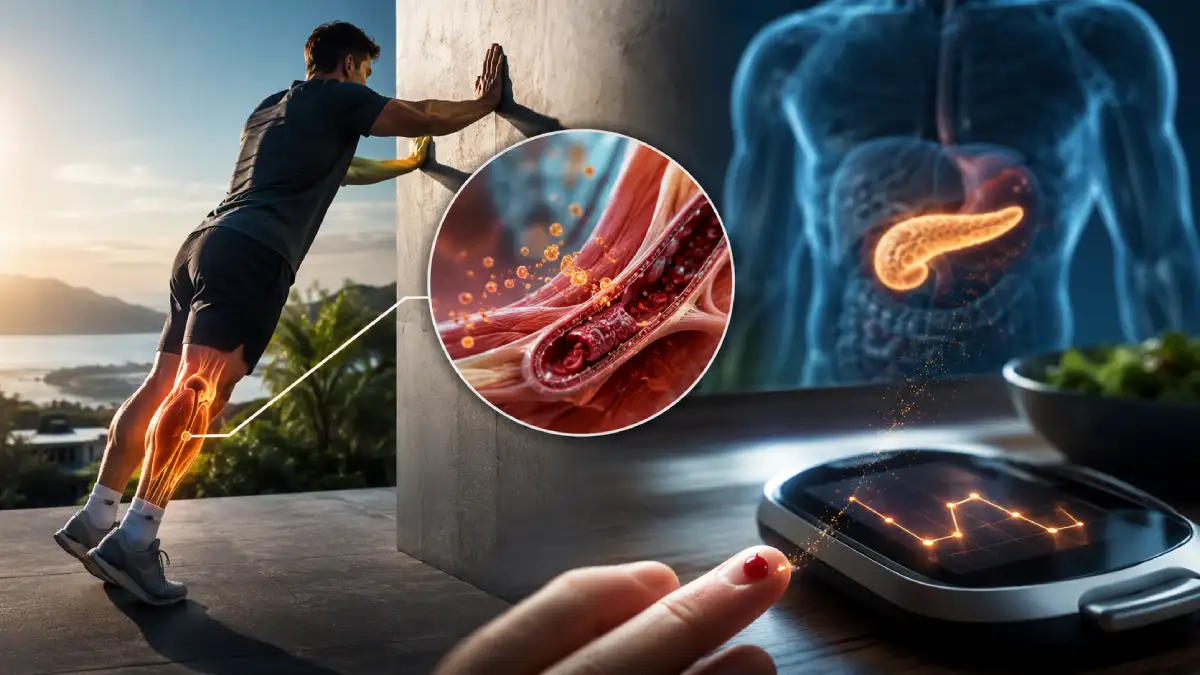
The soleus push-up can lower blood glucose after a glucose load, but the viral version leaves out almost everything that makes the result possible. In the main experiment, participants were not just bouncing their feet a few times under their desks. They performed a movement learned with electromyography, almost without interruption, for three hours.
The signal is still interesting. In 2022, the higher intensity reduced the incremental glucose area under the curve by 52% and the insulin response by 60% compared with a sitting session. A small independent pilot published in 2025 also found an acute effect in ten people with prediabetes, including without continuous electromyographic feedback.
But no study has yet shown that a self-directed home protocol improves HbA1c, prevents diabetes or produces the same effect after an ordinary meal. My provisional verdict is therefore simple: a promising addition to break up seated inactivity, not a substitute for walking or a metabolic treatment.
What is a soleus push-up?
The soleus is the deep calf muscle, beneath the two heads of the gastrocnemius. It contributes to plantar flexion, the movement that takes the top of the foot away from the shin, and helps maintain an upright standing posture. Its high proportion of slow-twitch oxidative fibers makes it particularly resistant to fatigue.
The movement studied is a very specific form of plantar flexion. You stay seated, with your knee bent and your forefoot on the floor. You press your forefoot gently downward as your heel rises, then relax your foot to let it come back down. The intended contraction focuses on the upward phase, when the soleus shortens.
Why keep the knee bent? The gastrocnemius crosses both the knee and the ankle. Bending the knee reduces its relative contribution, while the soleus continues to produce plantar flexion. This does not isolate it perfectly, but shifts the work toward it.
A plausible mechanism, without muscle magic
An inactive muscle needs little energy. When it contracts, its consumption of oxygen and substrates increases. In the 2022 iScience study, 270 minutes of soleus push-ups barely depleted soleus glycogen despite high local energy expenditure. The authors suggest that a greater share of the fuel then came from circulating substrates, including glucose and lipids.
This explanation is consistent with the measured increase in carbohydrate oxidation. However, it proves neither a “metabolic boost” for the rest of the day nor fat loss. As soon as the contractions stop, their direct energy demand drops.
Soleus push-ups and calf raises have different goals
A conventional calf raise, or calf raise, primarily targets strength or hypertrophy. It uses body weight or an external load, in sets short enough to fatigue the muscle. Standing with the knee straight recruits the gastrocnemius more. A weighted seated version targets the soleus better, but remains a resistance exercise.
The soleus push-up uses only the mass of the legs, is performed seated and aims for a smooth activity that can continue for a long time. Adding weight to “burn more” therefore changes the stimulus and increases fatigue. Rapid leg tapping through a tiny range of motion is not the movement tested either.
What the researchers actually measured
The original paper brings together two separate crossover experiments, with 25 volunteers in total. Only 15 took part in the blood glucose test.
Here is what they did:
- Experiment 1, ten adults : 270 cumulative minutes of contractions, muscle biopsies, indirect calorimetry and electromyography
- Experiment 2, fifteen adults : ingestion of 75 g of glucose after fasting, followed by three hours sitting still or performing the contractions
- Two intensities : everyone tested the lower level, and ten tested the higher level, with each person compared against their own control session
- Acute measurements : blood glucose every fifteen minutes, insulin, C-peptide, substrate oxidation, heart rate and blood pressure
The lower level reduced the incremental glucose area under the curve by about 39% and the insulin area under the curve by 41%. The higher level reduced them by 52% and 60%, respectively. Between 75 and 135 minutes, mean blood glucose at the higher level was about 46 to 49 mg/dL lower than in the sitting session.
These figures describe a comparison with remaining still after hyperglycemia induced by 75 g of pure glucose. They do not mean “52% lower blood glucose,” let alone a 52% lower risk of diabetes.
A small replication, but not yet robust evidence
The independent 2025 pilot included ten adults with prediabetes. They first underwent a seated glucose test, then a second test while doing soleus push-ups for two hours. The glucose area under the curve decreased by 37% in the electromyography-guided group and by 26% in the group that had only learned the movement. The difference between these two small groups was not significant.
This replication makes use outside the laboratory more plausible, but still has major limitations: about five people per group, session order not counterbalanced, no measurement of insulin or energy expenditure and no follow-up beyond two hours.
The frequently cited 2025 “perspective” is not independent confirmation. It was written by the three authors of the original study. In 2022, these authors also reported developing technologies for learning the movement, while the University of Houston was considering patenting potential intellectual property. That is not evidence that the result is false. It is another reason to wait for larger independent trials.
So far, the studies have not measured the following outcomes:
- HbA1c after several months
- the development of diabetes or complications
- weight loss
- the effect after mixed meals eaten at home
- adherence and pain during prolonged daily use
- a direct randomized comparison with walking
How to perform the movement correctly
Choose a stationary chair rather than one on wheels. Sit in a relaxed position, without perching on the edge or tensing your entire trunk. The ball of your foot should be approximately beneath your knee.
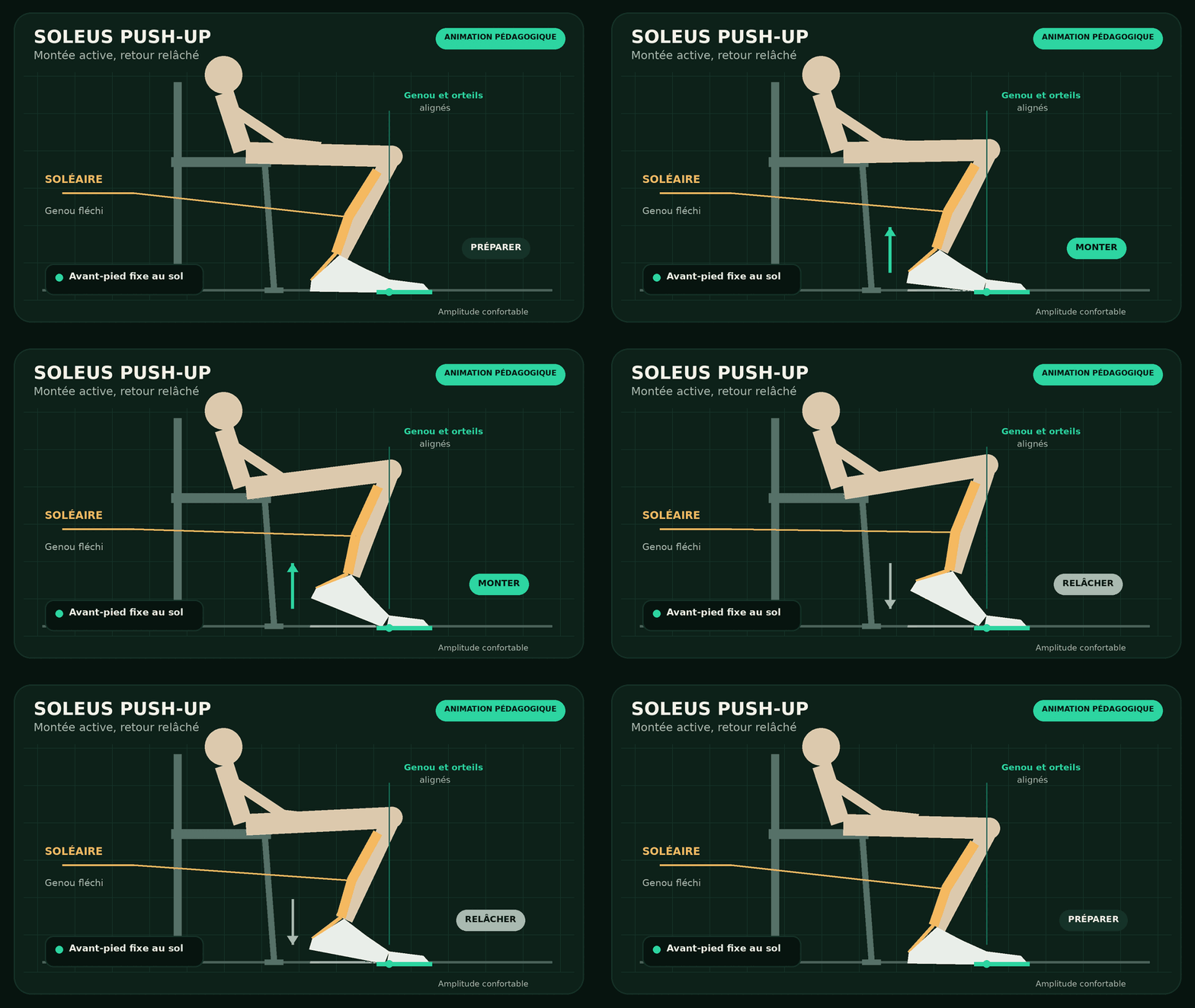
Educational animation, not based on a laboratory measurement. The range of motion should remain comfortable and the forefoot should stay on the floor.
Learn the movement in this order:
- Place your whole foot on the floor, with your knee bent and your toes pointing forward
- Gently press the ball of your foot into the floor and slightly forward
- Let this pressure lift your heel as high as your comfortable range of motion allows
- Relax your ankle so your heel comes back down without actively pushing downward
- Keep the movement broad, smooth and steady, without bouncing your trunk
- Start with one leg, then use both legs together or alternate them
The original team suggests about 60 repetitions per minute as a learning guide, and the 2025 pilot used this cadence with a range of motion reaching approximately 45 degrees. This is neither a universal frequency nor a validated clinical dose. In the original study, range of motion and muscle activation mattered more than haphazardly speeding up.
There are clear signs of poor execution:
- your heel barely moves while your leg shakes rapidly
- your toes or forefoot lift off the floor
- you add weight on your knees
- the movement comes from rocking your whole body
- an increasing burning sensation, a cramp or joint pain develops
Duration, timing and comparison with walking
How long should you do it?
The honest answer is that the minimum effective dose is unknown. The two blood glucose tests required two or three almost continuous hours after the glucose drink. The glycogen experiment totaled 270 minutes. The promise that “ten minutes is enough” therefore does not come from these studies.
If you want to learn the movement, start with two to five minutes to check your coordination and tolerance. This is familiarization, not a protocol intended to reproduce the results. You can then extend it in comfortable blocks during a period when you would otherwise remain seated, ideally after a meal. Stop if your technique deteriorates or pain develops, then reassess after two weeks whether the habit is actually sustainable.
If you only have ten minutes after a meal, I would prioritize walking. A meta-analysis of eight small crossover trials found that exercise, mainly walking, reduced the glucose excursion more when it started after a meal than before it or with no exercise. The 116 participants and high risk of bias call for caution, but this evidence base is more varied than that for the soleus push-up. Our post-meal walking protocol · FR offers simple options when you can get up.
| Criterion | Soleus push-up | Post-meal walking | Conventional calf raise |
|---|---|---|---|
| Position | Seated, knee bent | Standing, moving around | Standing or seated depending on the variation |
| Main stimulus | Soleus, prolonged contractions with no added weight | Several leg muscles, whole-body movement | Soleus and gastrocnemius, higher resistance |
| Dose directly studied for blood glucose | Two to three almost continuous hours | Various durations, including short walks after meals | No established metabolic dose |
| Strength of blood glucose evidence | Two very small acute studies | Several trials and reviews, still imperfect | Not established for this purpose |
| Benefits beyond glucose | Local energy expenditure and breaking up inactivity | Cardiorespiratory activity, mobility and overall energy expenditure | Calf strength and hypertrophy |
| Can it replace walking? | No, only make sitting time more active | Contributes directly to physical activity | No |
The WHO notes that all activity counts, but also recommends limiting sedentary time and accumulating regular physical activity. No trial shows that the soleus push-up provides the cardiorespiratory or muscular adaptations of walking and exercise training.
What about calories burned?
In the three-hour experiment, the lower level burned 108 kcal more than the sitting session, or an additional 36 kcal per hour. The higher level added 201 kcal, or 67 kcal per hour. A separate, more intense experiment produced even greater energy expenditure.
These values were obtained with electromyographic monitoring of activation and measurement of respiratory gas exchange. A watch cannot accurately convert this small, isolated movement into calories, and your execution may be far less intense. Nor is there any evidence of long-term weight loss. The measured calories therefore do not turn the movement into a way to offset a meal.
Limitations, precautions and who it may suit
For an adult without pain who works sitting down, the soleus push-up mainly makes sense in one specific situation: you cannot get up right now and would otherwise spend that time completely still. If you can walk, climb a few steps or take a proper active break, those options engage more of your body.
It is not a treatment
The soleus push-up altered an acute blood glucose response. It has not been shown to treat prediabetes or diabetes, reduce HbA1c, prevent a complication or justify changing medication. A normal rise after a meal is not a disease to erase. The guide to blood glucose spikes after meals helps distinguish normal variation from findings worth discussing with a healthcare professional.
The original study excluded diagnosed diabetes. The subsequent pilot involved ten people with prediabetes who were not taking glucose-lowering medication. The NIDDK notes that activity can contribute to hypoglycemia during or after exercise in people taking insulin or a sulfonylurea. Agree on timing, monitoring and any adjustments with your healthcare team, without changing your treatment on your own.
Long-term safety has not been established. No adverse events were reported during the small supervised sessions, but a few dozen participants are not enough to detect rare problems or cumulative irritation.
Use a smaller range of motion or skip trying it in the following situations:
- current pain in the Achilles tendon, calf, ankle or forefoot
- recent surgery or a sprain without clearance to resume activity
- neuropathy with reduced foot sensation
- a wound, ulcer, unusual swelling or change in foot color
- difficulty controlling the movement without cramps or compensatory movements
Sharp pain, sudden weakness, one-sided swelling or numbness means you should stop and seek medical advice. Mild fatigue is not a target to push past, since the studied protocol specifically aimed for a sustainable contraction without fatigue.
Verdict
The soleus push-up is neither complete nonsense nor the metabolic shortcut sold in videos. Two small studies show a substantial acute reduction in the glucose response when the movement is properly learned and sustained for a very long time. Confidence is moderate for this experimental effect, but low for a short dose at home and for any lasting clinical benefit.
So keep this hierarchy: walk after meals when possible, use the soleus push-up when you have to stay seated, and keep up strength training and cardiorespiratory activity. The point of the movement is to make sitting time a little less inactive, not to pretend one calf can replace the rest of your body.