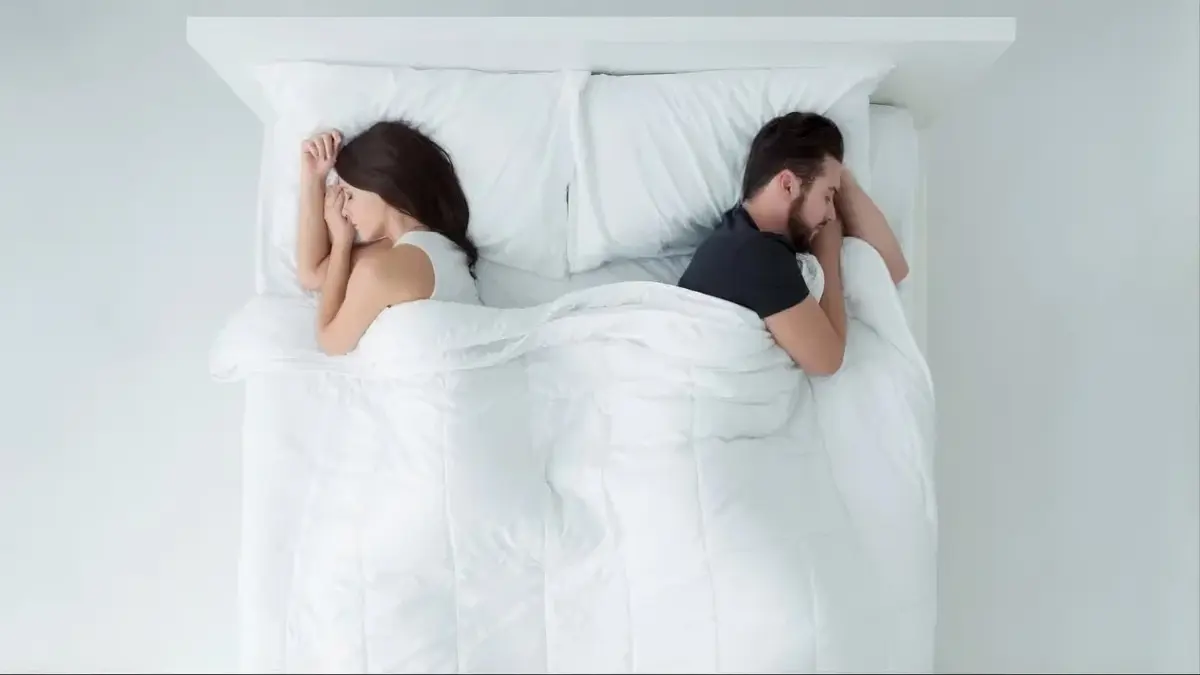
“Sleep divorce” has gone from taboo to trend: separate bedrooms for better sleep, and therefore a better love life. Research on the subject is thin, and sharing a bed isn’t necessarily the enemy.
Sleeping in separate beds can improve sleep when one partner snores, moves a lot, comes home late or prefers a different environment. But it is neither a universal treatment nor proof of a relationship crisis. Research on “sleep divorce” itself is scarce, couple studies are small, and sharing a bed can also have neutral or beneficial effects.
A useful decision, then, doesn’t pit love against performance. It means identifying a specific disruption, treating any underlying condition and comparing arrangements that work for both people.
What the science can tell us
Sleep is often studied as an individual behavior, even though it takes place in a two-person system. Schedules, light, noise, temperature, childcare and relationship quality can affect each partner. In turn, poor sleep can make the next day’s interactions harder. Reviews describe this relationship as bidirectional, not as a simple chain in which sharing a bed destroys health.
Objective data are far from establishing that sleeping alone automatically improves sleep architecture. In a laboratory study published in 2020, twelve healthy young heterosexual couples slept together and then separately while undergoing polysomnography. Bed-sharing was associated with more limb movements, but also with about 10% more REM sleep, less fragmented REM sleep and synchronized sleep stages. The other stages did not differ significantly.
This study has major limitations: a tiny sample, young and healthy couples, a laboratory night, and no participants dealing with severe snoring or incompatible schedules. Nevertheless, it contradicts a common claim: nighttime closeness isn’t “almost always” bad for recovery.
An actigraphy study of twenty-nine couples over seven days also observed associations in both directions between sleep efficiency and couple interactions. It does not prove that a particular arrangement causes a better relationship. It reminds us that relationship context and sleep are intertwined.
When your partner really is disrupting your sleep
Sharing a bed can become a problem when the disruption is repeated and identifiable. The most plausible situations are:
- snoring, gasping or pauses in breathing
- frequent movements, restless legs or motor behaviors
- very different bedtimes and wake-up times
- repeated alarms and shift work
- incompatible preferences for temperature, light or bedding
- an infant or unevenly shared caregiving responsibilities
The first response depends on the cause. Two duvets can reduce blanket-hogging. A suitable sleep mask and earplugs can help with moderate light or noise, provided safety alarms remain audible. Separate mattresses in the same room can reduce motion transfer. A separate bedroom does more to address noise and schedules.
Snoring calls for a distinction. Occasional noise can be managed as a nuisance. Loud snoring accompanied by pauses, gasping, daytime sleepiness or morning headaches suggests obstructive sleep apnea. Moving the partner who hears the noise may improve their night, but it doesn’t treat the person who stops breathing. The AASM recommends a clinical evaluation and, when the signs warrant it, polysomnography or a home sleep apnea test.
Chronotypes don’t explain everything
Two partners may prefer different schedules. But chronotype isn’t a fixed identity, and a questionnaire alone doesn’t measure circadian phase. Work, morning light, family commitments and habits also affect schedules.
Before concluding that you’re biologically incompatible, measure the actual mismatch. If one person reads under a bright lamp while the other tries to sleep, address the light or the reading location. If a 5:30 a.m. alarm consistently wakes someone who gets up at 7:30 a.m., separate beds may make sense. However, no robust research shows that sharing a bed with someone of a different chronotype causes metabolic harm in itself.
What trackers can’t settle
A watch may suggest that movement or heart rate differs between nights. It cannot attribute a brief arousal to a specific movement by your partner, and it estimates sleep stages without EEG. A two-minute gap between a recorded snore and a pulse spike doesn’t demonstrate causation.
Use consumer data to spot a trend, then check it against outcomes that matter: sleepiness, mood, alertness, frequency of remembered awakenings and both partners’ satisfaction. If tracking fuels accusations or anxiety, pause it. The goal isn’t to identify “patient zero” of a bad night’s sleep.
A four-step experiment for couples
A reversible experiment tells you more than a nighttime move announced as permanent. Choose a period without acute illness, travel, unusual alcohol consumption or a schedule change.
Step 1: define the problem
Each person answers these questions separately:
- what event disrupts your sleep
- how many nights a week it happens
- what daytime outcome is causing a problem
- what level of intimacy or closeness needs to be preserved
Form a testable hypothesis, such as: “The 5:30 a.m. alarms increase my awakenings and sleepiness on workdays.” Avoid “You’re destroying my sleep,” which mixes observation with accusation.
Step 2: address the simplest factor
For one week, keep sharing the bed but change one variable. Two duvets test mechanical disturbance. A directional lamp tests light. A quiet bedtime routine tests the schedule mismatch. For heat, use the principles in our article on body temperature and sleep.
If the problem is a sign of illness, this step becomes booking an appointment. Your partner’s earplugs are no substitute for an assessment of sleep apnea, a movement disorder or violent behavior during sleep.
Step 3: compare arrangements
Over the following two weeks, plan several shared and separate nights. Don’t schedule separate nights only before difficult days, or the comparison will be biased. Keep schedules, alcohol, caffeine and activity as consistent as possible.
Each morning, record on a simple scale:
- estimated time to fall asleep
- number of remembered awakenings
- energy and sleepiness before noon
- mood
- satisfaction with the arrangement
Compare medians rather than one spectacular night. A useful improvement should be repeated and noticeable without relying solely on a device score.
Step 4: decide and reassess
Choose the option that reduces the problem without imposing an unacceptable relationship cost. It may be permanent, hybrid or limited to periods of caregiving, shift work or illness. Schedule a discussion after one month, then after any major change.
A ritual of closeness before separating can preserve intimacy, but there is no scientifically required twenty-minute duration. You can choose reading, conversation, sex or breakfast together. What matters is that the arrangement doesn’t become punishment or a way to avoid conflict.
Limits, safety and your relationship
Sleeping apart can mask three problems. The first is medical, particularly sleep apnea. The second is logistical, when caring for a child or loved one always falls to the same person. The third is relational, if one person decides alone or uses the separate bedroom as punishment.
In these cases, changing the physical setup isn’t enough. A sleep specialist is appropriate for breathing or movement symptoms. CBT-I is indicated for chronic insomnia. A couples therapist can help if discussions about the bed bring issues of rejection, sexuality or shared responsibilities to a head.
Don’t continue a trial that increases fear, isolation or the risk of violence. Safety in your relationship comes before sleep optimization.
The Verdict
Sleep divorce is a practical tool, not a scientific conclusion about your relationship. It makes sense when a specific disturbance resists simple solutions and a planned comparison shows a daytime benefit. It doesn’t make sense when it’s used to ignore pathological snoring, impose a performance standard or interpret watch-estimated sleep stages as a diagnosis.
The best arrangement is neither a shared bed on principle nor a separate bedroom because it’s trendy. It’s the one that protects sleep and the relationship, with both people’s agreement and a plan to reassess.