During intermittent fasting for dietary purposes, prioritise water, black coffee or unsweetened tea, and keep milk, juice, collagen, nutrient-rich broth and coffee with added fats within your meal window. A caloric drink breaks a strict fast with no energy intake, but no human study allows us to claim that it “stops autophagy” throughout the body. In humans, we have neither a universal activation time nor a sensor that can track autophagy in every organ after each drink.
For weight loss or improvements in certain metabolic markers, sticking to an eating window matters more than an occasional splash of milk. For a blood test, surgery or religious practice, follow the specific rules, which may exclude even coffee, tea, chewing gum or water.
The most cautious approach during a 16/8 fasting window is simple: water, black coffee or unsweetened tea if you tolerate them. Keep collagen, BCAAs, broth, milk and coffee with added fats within the eating window. Not because they “cancel out cellular cleanup”, but because they provide nutrients and make the definition of fasting inconsistent.
To choose a window you can stick to, compare 16/8 and OMAD, including their limitations. If fasting causes you to feel unwell, eat compulsively or sleep poorly, check the signs that call for a break.
After how many hours of fasting does autophagy begin?
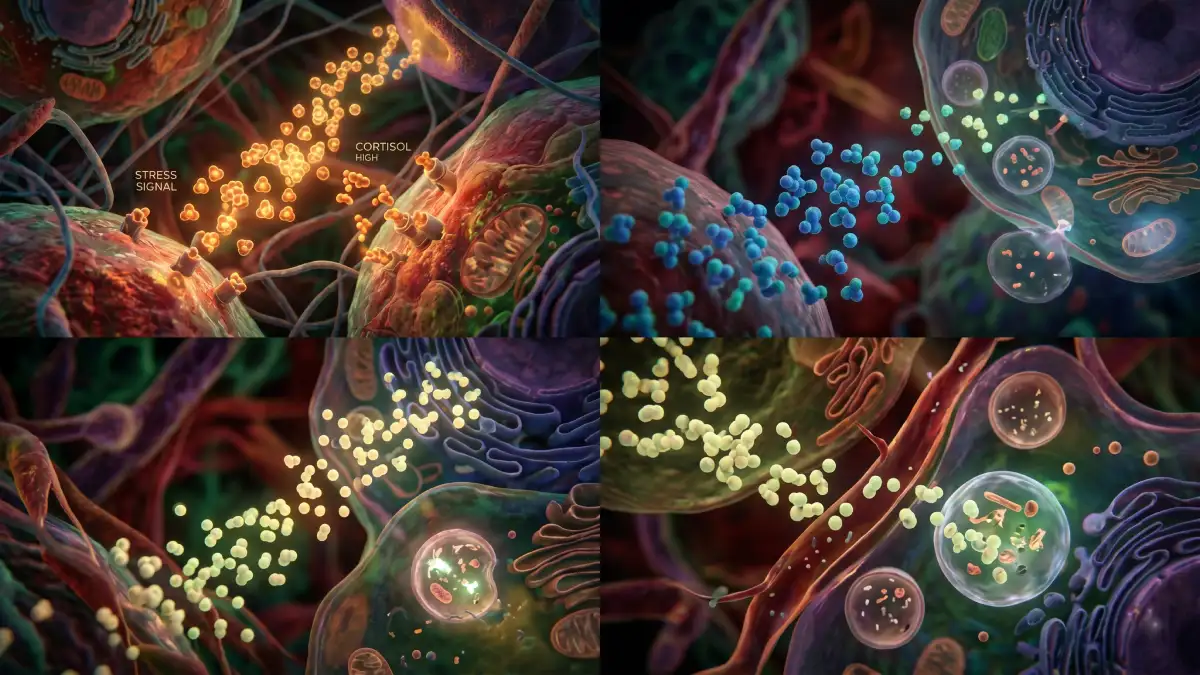
Autophagy encompasses processes through which a cell directs certain components to lysosomes for degradation and recycling. It contributes to cellular quality control, adaptation to nutrient shortages and many stress responses.
It does not stay switched off after breakfast and then switch on after 16 hours of fasting. There is baseline activity that differs between the liver, muscles, brain, immune cells and other tissues. Nutrients, exercise, hormones, illness and circadian timing can modulate it.
International methodological guidelines on measuring autophagy emphasise a central difficulty: a single marker is not enough. More autophagosomes can mean that flux is increasing or, conversely, that their degradation is blocked. Multiple methods and tissue-specific interpretation are needed.
That is why the following claims go beyond the human evidence:
- “autophagy really gets going between 14 and 16 hours”
- “it reaches its universal peak between 24 and 48 hours”
- “a drop of insulin instantly switches it off throughout the body”
- “mental clarity proves that cells are cleaning themselves”
These thresholds often come from animals, cells or indirect markers. A mouse’s metabolism does not translate hour for hour to a human’s.
mTOR and AMPK: a network, not two buttons
mTORC1 responds to factors including amino acids, growth factors and energy status. AMPK responds to the cell’s energy ratio and can promote catabolic pathways. These systems interact with autophagy, but they do not work like two switches that are always opposed in every organ.
Leucine and other amino acids activate mTORC1 in cellular and muscle contexts. This explains why BCAAs, protein or collagen do not fit a strict fast. But transient activation after an intake does not mean that all autophagy is “cancelled” for a known period.
This nuance matters for health. Muscle building and autophagy are not opposing camps. Eating enough protein and doing strength training are essential, especially as you age. Trying to keep mTOR permanently “switched off” would be a poor physiological goal. To plan your eating window, use the table of protein-rich foods · FR rather than cutting out this category of nutrients.
What fasting trials measure in humans
A blood glucose result does not measure cellular recycling. To assess a fasting trial, look at the population, the window being compared and the analyses actually performed, rather than attributing every improvement to autophagy.
In a 2019 crossover trial, fifteen men at risk of type 2 diabetes followed two nine-hour eating windows for seven days. Glucose tolerance improved, with some differences depending on the timing of the window. The study was short and small. It did not measure autophagy or demonstrate that 16/8 outperforms all other windows.
The useful conclusion is modest. A consistent window may help some people structure their eating. Autophagy remains an important mechanistic hypothesis, not an individual benefit that can be promised after sixteen hours.
Which drinks are allowed during intermittent fasting?
| Drink | Strict fast | Window aimed at weight or blood glucose | Human autophagy |
|---|---|---|---|
| Water | compatible | compatible | acute effect not quantified |
| Black or decaffeinated coffee with nothing added | not in a water-only protocol | generally compatible | not established in humans |
| Tea or herbal tea without sugar or honey | not in a water-only protocol | generally compatible | not established in humans |
| Zero-sugar soda | depends on the fasting rule | low in calories, usefulness varies | stopping effect not demonstrated |
| Milk or plant-based drink | no | a small amount may be possible depending on the protocol | not quantified |
| Collagen or BCAAs | no | provides protein and energy | modulation plausible, threshold unknown |
| Broth | no if it provides nutrients | possible in a modified fast | not quantified |
| Coffee with butter or MCTs | no | very high in calories, may reduce the deficit | not quantified |
Does black or decaffeinated coffee break a fast?
A study published in 2014 observed an increase in markers of autophagic flux in several organs of mice after caffeinated or decaffeinated coffee. This is an animal experiment. It does not demonstrate that coffee “speeds up the onset of autophagy” in a fasting human.
Coffee and tea can help you stick to the window, but they can also cause reflux, anxiety or insomnia. Sacrificing sleep to extend a fast is a bad trade. The 2013 Drake trial observed sleep disruption with 400 mg of caffeine, even six hours before bedtime. This does not establish a universal cutoff time for every cup. Avoid late consumption and move your cutoff earlier if your sleep worsens.
Coke Zero, sweeteners and chewing gum: should you ban them all?
The cephalic-phase insulin response exists as a physiological phenomenon, but it is small, variable and difficult to reproduce depending on the stimulus. Not all sweeteners have the same effect. Tasting something sweet does not automatically trigger a wave of insulin that stops autophagy. For a practical choice, the erythritol versus stevia comparison distinguishes blood glucose effects, culinary uses and digestive tolerance.
For a zero-sugar drink or sugar-free gum, check the label: “sugar-free” does not necessarily mean energy-free. You can exclude them to keep the rule simple. You cannot use that to infer a threshold at which human autophagy stops. Monitor hunger and tolerance rather than chasing a promise of zero insulin.
Butter coffee and MCT oil
Butter and MCTs provide a lot of energy. They break a strict fast and can turn a meal-free morning into a liquid breakfast. A small insulin increase guarantees neither fat loss nor an energy deficit. Your body also oxidises the fats you have just drunk.
This drink may fit a prescribed or chosen ketogenic strategy, but it is not necessary for intermittent fasting. Depending on the recipe, it may cause diarrhoea, nausea and excessive saturated fat intake.
Collagen, BCAAs and broth
Collagen and BCAAs provide amino acids. Broth may provide protein, fat and sodium depending on how it is prepared. They end a strict fast. Have them with a meal, where they do not “lose” their absorption.
BCAAs are generally unnecessary if your daily protein intake is adequate. They do not magically protect muscle during a fasted workout. Muscle preservation depends on total energy, protein, strength training and the rate of weight loss.
Lemon water, minerals and supplements
A few drops of lemon probably do not affect a weight goal. The juice of a whole lemon provides carbohydrates and no longer fits a strict fast. There is no validated human threshold allowing us to declare that a few grams of carbohydrates stop autophagy throughout the body.
For a standard 16/8 routine, water and meals generally cover electrolyte needs. Routinely adding half a teaspoon of salt is not harmless if you have high blood pressure, heart failure or kidney disease. Potassium powder can be dangerous and should not be used without proper guidance.
Fat-soluble vitamins and omega-3s are often better taken with a meal. Some medicines must be taken with food, others on an empty stomach. Never change the timing of a treatment to preserve a fasting window without checking the leaflet and asking your pharmacist.
Define fasting according to your goal
Before choosing a drink, write down your main goal.
Goal 1: structure your intake or lose weight
As a practical reference point, a ten- to twelve-hour eating window may help limit late-night snacking, without being a validated optimal duration. Use water, coffee or unsweetened tea. A small amount of milk does not undo a consistent week, but count it if it turns into several calorie-rich drinks.
Goal 2: blood glucose
Timing may help some people, but medication changes the safety considerations. Someone treated with insulin or a sulfonylurea is at risk of hypoglycaemia. The plan must specify dose adjustments, monitoring and stopping rules with the healthcare team.
Goal 3: religious practice or a medical test
Follow the relevant rule exactly. Before anaesthesia or a medical test, the facility’s instructions take priority over any article. Black coffee and chewing gum may be prohibited even if they provide little energy.
Goal 4: autophagy
Accept the uncertainty. No drink or at-home fasting duration guarantees a “cleanup”. If you choose a reasonable window, do it for its structure and measurable clinical outcomes, not to reach an invisible peak.
Caffeine and fasting: do not trade sleep for the window
Coffee often reduces hunger in the short term, but drinking it late can worsen sleep and make fasting harder the next day. To choose between coffee and tea, the comparison coffee or tea for energy · FR details doses and the cutoff before bedtime.
Do not confuse a withdrawal headache with a biological need to eat. If you use fasting as an opportunity to abruptly stop drinking several coffees a day, symptoms can last a few days. Gradually reducing caffeine is often more comfortable than simultaneously extending the eating window.
A practical fourteen-day test
This editorial framework is for observing tolerance, not measuring autophagy or replicating a clinical trial. Start with a twelve-hour window between dinner and breakfast. For one week, stabilise your schedule, hydration and sleep. If hunger remains tolerable and there are no contraindications, consider moving to fourteen hours the following week.
Measure concrete variables:
- morning and evening hunger on a scale of 10
- energy and ability to train
- sleep and irritability
- weight only if the goal justifies it
- blood glucose according to a medical plan, not out of anxious curiosity
Stop and eat if you feel unwell or experience trembling, confusion, unusual weakness or symptoms of hypoglycaemia. Reassess after two weeks. There is no need to progress to 16/8 if twelve or fourteen hours work better.
Who should not fast without support
Seek professional advice before fasting if you are pregnant, breastfeeding, under 18, have diabetes treated with medication, kidney or liver disease, take medication that must be taken with food, are underweight or frail, or have a history of an eating disorder. Prolonged fasting should not be improvised.
Time-restricted eating is not a treatment for cancer, Alzheimer’s disease or autoimmune disease. It must never delay care.
Le Biohacker’s take
A longer window is not automatically better. If it leads to compulsive eating, reduced performance or social isolation, shorten it and reassess the goal with a healthcare professional.
Drinks do not control autophagy through an on/off switch you can monitor from your kitchen. For a strict fast, stick to water and drinks explicitly allowed by the protocol. For a metabolic goal, black coffee and unsweetened tea are generally compatible, while protein, broth, milk and fats belong in the eating window. Safety, adherence and clinical markers matter more than a made-up autophagy hour.