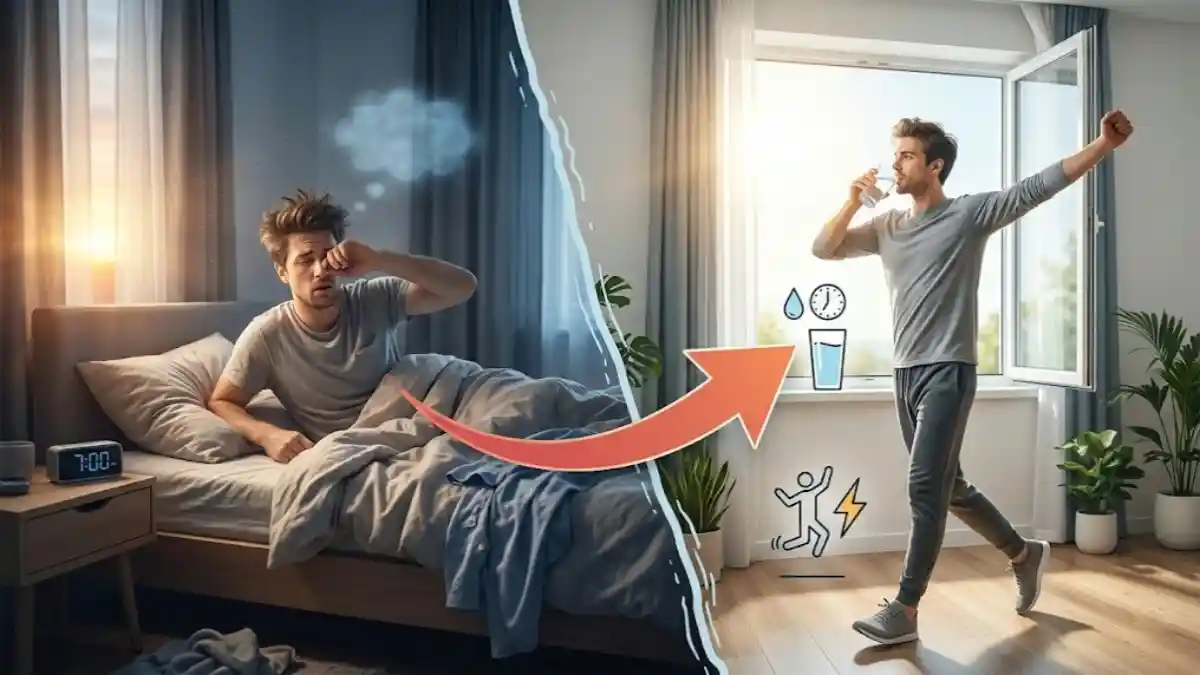
After a sleepless night, your reaction time resembles that of someone who has been drinking. No coffee or cold shower makes you fit to drive. What works is organizing your day to limit risks, then recovering sensibly.
After a sleepless night, no supplement, coffee or cold bath makes you fully fit to drive, care for a patient or operate machinery. Productivity is not the priority. Avoiding a serious mistake while your attention and judgment are impaired is.
The measures below may temporarily reduce sleepiness or help recovery. They do not repay lost sleep and should not be used to normalize sleepless nights.
What a night without sleep actually changes
A meta-analysis of 70 studies on total sleep deprivation lasting less than 48 hours found impairments across several cognitive domains. Lapses in simple attention were among the most pronounced effects. Working memory, processing speed and complex attention were also affected.
The trap is subjective: you may feel “functional” while your reaction times and decisions deteriorate. Research on chronic sleep restriction also shows that performance keeps declining while perceived sleepiness does not always track it accurately.
Adenosine contributes to sleep pressure, but there is more to the picture than “flushing out a molecule.” Sleep deprivation interacts with the circadian clock, time spent awake, mood and alertness systems. There is no protocol that can reset your brain in a few hours.
1. Cancel high-risk tasks
Start by reviewing your day. If possible, postpone activities where a second of inattention is all it takes:
- driving and long journeys
- working at height
- using machinery or sharp tools
- maximal-strength training or technically complex exercise
- financial, medical or legal decisions that are hard to reverse
The NHTSA notes that coffee alone is not enough and that microsleeps can still occur in someone who is severely sleep-deprived. If you keep yawning, drift across lane markings, forget the last few kilometers or involuntarily close your eyes, stop somewhere safe. A ride-hailing service, public transport, someone you know or an overnight stay is better than a stimulation strategy.
2. Tell the people who need to know
Saying “I haven’t slept” is not a weakness. It is safety information. Ask someone to double-check important decisions, reduce your workload and avoid working alone on a critical task.
Build your day around simple actions. Work in short blocks with breaks, but don’t turn supposed 90-minute ultradian cycles into an exact biological law. The optimal duration varies by task and person.
3. Use light to stay awake without pushing back the next night’s sleep
Bright light acutely increases alertness, especially during the biological night. But it can also shift the circadian clock depending on its timing. Keeping screens at full brightness all night is not a cost-free “reset.”
In the morning, go outside when daylight is available. This supports the wakefulness signal and helps you maintain a time cue. Morning exposure does not, however, restore lost performance. On your recovery evening, dim very bright lights and avoid stimulating screen use so you don’t delay falling asleep. Our guide to morning light exposure · FR explains its limitations.
4. Take a short nap if you need a little more alertness
A nap can reduce sleepiness, but its effect depends on the time of day, your sleep debt and its duration. A 10- to 20-minute nap often limits the risk of entering deep sleep, without eliminating it. After waking, allow sleep inertia to pass before tackling a demanding task. If you can’t fall asleep, you can explore 20-minute yoga nidra as a guided break, without counting it as recovered sleep.
If you have more time and a safe place, a longer sleep may be more restorative than struggling through until evening. It may also make falling asleep at your usual time harder. The choice depends on immediate safety and your need to remain functional, not an absolute rule.
A review of short naps shows that “less than 30 minutes” does not always guarantee the absence of slow-wave sleep or sleep inertia. Set an alarm, allow some time after waking and don’t go straight into driving. You can explore this further in our article on the 20-minute nap · FR.
5. Keep caffeine as a limited tool
A meta-analysis of 45 publications concludes that caffeine improves several measures of cognitive and occupational performance after sleep loss. It remains a temporary countermeasure, not a substitute.
For a healthy adult who tolerates caffeine, a small, known dose may make more sense than repeated, imprecise doses. Avoid stacking coffee, pre-workout supplements and energy drinks. Note the time and total amount. Sensitivity varies, and some people develop palpitations, anxiety, tremors or digestive problems.
Stop early enough to avoid compromising your recovery night. A meta-analysis on sleep estimates that coffee providing about 107 mg should be consumed about 8.8 hours before bedtime on average to avoid reducing sleep duration. This group-level figure is not an individual guarantee. Use the caffeine calculator as a starting point, then observe your sleep.
Avoid caffeine or discuss it with a healthcare professional if you are pregnant, have a heart rhythm disorder or severe anxiety, take medication that may interact with it, or experience an unusual reaction.
6. A “caffeine nap” is not a license to drive
In a small trial, twelve sleepy people took 200 mg of caffeine and then napped for less than 15 minutes. The combination reduced simulator incidents more than caffeine alone during two hours of monotonous driving.
The tiny sample, simulator setting and temporary effect limit its applicability. If you are already driving and feel sleepy, the right action is to stop safely. Coffee and a nap may help as a stopgap after stopping, but they do not prove you are fit to drive again.
7. Eat and hydrate normally
A sleepless night does not call for prolonged fasting, a liter of salt water or a “serotonergic” meal. Digestion does not suck up some magical amount of energy, and a large salt load may be unsuitable if you have high blood pressure, kidney disease or heart disease.
Choose simple, familiar meals with protein, fiber and portions suited to your hunger. Avoid alcohol, which increases sleepiness and then fragments recovery sleep. Drink according to your thirst and activity conditions. Very dark urine or intense heat calls for extra attention, not forcing down extreme amounts.
8. Move gently, but don’t test your limits
A walk outside may temporarily increase alertness and help you get through a sleepy spell. It does not “drain” toxins from your brain or restore proprioception.
Keep the intensity low to moderate, in a safe environment. Avoid personal records, contact sports, long solo outings and exercises where a technical error has serious consequences. If you experience dizziness, chest pain, feeling unwell or confusion, stop and ask for help.
9. Plan your recovery night without rigid rules
After an isolated episode of sleep deprivation, return to a stable schedule as soon as safety allows. You can go to bed a little earlier than usual and keep your wake-up time reasonably close to your normal routine. Allow a sufficient sleep window, ideally compatible with the seven hours or more routinely recommended for adults.
Don’t set a punishing alarm if your work is done and you are still dangerously sleepy. On the other hand, sleeping in very late for several days can maintain a shifted schedule. Adjust gradually according to your circumstances and how you feel.
Melatonin is not necessary after every sleepless night. Its effect depends heavily on circadian timing, and a poorly timed dose can shift your rhythm in the wrong direction. It can also cause drowsiness and interactions. Ask a doctor or pharmacist for advice, especially if you take medication, are pregnant or have a persistent sleep disorder.
“Emergency” supplements to avoid
Tyrosine, Alpha-GPC, creatine and nootropics are not a standard protocol for the day after a sleepless night. Some small experimental studies may find an effect on a task, often under specific conditions. They do not demonstrate the safety of taking a mixture on an empty stomach with lots of caffeine.
Also avoid prescription stimulants obtained without a prescription, high doses of nicotine and combinations of energy drinks. Feeling more alert can mask impairment without correcting it.
When to seek medical advice
An involuntary sleepless night may signal more than poor planning. Seek prompt advice if it comes with marked confusion, hallucinations, suicidal thoughts, unusual agitation, chest pain or neurological symptoms.
Also seek medical advice if sleepless nights recur, if you no longer feel the need to sleep and have unusually high energy, or if sleepiness persists despite sufficient nights of sleep. Chronic insomnia, a manic episode, sleep apnea or a medication may require specific management.
The Verdict
The best strategy after a sleepless night comes down to three decisions: remove the risk, use naps and caffeine sparingly, then allow a real window for sleep. Don’t try to “save” a day at the cost of an accident or a second disrupted night.