

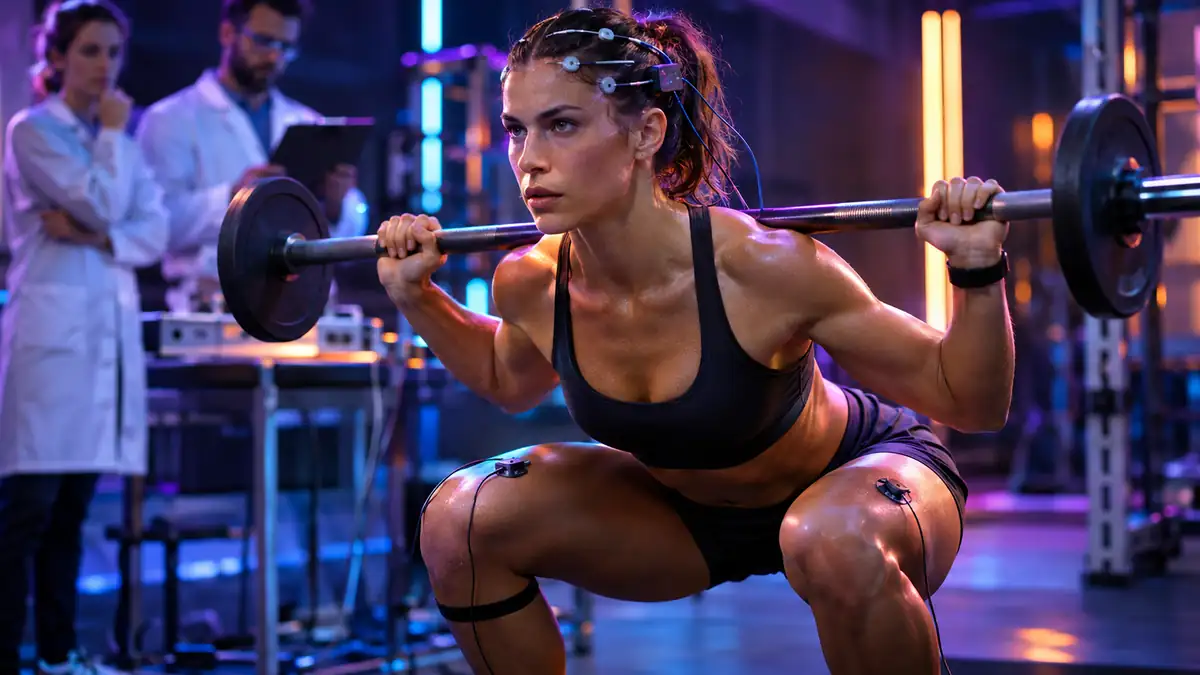
Three conditions compared in the same participants
The study compared anodal stimulation, cathodal stimulation and sham stimulation applied over the dorsolateral prefrontal cortex. It used a randomized, sham-controlled, triple-blind crossover design: the same participants completed all three conditions.
After 20 minutes of stimulation at 2 mA, participants performed successive sets of five repetitions at 80% of their one-repetition maximum, with one minute of rest between sets, until task failure. The abstract’s conclusion specifies that these were partial back squats, an important distinction to avoid generalizing the result to all squat ranges of motion.
More repetitions, with no detected difference in perceived exertion
The total number of repetitions was the primary outcome. The reported values were 67.5 after anodal stimulation, compared with 43.5 after sham stimulation and 43.0 after cathodal stimulation. The differences favoring anodal stimulation were statistically significant. No difference was detected between cathodal and sham stimulation.
Session perceived exertion did not differ significantly between conditions. This means the study did not detect an increase in this score despite the higher volume, not that stimulation necessarily made exercise feel easier for every participant.
Blood lactate increased after exercise in all three conditions. Its concentration after anodal stimulation was higher than after cathodal stimulation, but not higher than after sham stimulation. This secondary finding therefore does not demonstrate a distinct metabolic effect compared with placebo.
An acute effect does not demonstrate better training outcomes
The crossover design allows comparisons within the same people, but the sample remains limited to 16 resistance-trained men. These results do not allow conclusions about women, beginners or other exercises.
Most importantly, completing more repetitions in a test demonstrates neither greater muscle growth, nor lasting strength gains, nor equivalent recovery. These results are not sufficient to recommend using a stimulation device for training.
The abstract does not allow a detailed assessment of adverse effects, the effectiveness of blinding or possible carryover effects between sessions. Funding and conflicts of interest could not be verified from the source material.
Limitations to keep in mind
Small sample, consisting only of resistance-trained men, a partial-range-of-motion exercise and acute outcomes. Full text not reviewed. Safety, funding and conflicts of interest cannot be verified from the supplied abstract.
What we can take away
This trial suggests an immediate effect of anodal stimulation on partial squat volume in resistance-trained men. It does not demonstrate a lasting benefit for resistance training.
Sources and provenance
- Acute effects of transcranial direct current stimulation on repetition volume, blood lactate concentration, and perceived exertion during back squat exercise.
Source date: 2026-11-17.
Journal Article, Randomized Controlled Trial · Résumé PubMed uniquement, texte intégral non consulté