

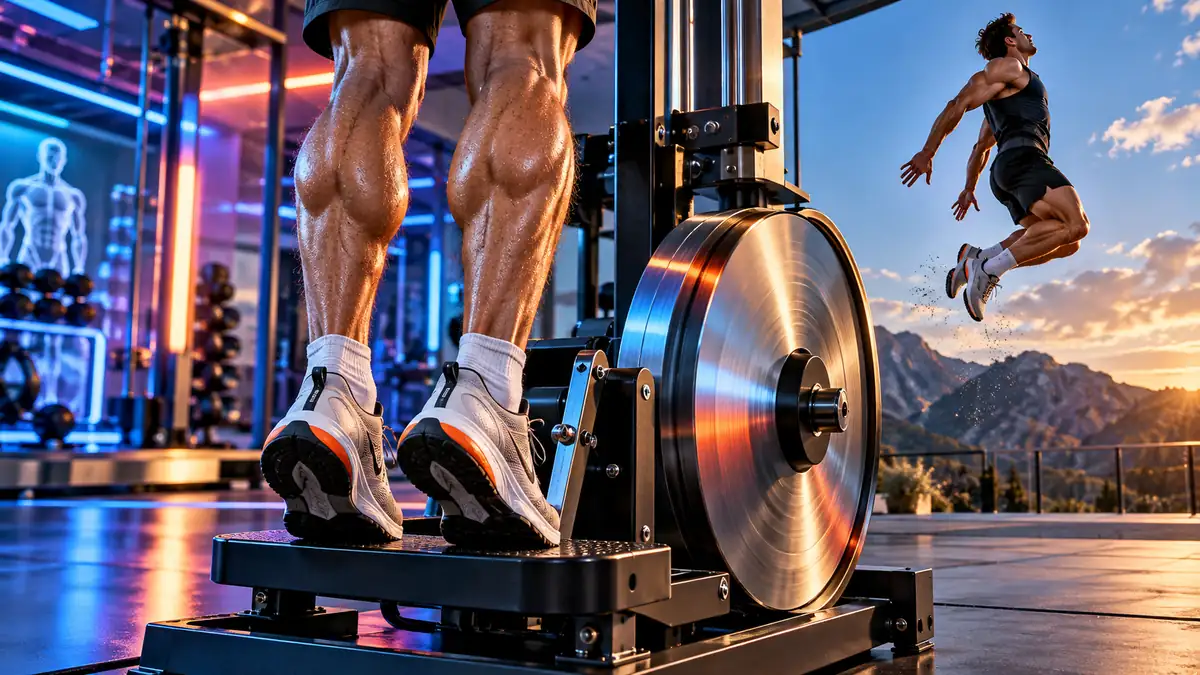
Three inertia levels compared in the same athletes
The participants, all national-level track and field athletes, completed three sessions in random order, at least 48 hours apart. Each session involved three sets of eight flywheel calf raises.
The researchers compared light inertia of 0.0281 kg·m², moderate inertia of 0.0711 kg·m² and high inertia of 0.1011 kg·m². Since every athlete tested all three conditions, the comparison was based on their own responses to the different loads.
Before exercise and again four minutes afterward, a repeated-jump test measured ground contact time, jump height and reactive strength index. Peak concentric and eccentric power were also recorded.
Moderate inertia delivers the best immediate results
After the light- and moderate-inertia conditions, jump height and reactive strength index increased, while ground contact time decreased. Moderate inertia produced greater gains in jump height and reactive strength index than either of the other conditions.
However, the abstract does not report the average magnitude of these improvements in centimeters or percentages. Statistical differences alone therefore do not establish their practical importance for competition.
Under high inertia, some power measures were associated with post-exercise performance. This association does not contradict the lack of a statistically clear improvement in this condition: being more powerful and benefiting more from a preparatory exercise are two different findings.
An acute finding, not a validated training method
This study suggests that moderate inertia deserves more attention than high inertia for temporarily improving these measures in comparable athletes. It demonstrates neither a lasting gain in jumping ability nor improved competition performance.
The only post-exercise measurement was taken at four minutes. The abstract does not establish when the effect begins, how long it lasts or whether it also occurs in beginners or women. Nor does it describe a control condition without exercise.
Limitations to keep in mind
Only the Europe PMC abstract was consulted, not the full text. The trial involves 37 national-level men and an acute response. The absolute magnitude of the gains, adverse effects, funding and conflicts of interest have not been verified in the dossier.
What we can take away
In this trial, moderate inertia outperformed high inertia on several jump measures at four minutes. This finding challenges the idea that heavier loading is always better, without establishing a broadly applicable protocol.
Sources and provenance
- Acute Reactive Strength Responses and Peak Power-Performance Relationships After Flywheel Calf Raises in National-Level Track-and-Field Athletes: A Randomized Crossover Trial.
Source date: 2026-11-01.
research-article, Randomized Controlled Trial, Journal Article · Résumé Europe PMC uniquement, texte intégral non consulté