

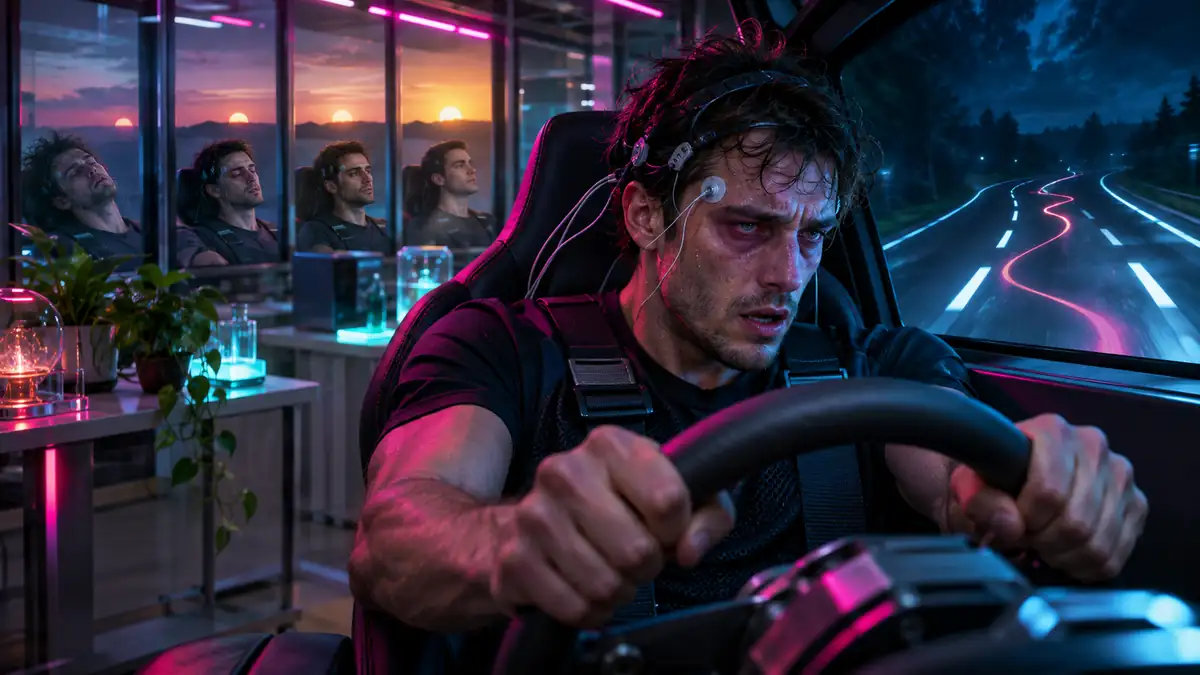
The same sleep loss, accumulated in two different ways
The researchers used a randomized crossover design: each participant experienced all three conditions studied. A period of normal sleep served as the comparison for four nights with two fewer hours of sleep each and one night without sleep. Both sleep deprivation conditions thus represented a reported total loss of eight hours.
After each condition, participants drove in an immersive simulator, at night into the early morning. This setup allows researchers to compare the effects of the conditions within the same person, but does not reproduce all the demands of real-world driving.
Lane control deteriorates quickly after a sleepless night
After the night without sleep, lateral vehicle control deteriorated as early as four to six minutes into the drive. Steering instability and an overall driving performance measure also worsened.
After the four shortened nights, changes were smaller and less consistent. This does not demonstrate that this accumulated sleep restriction is harmless: the abstract provides neither detailed effect sizes nor their uncertainty intervals.
Performance on a vigilance task and speed variability were, by comparison, relatively preserved across the different conditions. The measures therefore did not all respond to sleep loss in the same way.
Total hours lost do not fully describe the effect
Self-reported sleepiness increased progressively across the conditions, while the sleepless night caused a particularly marked deterioration in vehicle control. In this trial, subjective experience and the different performance measures therefore did not change in parallel.
The finding suggests that the pattern of sleep loss matters, not just the total. However, it cannot quantify an individual's crash risk or establish an acceptable driving duration after sleep deprivation.
The sample remains limited to 20 healthy men. The findings cannot be generalized without qualification to women, people with a sleep disorder or driving at other times of day.
Limitations to keep in mind
Only the PubMed abstract was consulted, not the full text. The study involves 20 healthy men and simulated nighttime driving into the early morning. Detailed effect sizes, their uncertainty, funding and conflicts of interest were not verified.
What we can take away
With equivalent total sleep loss, the sleepless night impaired vehicle control more severely in this trial. The smaller effect of shortened nights is not evidence that driving is safe.
Sources and provenance
- Commonly experienced acute and cumulative 8-hour sleep loss differentially affect simulated driving during a night-time to early-morning commute: a randomized controlled crossover trial.
Source date: 2026-11-10.
Journal Article, Randomized Controlled Trial · Résumé PubMed uniquement, texte intégral non consulté