

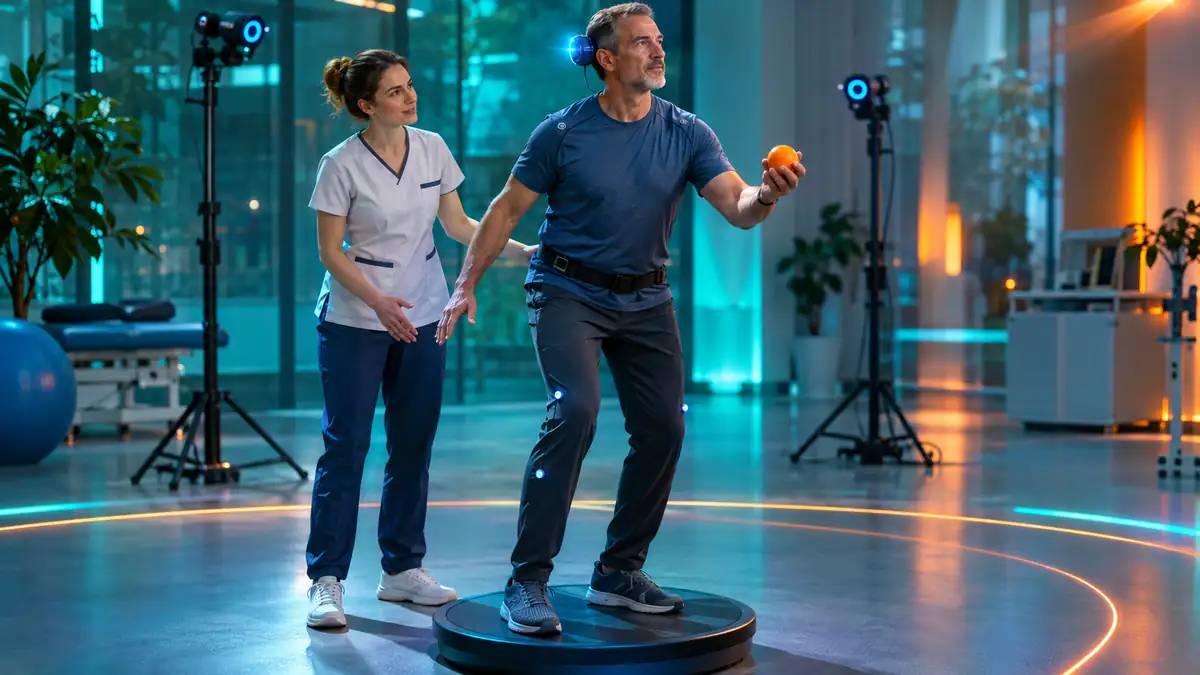
Stimulation added to rehabilitation
The researchers included 26 patients with subacute ischemic stroke and lower-limb impairment. Participants were randomly assigned to cerebellar intermittent theta-burst stimulation, called CRB-iTBS, or sham stimulation. Both groups also received physiotherapy.
The stimulation targeted the cerebellar hemisphere on the opposite side to the lesion. Before and after the intervention, participants performed standing and walking tasks, either alone or while counting backwards. The treatment duration and stimulation parameters are not provided in the abstract reviewed.
A primary outcome focused on stability
The primary outcome was the dual-task cost for sway area, a measure of postural stability. This cost reflects the change in performance when a cognitive task is added to a motor task.
The authors report a statistically significant reduction in this cost after active stimulation. They also report a reduction in dual-task cost for cadence and double-support time, as well as improvements in balance and walking.
However, the abstract provides neither effect sizes nor confidence intervals. It therefore does not allow us to determine whether the observed changes represent a meaningful improvement in everyday life.
Brain signals, not proof of a mechanism
The cerebellum helps integrate cognitive and motor functions, which is the rationale for targeting it. During dual-task walking, stimulation was associated with increases in certain types of electrical brain activity and in global connectivity.
An increase in frontal theta activity was also correlated with a decrease in dual-task cost for cadence. This correlation does not demonstrate that this brain change explains the motor improvement.
A clinical avenue with limits still to address
This trial provides an encouraging signal for stimulation used alongside rehabilitation, not instead of it. Its small sample limits the strength and generalizability of the conclusions.
The abstract reports no results on falls, independence in daily life or whether the benefit is maintained. It does not detail adverse effects either. These findings therefore justify neither a promise of fall prevention nor extrapolation to people who have not had a stroke.
Limitations to keep in mind
Only the Europe PMC abstract was reviewed, not the full text. The trial includes 26 participants. Effect sizes, intervention duration, follow-up and safety data are not specified in this abstract. Funding and conflicts of interest were not checked.
What we can take away
Cerebellar stimulation appears to improve some measures of dual-task balance after a stroke. Its lasting value for independence and fall prevention remains to be demonstrated.
Sources and provenance
- Cerebellar Intermittent Theta-burst Stimulation Reduces Dual Task Cost in Walking and Balance in Stroke Patients.
Source date: 2026-11-12.
IM, Randomized Controlled Trial, Journal Article · Résumé Europe PMC uniquement, texte intégral non consulté